DEF 14A: Definitive proxy statements
Published on March 16, 2026
UNITED STATES
SECURITIES AND EXCHANGE COMMISSION
Washington, D.C. 20549
SCHEDULE 14A
Proxy Statement Pursuant to Section 14(a) of
the Securities Exchange Act of 1934 (Amendment No. )
Filed by the Registrant ☒
Filed by a Party other than the Registrant ☐
Check the appropriate box:
☐ | Preliminary Proxy Statement |
☐ | Confidential, for Use of the Commission Only (as permitted by Rule 14a-6(e)(2)) |
☒ | Definitive Proxy Statement |
☐ | Definitive Additional Materials |
☐ | Soliciting Material under §240.14a-12 |

_______________________________________________________________________________________
(Name of Registrant as Specified in Its Charter)
_______________________________________________________________________________________
(Name of Person(s) Filing Proxy Statement, if other than the Registrant)
Payment of Filing Fee (Check all boxes that apply):
☒ | No fee required. |
☐ | Fee paid previously with preliminary materials. |
☐ | Fee computed on table in exhibit required by Item 25(b) per Exchange Act Rules 14a6(i)(1) and 0-11. |

WHO WE ARE
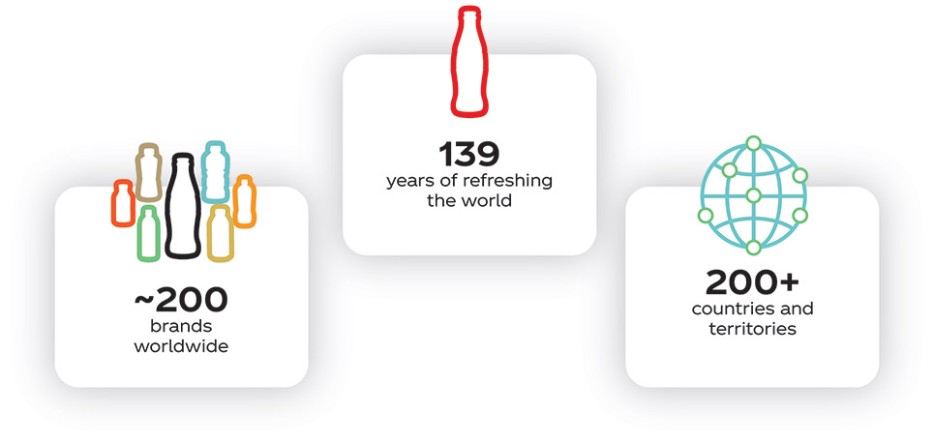
139 YEARS OF REFRESHMENT
On May 8, 1886, Dr. John Pemberton brought his perfected syrup to Jacobs’ Pharmacy in downtown Atlanta, where the first glass of Coca-Cola was poured. From that one iconic drink, we’ve evolved into a total beverage company. Today, 2.2 billion servings of our drinks are enjoyed in more than 200 countries and territories each day and we own 32 billion-dollar brands across several beverage categories worldwide.
OUR PURPOSE
REFRESH THE WORLD. MAKE A DIFFERENCE.
our vision
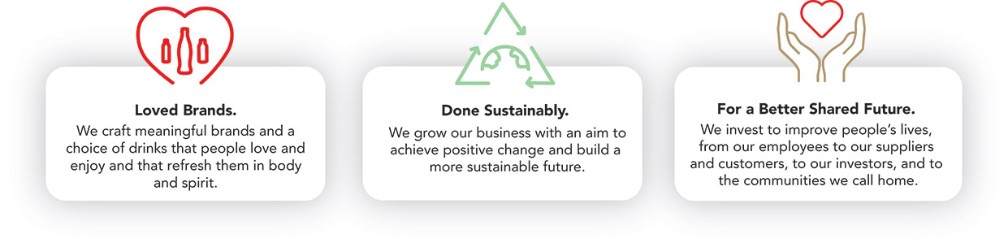
Our vision is to craft the brands and choice of drinks that people love and that refresh them in body and spirit. And done in ways that create a more sustainable business and better shared future, making a difference in people’s lives, communities and our planet.
To achieve this vision, we focus on three connected pillars:
TO MY FELLOW SHAREOWNERS:
On behalf of the Board of Directors and the people at The Coca-Cola Company, thank you for your investment and the trust you have placed in our Company.
As I write this letter, which is my last as CEO, I’m proud to report that 2025 was another year of resilience and strong performance. We delivered solid growth while navigating the familiar challenges of a dynamic global marketplace. More importantly, we continued building momentum across our strategic priorities, positioning the Company for sustained success in the years ahead.
I’m incredibly thankful for the opportunity to lead this remarkable Company, and I have great confidence in our future.
A Company Built to Endure The Coca-Cola Company has thrived for many decades because each generation of leadership has embraced change while staying true to our purpose: to refresh the world and make a difference. Throughout my tenure, we’ve worked to position the Company for the next chapter of growth. We evolved into a total beverage company with a focused portfolio of approximately 200 brands. We built a networked organization that combines global scale with local market expertise. We transformed our marketing to be digital-first and consumer-centric. We accelerated innovation while maintaining the discipline to scale what works. We’re proud of what this has helped us achieve. We’ve added 12 billion-dollar brands since 2017. Our system is stronger and more aligned than ever. Our brands continue to win with consumers across categories and geographies. Our bottling partners are investing for growth. And our financial performance demonstrates the durability of our business model. Focused on Our Opportunities Our strategy to capture immense opportunities for growth around the world is clear and unchanging: stay relentlessly focused on consumers, innovate with discipline, build brands that matter, and execute with excellence through our unmatched global system. In 2025, we continued making progress. Our marketing transformation is delivering results, with digital now representing a majority of our media investment. Our revenue growth management capabilities continue to strengthen. Our sustainability aspirations, from water stewardship to packaging circularity, are integrated into our business. We also continued to push the boundaries of innovation, from AI-powered consumer engagement to new product platforms to strategic partnerships that expand our reach into adjacent categories. | | Leadership for the Future As I prepare to pass the baton to Henrique Braun, I’m struck by how much of our success comes from the right combination of continuity and discontent: continuity of purpose, strategy and culture, coupled with the belief that we must always focus on getting better. Henrique joined the Company 30 years ago and has added value in countless ways by contributing to our success in markets around the world. Leadership transitions are a necessary and healthy part of any enduring enterprise. Our Board has prepared thoughtfully for this moment, and I have complete confidence in Henrique and the team that will lead us forward. They know this business deeply. They embrace our culture. They’re committed to the strategies we’ve put in place together. And they’re eager to build on the momentum we’ve created. As our longtime chairman Robert Woodruff famously said, “The world belongs to the discontented.” The Company’s restless ambition, combined with disciplined execution and deep respect for our heritage, is what positions us to win for decades to come. In closing, thank you to our shareowners: Thank you for believing in this business and for giving me the privilege to steward it. | |
Sincerely,
JAMES QUINCEY Chairman and Chief Executive Officer The Coca-Cola Company |
| ||

“I’m incredibly thankful for the opportunity to lead this remarkable Company, and I have great confidence in our future.” |

DATE & TIME | | | | Items of Business | Our Board’s | Page | ||||||
| | |||||||||||
Wednesday, April 29, 2026 | | Company Proposals | | | | |||||||
| Item 1 | | Elect as Directors the 12 Director nominees named |
| FOR each Director Nominee | 6 | ||||||
VIRTUAL MEETING LOCATION | | |||||||||||
| ||||||||||||
The 2026 Annual Meeting of Shareowners will be held exclusively online. Visit meetnow.global/KO2026 to attend the meeting. | | Item 2 | | Conduct an advisory vote to approve executive compensation. |
| FOR | 46 | |||||
| Item 3 | | Ratify the appointment of Ernst & Young LLP as Independent Auditors of the Company to serve for the 2026 fiscal year. |
| FOR | 85 | ||||||
ANNUAL MEETING WEBSITE | | | Shareowner Proposals | | | | ||||||
| | Item 4 | | Vote on a shareowner proposal requesting a sustainability committee by-law amendment. |
| AGAINST | 89 | |||||
Access links to vote in advance, submit questions in advance of the meeting and learn more about our Company at www.coca-colacompany.com/annual-meeting-of-shareowners. | | | | | | | | |||||
| Item 5 | | Vote on a shareowner proposal requesting a report evaluating the Company’s plastics packaging policies. |
| AGAINST | 91 | ||||||
| Item 6 | | Vote on a shareowner proposal requesting a report on the extent of the Company’s diversity, equity and inclusion efforts. |
| AGAINST | 93 | ||||||
RECORD DATE | | | Item 7 | | Vote on a shareowner proposal requesting a report on risks related to ingredients. |
| AGAINST | 95 | ||||
| | |||||||||||
Holders of record of our Common Stock as of March 2, 2026 are entitled to notice of, and to vote at, the meeting. | | Item 8 | | Vote on a shareowner proposal requesting a report on the Company’s plans to increase sustainability disclosure. |
| AGAINST | 97 | |||||


Shareowners will also transact such other business as may properly come before the meeting and at any adjournments or postponements of the meeting.
VOTING METHODS | | | |||||||
| | ||||||||
Your vote is important to us. Whether or not you plan to participate in the 2026 Annual Meeting, we urge you to vote and submit your proxy in advance of the meeting using one of the below advance voting methods. Make sure to have your proxy card or voting instruction form in hand and follow the instructions. Shareowners may also vote during the meeting by accessing the virtual meeting according to the instructions in question 2 on page 99 of the attached Proxy Statement. | | ||||||||
| Advance Voting Methods | | Internet | | Phone | | | ||
| Shareowners of Record | | www.investorvote.com/coca-cola | | Call 1-800-652-VOTE or the telephone | | Sign, date and | | |
| Beneficial Owners (shares held through your bank, | | www.proxyvote.com | | Call 1-800-454-8683 or the telephone | | Sign, date and return your voting | | |
| Not all beneficial owners may vote at the web address and phone number provided above. If your control number is not recognized, please refer to your voting instruction form for specific voting instructions. | | |||||||
| | | | | | | | | |
The 2026 Annual Meeting of Shareowners (“2026 Annual Meeting”) will be held exclusively online via live webcast. Our virtual format provides expanded access to more shareowners, while also providing the same rights shareowners would have during an in-person meeting. We have received consistent positive feedback regarding our virtual format, including that our virtual format allows shareowners to attend a greater number of companies’ annual meetings, from any location around the world, at no cost to them. While you will not be able to attend the meeting at a physical location, as a shareowner of The Coca-Cola Company (the “Company”), you will be able to attend the meeting online, vote your shares electronically and submit questions during the meeting.
To attend the 2026 Annual Meeting, visit meetnow.global/KO2026. For more information on how to participate in the 2026 Annual Meeting, please see Annex A of the attached Proxy Statement beginning on page 99.
An electronic list of shareowners of record as of the record date will be available for inspection by shareowners for any purpose germane to the meeting from April 17 through April 28, 2026. To access the electronic list during this time, please send your request, along with proof of your Company share ownership, by email to shareownerservices@coca-cola.com. You will receive confirmation of your request and instructions on how to view the electronic list. Please see question 23 on page 104 of the attached Proxy Statement for more information.
We are making the Proxy Statement and the form of proxy first available on or about March 16, 2026.
By Order of the Board of Directors
JENNIFER D. MANNING Corporate Secretary and Senior Vice President, Associate General Counsel March 16, 2026 | | | | | Important Notice Regarding the Availability of Proxy Materials for the 2026 Annual Meeting of Shareowners to be held on April 29, 2026: |
| | | | The Notice of Annual Meeting, Proxy Statement and Annual Report on Form 10-K for the year ended December 31, 2025 are available free of charge at www.edocumentview.com/coca-cola. |

| | |
44 | ||
| | |
44 | ||
45 | ||
| | |
46 | ||
| | |
46 | ||
47 | ||
48 | ||
63 | ||
63 | ||
64 | ||
73 | ||
77 | ||
78 | ||
79 | ||
| | |
83 | ||
| | |
83 | ||
85 | ITEM 3 Ratification of the Appointment of Ernst & Young LLP | |
| | |
| | | ||
| | | Additional Important Information: | |
| | | Please see Questions and Answers in Annex A beginning on page 99 for important information about the 2026 Annual Meeting, proxy materials, voting, Company documents, communications, and the deadlines to submit shareowner proposals and Director nominees for the 2026 Annual Meeting of Shareowners. Additional questions may be directed to Shareowner Services at (404) 676-2777 or shareownerservices@coca-cola.com. |
|
| | | | |
| | | | |

Links to websites included in this Proxy Statement are provided solely for convenience purposes. Content on the websites, including content on our Company website, is not, and shall not be deemed to be, part of this Proxy Statement or incorporated herein or into any of our other filings with the Securities and Exchange Commission (the “SEC”).
This Proxy Statement contains information that may constitute “forward-looking statements.” Generally, the words “believe,” “expect,” “intend,” “estimate,” “anticipate,” “project,” “will” and similar expressions identify forward-looking statements, which generally are not historical in nature. The absence of these words or similar expressions, however, does not mean that a statement is not forward-looking. All statements that address operating performance, events or developments that we expect or anticipate will occur in the future, including statements regarding general views about future operating results, are forward-looking statements. Management believes that these forward-looking statements are reasonable as and when made. However, caution should be taken not to place undue reliance on any such forward-looking statements because such statements speak only as of the date when made. Our Company undertakes no obligation to publicly update or revise any forward-looking statements, whether as a result of new information, future events or otherwise, except as required by law. In addition, forward-looking statements are subject to certain risks and uncertainties that could cause our Company’s actual results to differ materially from historical experience and from our present expectations or projections. These risks and uncertainties include, but are not limited to, those described in Part I, “Item 1A. Risk Factors” in our Annual Report on Form 10-K for the year ended December 31, 2025 (the “Form 10-K”) and those described from time to time in our future reports filed with the SEC.

OUR BRANDS
The Coca-Cola Company is a total beverage company with products sold in more than 200 countries and territories. Our Company’s purpose is to refresh the world and make a difference. Our brands include the following:
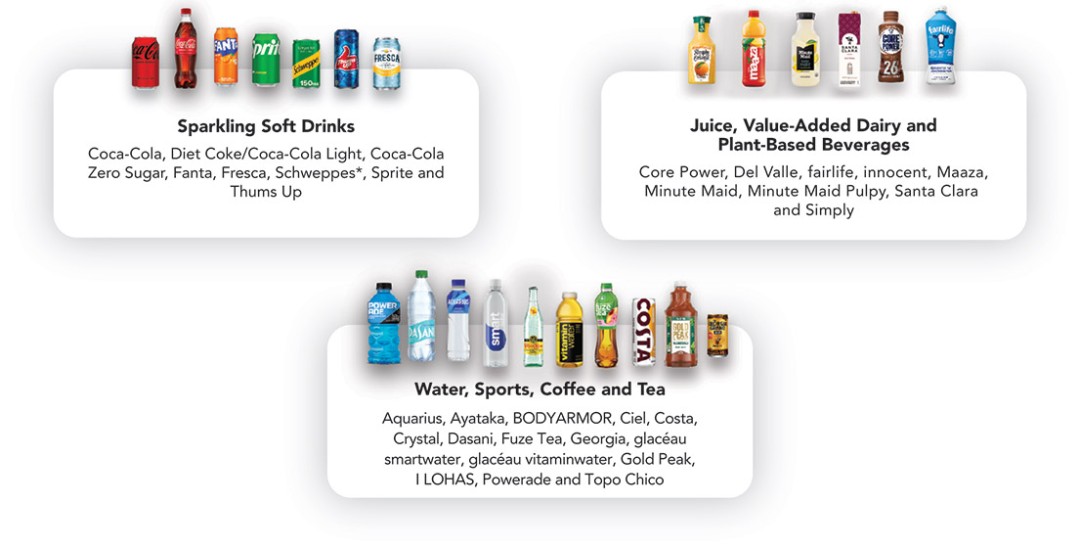
* | Schweppes is owned by the Company in certain countries outside the United States. |
| | | Learn More About Our Company: |
| | | You can learn more about the Company by visiting our website, www.coca-colacompany.com. We also encourage you to read our latest Form 10-K, available at www.coca-colacompany.com/annual-meeting-of-shareowners. The Company’s principal executive offices are located at One Coca-Cola Plaza, Atlanta, Georgia 30313. |

| | | | | | | | | | |||||||
| Our |
| Voting |
| Governance |
| Share |
| Compensation |
| Audit Matters |
| Shareowner |
| Annexes |
|
2025 FINANCIAL HIGHLIGHTS
Our 2025 performance showed both the resilience and momentum of our business as we remained agile and focused on improving execution of our strategy. The Company drove revenue, operating income and earnings per share growth despite a complex external environment. We will continue to focus on investing behind our brands to drive balanced growth and create enduring value for our shareowners.
REVENUE PERFORMANCE | | | |
| | | |
| | | |
2% | | | 5% |
Reported Net Operating Revenue Growth vs. 2024 | | | Organic Revenue (Non-GAAP) Growth vs. 2024 |
| | | |

OPERATING INCOME PERFORMANCE | | | | |
| | | ||
| | | | |
38% | | | 13% | |
Reported Operating Income Growth vs. 2024 | | | Comparable Currency Neutral Operating Income (Non-GAAP) Growth vs. 2024 | |
| | | | |
EARNINGS PER SHARE PERFORMANCE | | | | |
| | | ||
| | | | |
23% | | | 4% | |
Reported Earnings Per Share (“EPS”) Growth vs. 2024 | | | Comparable EPS (Non-GAAP) Growth vs. 2024 | |
| | | | |
CASH FLOW | | | | | | | DIVIDENDS | | |
| | | | | | | | ||
| | | | | | | | | |
$7.4 BN | | | $11.4 BN | | | $8.8 BN | |||
Reported Cash Flow from Operations | | | Free Cash Flow Excluding the | | | Returned to Shareowners in 2025 | |||
| | | | | | | | | |
Organic revenues is a financial measure outside of generally accepted accounting principles in the United States (“GAAP”) that excludes or has otherwise been adjusted for the impact of acquisitions and divestitures, as applicable, and the impact of fluctuations in foreign currency exchange rates. Comparable currency neutral operating income is a non-GAAP financial measure that excludes or has otherwise been adjusted for items impacting comparability and the impact of fluctuations in foreign currency exchange rates. Comparable EPS is a non-GAAP financial measure that excludes or has otherwise been adjusted for items impacting comparability. Free cash flow excluding the fairlife contingent consideration payment is a non-GAAP financial measure that represents net cash provided by operating activities less purchases of property, plant and equipment and excludes the Company’s contingent consideration payment that was paid in 2025 for our acquisition of fairlife, LLC. See Annex C on page 109 for reconciliations of non-GAAP financial measures to our results as reported under GAAP.

| | |
The Coca-Cola Company | 3 | 2026 Proxy Statement |
| | | | | | | | | | |||||||
| Our |
| Voting |
| Governance |
| Share |
| Compensation |
| Audit Matters |
| Shareowner |
| Annexes |
|
OUR STRATEGY AND 2025 BUSINESS HIGHLIGHTS
Our global franchise operating model combines the benefits of scale with deep, local market intimacy. The power of our portfolio, amplified by our system’s unique capabilities, is a clear advantage to win in the marketplace. We are focused on the following strategic priorities: shaping a portfolio of loved brands; transforming our marketing and innovation agenda; optimizing the
Coca-Cola ecosystem; building talent and capabilities; and enhancing our license to win. Moving forward, we intend to prioritize getting closer to consumers; remaining constructively discontented; and placing digital at the core of our connections with consumers, customers and across our system. Highlights from 2025 against our strategic priorities include the following:
| | Shaping a Portfolio of Loved Brands | |
| |
| ● We expanded our portfolio of billion-dollar brands, as Santa Clara, our value-added dairy brand in Mexico, and innocent, our London-based maker of juices and smoothies, both surpassed the billion-dollar threshold. In total, we have 32 billion-dollar brands, over half of which were created through acquisitions and the remainder of which were created organically. ● Trademark Coca-Cola gained value share, and Coca-Cola Zero Sugar grew unit case volume 14%. Coca-Cola remains the highest-valued food and beverage brand in the world according to the May 2025 edition of Kantar’s annual Most Valuable Global Brands Report. Sprite became the #3 sparkling soft drinks brand in the United States, according to Beverage Digest. ● Juice, value-added dairy and plant-based beverages gained value share. In the United States, fairlife and Core Power continued to have strong unit case volume growth. Water, sports, coffee and tea grew unit case volume for the year. Volume growth included notable performance from Fuze Tea, Ayataka, Aquarius, BODYARMOR and smartwater. ● In partnership with Statista, TIME Magazine named Coca-Cola the #1 soft drinks brand; fairlife the #1 milk brand; and Minute Maid the #1 juice brand, all in the United States portion of its 2025 list of the World’s Best Brands. |

| | Transforming Our Marketing & Innovation Agenda | |
| |
| ● Our marketing model focused on recruiting consumers through local marketing platforms. Examples included Trademark Coca-Cola’s “Rings of Magic” platform, which engaged young adult consumers across universities; and Powerade’s activations with Springboks Rugby in South Africa, FIFA World Cup 2026 CONMEBOL Qualifiers in Latin America and Major League Soccer playoffs in North America. ● Our marketing transformation continued to focus on deeper consumer connections through digital engagement, personal experiences and cultural relevance. For example, our partnership with Universal Pictures and Blumhouse brought Fanta’s Halloween campaign to life across approximately 50 markets, featuring immersive retail activations and digital experiences. ● We continued to introduce bold innovations aimed at increasing shelf space and attracting consumers. Examples included (in designated markets around the world) Coca-Cola with U.S. cane sugar, Sprite + Tea, Bacardi Mixed with Coca-Cola, Cappy Bubble, and BODYARMOR Flash I.V. |

| | Optimizing the Coca-Cola Ecosystem | |
| |
| ● Despite a complex external environment and evolving global trade dynamics, the Company expanded both gross margin and operating margin in 2025. Our franchise operating model, which includes capable and trusted bottling partners, is an advantage to deliver in various operating environments. ● We continued to make progress on our refranchising journey. In 2025, we entered into a definitive agreement to sell a portion of our interest in our bottling operations in Africa. We also completed the sale of a noncontrolling interest in the parent company of our bottling operations in India. Our Bottling Investments operating segment was 12% of 2025 consolidated reported net operating revenues. |

| | Building Talent and Capabilities and Enhancing Our License to Win | ||
| |
|
| ● In December 2025, the Company announced Henrique Braun will serve as the next CEO, effective March 31, 2026. As we transition into the next chapter, we will continue to empower our people with a culture that prioritizes agility, relentlessness and accountability. ● We maintained our focus on highlighting the local and economic impact of our business and community investment. For example, in Türkiye, we continued our “Made in, Made By” campaign to emphasize the local essence of our products, including production and distribution by our system. In Great Britain, we celebrated the system’s 125-year presence in the country with “The Bosses” campaign, featuring stories of local corner shop owners; in Algeria, we celebrated 32 years of the system’s local operation and economic impact with a “Made in Algeria” campaign. ● In the last 40 years, The Coca-Cola Foundation (“TCCF”), the Company’s primary philanthropic arm, has awarded more than $1.7 billion in grants to support initiatives around the world. In 2025, we published our 2024 People & Communities Update, which highlighted that TCCF and the Company’s charitable contributions totaled $174.9 million in 2024. |


| | |
The Coca-Cola Company | 4 | 2026 Proxy Statement |
| | Company Proposals | |
| | | |
| | ITEM 1 |
|
| | Our Board recommends a vote FOR each Director nominee The Board and the Corporate Governance and Sustainability Committee believe that the 12 Director nominees possess the necessary qualifications and experiences to provide quality advice and counsel to the Company’s management and effectively oversee the business and the long-term interests of shareowners. ► See page 6 for further information | |
| | ||
| | | |
| | ITEM 2 |
|
| | Our Board recommends a vote FOR this item The Company seeks a non-binding advisory vote to approve the compensation of its Named Executive Officers as described in the Compensation Discussion and Analysis beginning on page 48 and the Compensation Tables beginning on page 64. ► See page 46 for further information | |
| | | |
| | ITEM 3 |
|
| | Our Board recommends a vote FOR this item The Board and the Audit Committee believe that the retention of Ernst & Young LLP (“EY”) to serve as the Company’s independent auditors (the “Independent Auditors”) for the fiscal year ending December 31, 2026 is in the best interests of the Company and its shareowners. As a matter of good corporate governance, shareowners are being asked to ratify the Audit Committee’s selection of the Independent Auditors. ► See page 85 for further information | |
| | | |

| | Shareowner Proposals | |
| | | |
| | Items 4-8 |
|
| | Our Board recommends a vote AGAINST each of the shareowner proposals Five proposals were submitted by shareowners, which will each be voted on if the shareowner proponent, or a representative who is qualified under state law, is present at the 2026 Annual Meeting and submits the proposal for a vote. ► See page 88 for further information | |
| | ||
| | | |

| | |
The Coca-Cola Company | 5 | 2026 Proxy Statement |

| | | | ITEM 1: ELECTION OF DIRECTORS | | | | |||
| | | | What am I voting on? | | | | |||
| | | The Board of Directors, upon the recommendation of the Corporate Governance and Sustainability Committee, has nominated the following 12 individuals for election to the Board for a one-year term. If elected, each Director nominee will hold office until the 2027 Annual Meeting of Shareowners and until his or her successor is elected and qualified. | | ||||||
| | | | Herb | Henrique | Thomas S. | James | | | |
| | | | Bela | Christopher C. | Max | Caroline J. | | | |
| | | | Ana | Carolyn | Amity | David B. | | | |
| | | | The Board of Directors recommends a vote FOR each nominee. |
| | | |||
| | | | | | | | |||

All nominees are independent under the New York Stock Exchange (“NYSE”) corporate governance rules, except for James Quincey, our Chairman and Chief Executive Officer, and Henrique Braun, our Executive Vice President and Chief Operating Officer (see Director Independence and Related Person Transactions beginning on page 42). Each of the Director nominees was elected by shareowners at the 2025 Annual Meeting of Shareowners, other than Messrs. Levchin and Braun. Mr. Levchin was identified and recommended as a potential Director by the Corporate Governance and Sustainability Committee, which determined that he was qualified under the Committee’s criteria, and joined the Board effective October 16, 2025. In connection with the Company’s announcement that Mr. Braun will serve as Chief Executive Officer of the Company effective March 31, 2026, the Corporate Governance and Sustainability Committee determined he was qualified under the Committee’s criteria to join the Board.
We have no reason to believe that any of the nominees will be unable or unwilling to serve if elected. However, if any nominee should become unable for any reason or unwilling for good cause to serve, proxies may be voted for another person nominated as a substitute by the Board or the Board may reduce the number of Directors.

| | | | | | | | | | |||||||
| Our |
| Voting |
| Governance |
| Share |
| Compensation |
| Audit Matters |
| Shareowner |
| Annexes |
|
OUR 2026 DIRECTOR NOMINEES
| | | | | | | | |
| | | | | | | | | | ||
| | | | | | | | | | | | | | | | | | |||
| | | | | | | | | | | | | | | | | | |||
| | | | | | | | | | | | | | | | | | |||
| | | | | | | | | | | | | | | | | | |||
| | | | | | | | | | | | | | | | | | |||
| | | | | | | | | | | | | | | | | | |||
| | | | | | | | | | | | | | | | | | |||
| | | | | | | | | | | | | | | | | | |||
| | | | | | | | | | | | | | | | | | |||
| | | | | | | | | | | | | | | | | | |||
| | | | | | | | | | | | | | | | | | |||
| | | | | | | | | | | | | | | | | | |||
| | | | | | | | | | | | | | | | | | |||
DAVID B. WEINBERG, 74 Lead Independent Director Chairman and Chief Executive Officer, Judd Enterprises, Inc. Tenure: 11 years Other Public Boards: 0 Committee Membership: A G E | | |
| | | |
| | | HERB ALLEN, 58 Tenure: 4 years Other Public Boards: 1* Committee Membership: G F *alternate | ||||||||||
| JAMES QUINCEY, 61 Chairman and Chief Executive Officer, | | ||||||||||||||||||
| | | | |||||||||||||||||
| | | | | | | | | | | | | | | | | | | ||
| | | | | | | | | | | | | | | | | | | ||
| | | | | | | | | | | | | | | | | | | ||
CAROLINE J. TSAY, 44 Technology Company Advisor/ Limited Partner of Venture Capital Funds Tenure: 8 years Other Public Boards: 3 Committee Membership: A | | |
| | 10/12 Independent Committees: A Audit T Talent and Compensation G Corporate Governance and Sustainability F Finance E Executive Chair | |
| | | BELA BAJARIA, 55 Tenure: 1 year Other Public Boards: 0 Committee Membership: T | ||||||||||
| | | | | | |||||||||||||||
| | | | | | |||||||||||||||
| | | | | | |||||||||||||||
| | | | | | |||||||||||||||
| | | | | | |||||||||||||||
| | | | | | |||||||||||||||
| | | | | | |||||||||||||||
| | | | | | | | | | | | | | | | | | |||
| | | | | | | | | | | | | | | | | | |||
| | | | | | | | | | | | | | | | | | |||
AMITY MILLHISER, 62 Former Partner and Vice Chair, PricewaterhouseCoopers LLP Tenure: 3 years Other Public Boards: 0 Committee Membership: A | | |
| | |
| | | ANA BOTÍN, 65 Tenure: 13 years Other Public Boards: 2(2) Committee Membership: G F | |||||||||||
| | | | |||||||||||||||||
| | | | |||||||||||||||||
| | | | |||||||||||||||||
| | | | |||||||||||||||||
| | | | |||||||||||||||||
| | | | |||||||||||||||||
| | | | |||||||||||||||||
| | | | | | | | | | | | | | | | | | | ||
| | | | | | | | | | | | | | | | | | | ||
| | | | | | | | | | | | | | | | | | | ||
MAX LEVCHIN,50 Founder, Chairman and Chief Executive Officer, Affirm Holdings, Inc. Tenure: 5 months Other Public Boards: 1 Committee Membership: T | | |
| | | |
| | | HENRIQUE BRAUN, 57 Tenure: -- Other Public Boards: 0 Committee Membership: None | ||||||||||
| | | ||||||||||||||||||
| CAROLYN EVERSON, 54 Tenure: 4 years Other Public Boards: 2 Committee Membership: T F | | ||||||||||||||||||
| | |||||||||||||||||||
| | |||||||||||||||||||
| | |||||||||||||||||||
| | |||||||||||||||||||
| | |||||||||||||||||||
| | | | | | | | | | | | | | | | | | | | |
| | | | | | | | | | | | | | | | | | | | |
| | | | | | | | | | | | | | | | | | | | |
THOMAS S. GAYNER, 64 Chief Executive Officer, Markel Group Inc. Tenure: 3 years Other Public Boards: 2 Committee Membership: F | | |
| | |
| | |
| | | CHRISTOPHER C. DAVIS, 60 Tenure: 8 years Other Public Boards: 5(3) Committee Membership: A F E | ||||||||
| | | | | | | | | | | | | | | | | | | ||












| (1) | Effective March 31, 2026, Henrique Braun will succeed James Quincey as CEO of the Company. In addition, the Board has nominated Mr. Braun to stand for election as a Director at the 2026 Annual Meeting. Mr. Quincey will serve as CEO until March 31, 2026, and will then continue as Executive Chairman of the Board. |
| (2) | Consists of Banco Santander, S.A. and its wholly owned subsidiary, Santander Holdings USA, Inc. |
| (3) | Includes investment company directorships in Selected Funds, Davis Funds and Clipper Funds Trust, three fund complexes which are advised by Davis Selected Advisers, L.P. and other entities controlled by Davis Selected Advisers, L.P. |
| | | | | | | | | | |||||||
| Our |
| Voting |
| Governance |
| Share |
| Compensation |
| Audit Matters |
| Shareowner |
| Annexes |
|
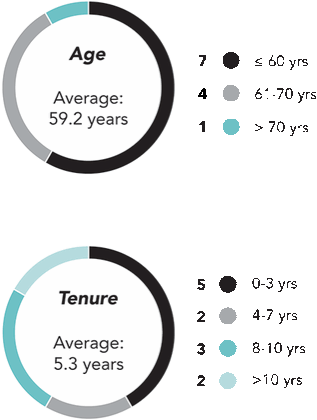
SNAPSHOT OF 2026 DIRECTOR NOMINEES
Building the Right Board for The Coca-Cola Company
Nominee Skills | Number of Directors | | Nominee Demographics | ||||||||||||||||
| High Level of Strategic and Financial Experience | | | | | | | | | | | | | 12 | |
| |||
| | | | | | | | | | | | | |||||||
| | | | | | | | | | | | | |||||||
| Marketing Experience | | | | | | | | | | | | | 9 | | ||||
| | | | | | | | | | | | | |||||||
| | | | | | | | | | | | | |||||||
| Innovation/Digital and Technology Experience | | | | | | | | | | | | | 9 | | ||||
| | | | | | | | | | | | | |||||||
| | | | | | | | | | | | | |||||||
| Broad International Exposure / Emerging Market Experience | | | | | | | | | | | | | 10 | | ||||
| | | | | | | | | | | | | |||||||
| | | | | | | | | | | | | |||||||
| Sustainability Experience | | | | | | | | | | | | | 4 | | ||||
| | | | | | | | | | | | | |||||||
| | | | | | | | | | | | | |||||||
| Governmental or Geopolitical Expertise | | | | | | | | | | | | | 5 | | ||||
| | | | | | | | | | | | | |||||||
| | | | | | | | | | | | | |||||||
| Risk Oversight/Management Expertise | | | | | | | | | | | | | 12 | | ||||
| | | | | | | | | | | | | |||||||
| | | | | | | | | | | | | |||||||
| Extensive Knowledge of the Company’s Business and/or Industry | | | | | | | | | | | | | 4 | | ||||
| | | | | | | | | | | | | |||||||
| | | | | | | | | | | | | |||||||
| Relevant Senior Leadership / Chief Executive Officer Experience | | | | | | | | | | | | | 12 | | ||||
| | | | | | | | | | | | | |||||||
| | | | | | | | | | | | | |||||||



GOVERNANCE HIGHLIGHTS
We are committed to good corporate governance, which promotes the long-term interests of shareowners, strengthens Board and management accountability and helps build public trust in the Company. Our governance framework includes the following highlights:
Board Accountability and Effectiveness | | Director Independence and Oversight |
| |
|
Shareowner Rights and Engagement | | Other Best Practices |
| |
|
 Demonstrated commitment to Board refreshment (in the past five years, six new Directors have joined and six Directors have rotated off the Board)
The Coca-Cola Company | 8 | 2026 Proxy Statement |
| | | | | | | | | | |||||||
| Our |
| Voting |
| Governance |
| Share |
| Compensation |
| Audit Matters |
| Shareowner |
| Annexes |
|
BOARD MEMBERSHIP CRITERIA
The Board and the Corporate Governance and Sustainability Committee believe that there are general qualifications that all Directors must exhibit and other key qualifications and experiences that should be represented on the Board as a whole but not necessarily by each individual Director.
Qualifications Required of All Directors
The Board and the Corporate Governance and Sustainability Committee require that each Director be a recognized person of high integrity, with a proven record of success in his or her field, and be able to devote the time and effort necessary to fulfill his or her responsibilities to the Company. Each Director must demonstrate innovative thinking, familiarity with and respect for corporate governance requirements and practices, an appreciation of multiple cultures, and a commitment to sustainability and to dealing responsibly with social issues. In addition, potential Director candidates are interviewed to assess intangible qualities, including the individual’s ability to ask difficult questions and, simultaneously, work collegially.
Key Qualifications and Experiences to be Represented on the Board
The Board has identified key qualifications and experiences that are important to have represented on the Board as a whole in light of the Company’s business strategy and expected future business needs. The below table summarizes the ways in which these key qualifications and experiences are linked to our Company’s core business needs and priorities.
| | Key Qualifications and Experiences | | Core Business Needs and Priorities | |||
| | | | | | | |
| |
| High Level of Strategic and Financial Experience |
| Relevant Senior Leadership / Chief Executive Officer Experience |
| The Company’s business is multifaceted and involves complex financial transactions in many countries and in many currencies. |
| | | | | | | |
| |
| Marketing Experience |
| The Company seeks to develop and deploy the world’s most effective marketing to support our brands. | ||
| | | | | | | |
| |
| Innovation/Digital and Technology Experience |
| Innovation, technology and digitalization are critical components to enhancing connections with the Company’s customers and consumers, delivering value by better understanding their needs, tailoring portfolio offerings and improving execution and efficiency. | ||
| | | | | | | |
| |
| Broad International Exposure / |
| The Company’s business is truly global, with its products sold in more than 200 countries and territories around the world. | ||
| | | | | | | |
| |
| Governmental or Geopolitical Expertise |
| The Company’s business requires compliance with a variety of regulatory requirements across a number of countries and requires that the Company maintain relationships with various governmental entities and non-governmental organizations. | ||
| | | | | | | |
| |
| Extensive Knowledge of the Company’s Business and/or Industry |
| The Company’s business is a complicated global enterprise, and most of the Company’s products are manufactured and sold by bottling partners around the world. | ||
| | | | | | | |
| |
| Risk Oversight/Management Expertise |
| The Board’s responsibilities include understanding and overseeing the various risks facing the Company and ensuring that appropriate policies and procedures are in place to effectively manage risk. | ||
| | | | | | | |
| |
| Sustainability Experience |
| As a foundational step as we conduct business and develop our corporate strategy, our Company focuses on advancing high-priority sustainability initiatives. | ||
| | | | | | ||


The Coca-Cola Company | 9 | 2026 Proxy Statement |
| | | | | | | | | | |||||||
| Our |
| Voting |
| Governance |
| Share |
| Compensation |
| Audit Matters |
| Shareowner |
| Annexes |
|
Experience of Director Candidates
The Board does not have a specific diversity policy but fully appreciates the value of having a range of backgrounds, experiences, skill sets and perspectives on the Board. The Board believes that having a variety of points of view improves the quality of dialogue, contributes to a more effective decision-making process and enhances overall culture in the boardroom.
In evaluating candidates for Board membership, the Board and the Corporate Governance and Sustainability Committee consider many factors based on the specific needs of the business and the best interests of the Company’s shareowners. When seeking Director candidates for consideration, the Board and the Corporate Governance and Sustainability Committee strive to develop a pool of candidates that includes a wide spectrum of professional experience, skills, perspectives, characteristics and backgrounds. In addition, throughout the process, the Board and the Corporate Governance and Sustainability Committee focus on how the experiences and skill sets of each Director nominee complement those of fellow Director nominees to create a balanced Board with a breadth of viewpoints and deep expertise.
DIRECTOR NOMINATION PROCESS
Source for Candidate Pool | |||||||
Directors | Management | Shareowners | Independent | Self-nominations | |||
| |||||||
In-Depth Review by Corporate Governance and Sustainability Committee | |||||||
Screen qualifications | Examine overall Board composition and balance | Review independence and potential conflicts | Examine board skills, experiences and needs | ||||
| |||||||
Recommendation of Slate of Nominees | |||||||
| |||||||
Full Board Review | |||||||
| |||||||
Board Nomination / Shareowner Vote | |||||||
| |||||||
Result | |||||||
We have nominated seven new highly qualified Directors in the past five years. | |||||||

The Corporate Governance and Sustainability Committee is responsible for recommending to the Board a slate of nominees for election at each Annual Meeting of Shareowners. The Corporate Governance and Sustainability Committee considers a wide range of factors when assessing potential Director nominees. This assessment includes a review of each potential nominee’s judgment, skills and experiences, independence, understanding of the Company’s business or other related industries, and such other factors as the Committee concludes are pertinent in light of the current and future needs of the Board. Consideration of these qualifications helps the Committee determine whether potential nominees meet the qualifications required of all Directors and the key qualifications and experiences we aspire to have represented on the Board, as described above.
Board Composition and Refreshment
When recommending to the Board the slate of Director nominees for election at the Annual Meeting of Shareowners, the Corporate Governance and Sustainability Committee strives to maintain an appropriate balance of tenure, backgrounds, experiences, skill sets and perspectives on the Board.
The Coca-Cola Company | 10 | 2026 Proxy Statement |
| | | | | | | | | | |||||||
| Our |
| Voting |
| Governance |
| Share |
| Compensation |
| Audit Matters |
| Shareowner |
| Annexes |
|
The Board believes that refreshment, including periodic committee rotation, is important to help ensure that Board composition is aligned with the needs of the Company and of the Board as our business evolves over time and that fresh viewpoints and perspectives are regularly considered. The Board also believes that, because of the significant value of the Directors’ ability to develop a deep understanding of the Company and ability to work effectively as a group over time, a degree of year-over-year continuity is beneficial to shareowners and should generally be expected.
Directors are elected at the Annual Meeting of Shareowners each year, to hold office until the next Annual Meeting of Shareowners and until their successors are elected and qualified. Because term limits could cause the Board to lose experience or expertise important to its optimal operation, there are no absolute limits on the length of time that a Director may serve, but the Corporate Governance and Sustainability Committee and the Board consider the tenure of Directors as one of several factors in nomination decisions. In addition, the Corporate Governance and Sustainability Committee evaluates the qualifications and performance of each incumbent Director before recommending the nomination of that Director for an additional term. Furthermore, pursuant to our Corporate Governance Guidelines, any Director whose job responsibilities change or who reaches the age of 74 is asked to submit a letter of resignation to the Board. These letters are considered by the Board and, if applicable, annually thereafter. Any Director who has reached the age of 76 following the filing of the proxy statement for the applicable Annual Meeting of Shareowners shall not be nominated to stand for reelection at the following Annual Meeting of Shareowners, subject to any determination by the Board to waive this requirement. The Corporate Governance and Sustainability Committee has reviewed the Director nominees who were 74 years of age or older and those whose job responsibilities changed in the prior year and determined to recommend them for reelection based on their skills, qualifications and experiences. Maria Elena Lagomasino has reached the age of 76 and therefore has not been renominated for election as a Director at the 2026 Annual Meeting.
Shareowner-Recommended Director Candidates
Shareowners who would like the Corporate Governance and Sustainability Committee to consider their recommendations for nominees for the position of Director should submit their recommendations in writing by mail to the Corporate Governance and Sustainability Committee in care of the Office of the Secretary, The Coca-Cola Company, P.O. Box 92487, Atlanta, Georgia 30314 or by email to asktheboard@coca-cola.com. Shareowner recommendations submitted in accordance with these procedures will receive the same consideration by the Corporate Governance and Sustainability Committee as other recommended nominees.
Shareowner-Nominated Director Candidates
Shareowners complying with the advance notice procedure in our By-Laws may also nominate directors before an Annual Meeting of Shareowners without such nominee being included in our proxy materials. See question 29 on page 105 for more information.
We also have a “Proxy Access for Director Nominations” by-law, which permits a shareowner, or a group of up to 20 shareowners, owning 3% or more of the Company’s outstanding Common Stock continuously for at least three years to nominate and include in the Company’s proxy materials Director nominees constituting no more than two individuals or 20% of the Board (whichever is greater), provided that the shareowner(s) and the nominee(s) satisfy the requirements specified in Article I, Section 12 of our By-Laws. See question 30 on page 105 for more information.
Majority Voting Standard and Director Resignation Policy
Our By-Laws provide that, in an election of Directors where the number of nominees does not exceed the number of Directors to be elected, each Director must receive the majority of the votes cast with respect to that Director. If a Director does not receive a majority vote, he or she has agreed that he or she would submit a letter of resignation to the Board. The Corporate Governance and Sustainability Committee would make a recommendation to the Board on whether to accept or reject the resignation or whether to take other action. The Board would act on the resignation, taking into account the recommendation of the Corporate Governance and Sustainability Committee, which would include consideration of the vote and any relevant input from shareowners. The Board would publicly disclose its decision and its rationale within 100 days of the certification of the election results. The Director who tenders his or her resignation would not participate in the decisions of the Corporate Governance and Sustainability Committee or the Board that concern the resignation.
Director Time Commitments and Overboarding
Our Board’s Philosophy
The Board expects every Director to sufficiently prepare for, and actively and effectively participate in, the Company’s Board and committee meetings. To help ensure this expectation is met, the Corporate Governance and Sustainability Committee (referred to as the “Governance Committee” in this section) monitors the Board as a whole and the Directors individually through robust governance processes and direct observation and experience. The Governance Committee believes consideration of both these factors is essential to recruiting and fostering an effective Board.
The Coca-Cola Company | 11 | 2026 Proxy Statement |
| | | | | | | | | | |||||||
| Our |
| Voting |
| Governance |
| Share |
| Compensation |
| Audit Matters |
| Shareowner |
| Annexes |
|
Many investors, corporate governance professionals, public companies, including the Company, and other stakeholders have policies governing the number of publicly traded company boards on which a director should sit. While this approach informs the Governance Committee’s perspective, the Governance Committee also believes that evaluating a Director’s effectiveness should not be solely determined by the number of boards on which he or she serves, as doing so may fail to take into consideration other important factors, including the size and complexity of the other boards on which a Director may sit, specific expertise or experiences needed to help ensure Board continuity due to Board refreshment and/or Director transition, and the Governance Committee’s observations of the Director’s capacity to manage their commitments. The Governance Committee and the Board are committed to conducting a thoughtful governance process, as further described below, in which they perform proper due diligence and exercise appropriate discretion.
| | Our Process for Determining Overboarding | |||||
| | | | | | | |
| | Under the Company’s Corporate Governance Guidelines: ● Directors should not serve on more than a total of four publicly traded company boards (including the Company’s Board). ● Notwithstanding the foregoing, if a Director actively serves as an executive officer (or similar position) of a publicly traded company, that Director should not serve on more than three publicly traded company boards (including the Company’s Board). ● If a Director serves on the board of a public subsidiary or affiliate of the company where the Director serves as an executive, the Governance Committee will consider all such service as one board. The Governance Committee has discretion to grant exceptions to this overboarding guideline if it determines that doing so would best serve the Company and the Board’s current or future needs or if a Director’s other commitments do not impair the Director’s ability to sufficiently prepare for, and actively and effectively participate in, the Company’s Board and committee meetings. The Governance Committee intends to grant these exceptions sparingly. | |||||
The Coca-Cola Company | 12 | 2026 Proxy Statement |
| | | | | | | | | | |||||||
| Our |
| Voting |
| Governance |
| Share |
| Compensation |
| Audit Matters |
| Shareowner |
| Annexes |
|
BIOGRAPHICAL INFORMATION ABOUT OUR DIRECTOR NOMINEES
Included in each Director nominee’s biography that follows is a description of five key qualifications and experiences of such nominee. Many of our Director nominees have more than five qualifications, and the aggregate number for all Director nominees is reflected on page 8. The Board and the Corporate Governance and Sustainability Committee believe that the combination of the various qualifications and experiences of the Director nominees would contribute to an effective and well-functioning Board and that, individually and as a whole, the Director nominees possess the necessary qualifications to provide effective oversight of the business and quality advice and counsel to the Company’s management.
| HERB ALLEN AGE: 58 | INDEPENDENT DIRECTOR SINCE: 2021 COMMITTEES: Corporate Governance and Sustainability (Chair); Finance | |
CAREER HIGHLIGHTS | PUBLIC BOARD MEMBERSHIPS | |
Allen & Company LLC, a private investment banking firm focused on media, entertainment, technology and other innovative industries ● President (since 2002) ● Executive Vice President and Managing Director of Allen & Company Incorporated, the predecessor to the investment banking business of Allen & Company LLC (1993 to 2002) | Current Public Company Boards: ● Grupo Televisa, S.A.B. (Alternate) (since 2002) Previous Public Company Boards (Past Five Years): ● Coca-Cola FEMSA, S.A.B. de C.V. (Alternate) (2000 to 2022) | |
KEY QUALIFICATIONS AND EXPERIENCES | ||
Extensive experience supervising business operations, including providing strategic and financial advisory and investment banking services to public and private companies at Allen & Company LLC. Supervises Allen & Company LLC’s principal financial and accounting officers on all matters related to the firm’s financial position and results of operations as well as the presentation of its financial statements.
President of Allen & Company LLC, a privately held investment banking firm, and its affiliate, Allen Investment Management LLC, a privately held investment advisory firm, since 2002.
Extensive entrepreneurial experience overseeing investments by Allen & Company LLC into early-stage companies, focusing on technologies, including e-commerce, data analytics, cybersecurity, artificial intelligence, biotechnology and SaaS technologies.
Considerable international experience as President of Allen & Company LLC, working with international clients on mergers and acquisitions, capital markets and other advisory assignments with a focus on European and Latin American clients.
Extensive risk and management experience as President of Allen & Company LLC, including overseeing and assessing the performance of companies and public accountants with respect to matters related to the preparation, audit and evaluation of financial statements. | ||

 High Level of Strategic and Financial Experience
 Relevant Senior Leadership / Chief Executive Officer Experience
 Innovation/Digital and Technology Experience
  Broad International Exposure / Emerging Market Experience
 Risk Oversight/Management Expertise
The Coca-Cola Company | 13 | 2026 Proxy Statement |
| | | | | | | | | | |||||||
| Our |
| Voting |
| Governance |
| Share |
| Compensation |
| Audit Matters |
| Shareowner |
| Annexes |
|
| BELA BAJARIA AGE: 55 | INDEPENDENT DIRECTOR SINCE: 2024 COMMITTEES: Talent and Compensation | |
CAREER HIGHLIGHTS | PUBLIC BOARD MEMBERSHIPS | |
Netflix, Inc. (“Netflix”), one of the world’s leading entertainment services ● Chief Content Officer (since January 2023) ● Head of Global TV (October 2020 to January 2023) ● Vice President of Content (November 2016 to October 2020) Universal Television LLC (“Universal Television”), a U.S. television production company ● President (June 2015 to May 2016) ● Executive Vice President (August 2011 to June 2015) | Current Public Company Boards: ● None Previous Public Company Boards (Past Five Years): ● None | |
KEY QUALIFICATIONS AND EXPERIENCES | ||
As Chief Content Officer of Netflix, one of the world’s leading entertainment services with more than 325 million paying members, oversees an annual content budget of approximately $19 billion and sits on Netflix’s leadership team, which is responsible for strategy. Prior to joining Netflix in 2016, President of Universal Television, which she rebuilt into a major studio. Senior Vice President, Cable Programming for CBS TV Studios, and Senior Vice President of Movies and Miniseries for the CBS Network prior to Universal Television.
Oversees the creation and production of Netflix’s scripted and unscripted series around the world, including coverage of NFL, boxing matches and WWE, and podcasts and opened 27 country offices to launch a new strategy for local language originals. Served as Head of Global TV at Netflix from October 2020 to January 2023.
Extensive experience storytelling — understanding audiences and connecting with them, understanding pop culture, and creating content that resonates with consumers. At Netflix, responsible for producing engaging content, including the series Stranger Things, Squid Game, Bridgerton and Heeramandi, live-action anime, unscripted dating and reality TV shows, streaming live sports and events, and films. At Universal Television, shepherded creative programming including Chicago Fire, The Mindy Project and Unbreakable Kimmy Schmidt. Named one of TIME’s 100 Most Influential People in 2022.
As Chief Content Officer of Netflix, responsible for the development and management of TV series and films across a wide variety of genres and 50 different languages in the 190+ countries where Netflix is available. Extensive experience managing economic, reputational, regulatory, political and other risks arising from Netflix’s productions both in the U.S. and around the world.
As Chief Content Officer of Netflix, responsible for the implementation and distribution of content on digital platforms and the creation of anime adaptations. | ||

 Marketing Experience
 Innovation/Digital and Technology Experience
The Coca-Cola Company | 14 | 2026 Proxy Statement |
| | | | | | | | | | |||||||
| Our |
| Voting |
| Governance |
| Share |
| Compensation |
| Audit Matters |
| Shareowner |
| Annexes |
|
| ANA BOTÍN DIRECTOR SINCE: 2013 COMMITTEES: Corporate Governance and Sustainability; Finance | |
CAREER HIGHLIGHTS | PUBLIC BOARD MEMBERSHIPS | |
Banco Santander, S.A., a leading retail and commercial bank with a global presence based in Spain ● Executive Chair (since September 2014) ● Chief Executive Officer of subsidiary Santander UK plc, a large retail and commercial bank based in the U.K. (December 2010 to September 2014) ● Executive Chair of subsidiary Banco Español de Crédito, S.A. (2002 to 2010) ● Joined Banco Santander, S.A. in 1988 J.P. Morgan, a financial services firm with operations worldwide ● Started her career in the banking industry at J.P. Morgan in New York (1981 to 1988) | Current Public Company Boards: ● Banco Santander, S.A. (since 1989) ● Santander Holdings USA, Inc., a wholly owned subsidiary of Banco Santander, S.A. (since 2019) Previous Public Company Boards (Past Five Years): ● Santander UK plc (2010 to 2021) ● Santander UK Group Holdings plc (2014 to 2021) | |
KEY QUALIFICATIONS AND EXPERIENCES | ||
Internationally recognized expert in the investment banking industry with knowledge of global macroeconomic issues. Over 40 years of experience in investment and commercial banking.
Executive Chair of Banco Santander, S.A. since 2014 and Chief Executive Officer of Santander UK plc from 2010 to 2014.
Executive Chair of Banco Santander, S.A., a global financial institution with operations in Europe, the U.K., North America, Latin America and Asia. Board member of the Institute of International Finance, a global association of the financial industry, since 2015 and Chair since January 2023. Co-founder and Chair of Fundación Empresa y Crecimiento, which finances small and medium-sized companies in Latin America. Founder and President of Fundación Empieza Por Educar, the Spanish member of the global Teach for All network.
Extensive experience with the regulatory framework applicable to banking institutions throughout the globe. President of the European Banking Federation from 2021 to 2023. From 2020 to 2022, Vice Chair of the Executive Committee of the World Business Council of Sustainable Development, a CEO-led community of over 200 of the world’s leading sustainable businesses that works closely with a number of non-governmental organizations.
Extensive experience from her work with Banco Santander, S.A., Santander UK plc and Banco Español de Crédito, S.A. in the oversight and management of risk associated with retail and commercial banking activities. Since 2023, Chair of Open Bank, S.A., one of Europe’s largest digital banks, and Open Digital Services, S.L., offering cloud-based software solutions for the financial industry. Since 2020, Chair of PagoNxt, S.L., a standalone subsidiary of Banco Santander, S.A. that manages its global payment businesses. Experience with the regulated insurance industry as director of Assicurazioni Generali S.p.A., a global insurance company based in Italy, from 2004 to 2011. | ||

 Governmental or Geopolitical Expertise
The Coca-Cola Company | 15 | 2026 Proxy Statement |
| | | | | | | | | | |||||||
| Our |
| Voting |
| Governance |
| Share |
| Compensation |
| Audit Matters |
| Shareowner |
| Annexes |
|
| | |
| HENRIQUE BRAUN AGE: 57 DIRECTOR NOMINEE COMMITTEES: None | |
CAREER HIGHLIGHTS | PUBLIC BOARD MEMBERSHIPS | |
The Coca-Cola Company ● Executive Vice President (since January 2024) and Chief Operating Officer (since January 2025) ● Senior Vice President (July 2023 to December 2023) ● President, International Development (January 2023 to December 2024) ● President, Latin America operating unit (October 2020 to December 2022) ● President, Brazil business unit (September 2016 to September 2020) ● President, Greater China & Korea business unit (April 2013 to August 2016) | Current Public Company Boards: ● None Previous Public Company Boards (Past Five Years): ● None | |
KEY QUALIFICATIONS AND EXPERIENCES | ||
Extensive strategic and financial experience gained in executive leadership roles as Chief Operating Officer and President, International Development of the Company, delivering cross-functional turnarounds that restored growth, share and profitability in operational leadership roles in Latin America and Greater China over a 30-year tenure with the Company. Deep technical and supply chain background that reinforces disciplined execution at scale.
Chief Operating Officer of the Company since January 2025 and Executive Vice President of the Company since January 2024. President, International Development, with oversight of seven of the Company’s operating units, from January 2023 to December 2024. President of the Latin America operating unit from October 2020 to December 2022. Previously served as President of the Brazil business unit and the Greater China & Korea business unit.
As Chief Operating Officer and President, International Development, has been instrumental in modernizing the Coca-Cola system’s digital and technological backbone. Established dedicated digital capabilities across multiple Company operating units, partnered closely with bottlers to align technology roadmaps and drove the adoption of advanced tools—from eB2B platforms to enabling consumer-led innovation and more agile execution across both developed and emerging markets.
30 years of experience in the Coca-Cola system across four continents: Asia, Europe, North America and South America. Deep experience overseeing emerging markets as President, International Development. As Chief Operating Officer, responsible for all of the Company’s operating units worldwide and collaborates closely with bottlers and customers around the globe.
Since joining the Company in 1996, has held a multitude of operational roles within the Coca-Cola system. | ||

 Extensive Knowledge of the Company’s Business and/or Industry
The Coca-Cola Company | 16 | 2026 Proxy Statement |
| | | | | | | | | | |||||||
| Our |
| Voting |
| Governance |
| Share |
| Compensation |
| Audit Matters |
| Shareowner |
| Annexes |
|
| CHRISTOPHER C. DAVIS AGE: 60 | INDEPENDENT DIRECTOR SINCE: 2018 COMMITTEES: Audit; Finance (Chair); Executive | |
CAREER HIGHLIGHTS | PUBLIC BOARD MEMBERSHIPS | |
Davis Selected Advisers, L.P. (referred to jointly with Davis Selected Advisers–NY, Inc., its registered investment advisory subsidiary, as “Davis Advisors”), an independent investment management firm that oversees approximately $23 billion in assets, including exchange-traded funds (ETFs), mutual funds, variable annuities and separately managed accounts ● Chairman (since 1997) ● Portfolio manager of the firm’s flagship funds, Davis New York Venture Fund and Selected American Shares (since 1995) | Current Public Company Boards: ● Berkshire Hathaway Inc. (since 2021) ● Graham Holdings Company (since 2006) Current Boards for Registered Companies (Investment Company Act of 1940): ● Selected Funds (consisting of two portfolios) (since 1998) ● Davis Funds (consisting of 13 portfolios) (since 1997) ● Trustee of Clipper Funds Trust (consisting of one portfolio) (since 2014) Previous Public Company Boards (Past Five Years): ● None | |
KEY QUALIFICATIONS AND EXPERIENCES | ||
More than 30 years of experience in investment management and securities research at Davis Advisors. Also serves as a portfolio manager for the Davis Large Cap Value Portfolios and a member of the research team for other portfolios.
Serves as Chairman of Davis Advisors and as a director and officer of several mutual funds advised by Davis Advisors as well as other entities controlled by Davis Advisors.
Under the leadership of Mr. Davis, Davis Advisors is widely recognized as a premier investment manager serving individual investors worldwide, identifying investment opportunities both within and outside the United States in developed and developing markets and providing investors access to these investment opportunities.
Under the leadership of Mr. Davis, Davis Advisors seeks investment growth opportunities and diversification potential that international companies in both developed and developing markets provide.
Extensive experience evaluating strategic investments and transactions and managing risk against the volatility of equity markets during his more-than-30-year career at Davis Advisors. Serves on the Audit Committees of Graham Holdings Company and Berkshire Hathaway Inc. | ||

The Coca-Cola Company | 17 | 2026 Proxy Statement |
| | | | | | | | | | |||||||
| Our |
| Voting |
| Governance |
| Share |
| Compensation |
| Audit Matters |
| Shareowner |
| Annexes |
|
| CAROLYN EVERSON AGE: 54 | INDEPENDENT DIRECTOR SINCE: 2022 COMMITTEES: Talent and Compensation (Chair); Finance | |
CAREER HIGHLIGHTS | PUBLIC BOARD MEMBERSHIPS | |
Permira, a global investment firm ● Senior Advisor (since January 2023) Boston Consulting Group (“BCG”), a global consulting firm ● Senior Advisor (since September 2023) Instacart, a leading grocery technology company in North America ● President (September 2021 to December 2021) Facebook, Inc. (now Meta Platforms, Inc.) (“Facebook”), a social media and social networking service ● Vice President, Global Business Solutions (2011 to 2021) | Current Public Company Boards: ● Under Armour, Inc. (since 2023) ● The Walt Disney Company (since 2022) Previous Public Company Boards (Past Five Years): ● None | |
KEY QUALIFICATIONS AND EXPERIENCES | ||
Extensive experience and understanding of marketing and innovation strategies, including with consumer packaged goods companies. At Instacart, oversaw its Retail, Business Development and Advertising businesses. At Facebook, led the global marketing solutions team focused on top strategic accounts and global agencies and oversaw media strategy, advertising sales and account management. At Microsoft Corporation, led the advertising business across Bing, MSN, Windows Live, Mobile, Gaming Atlas and the Microsoft Media Network. Former director of Creative Artists Agency.
Extensive experience in senior operating roles in consumer-facing technology and media companies. At MTV Networks Company, oversaw strategic planning and was responsible for its Direct Response businesses. Senior Advisor in the technology, media and telecom practice areas at BCG. Serves as a director of Unitary Ltd., a U.K.-based company building multimodal artificial intelligence to understand content in context, accurately and at scale, and as a director at Viam, Inc., a company that uses an engineering platform to leverage data, the cloud and artificial intelligence to help companies build solutions across all industries. Also serves as a director of Squarespace, Inc., a website building and hosting company.
Extensive experience leading at-scale, global consumer technology teams with a focus on growing global partnerships, global agencies and industry-leading business development. Member of the Council on Foreign Relations and member of the 2017 Class of Henry Crown Fellows within the Aspen Global Leadership Network at the Aspen Institute.
Senior Advisor at Permira, a global investment firm focused on the technology, consumer, healthcare and services sectors. Extensive experience overseeing risk associated with leading the development of business, marketing and innovation strategies at Facebook, Microsoft Corporation and MTV Networks Company. Serves on the Audit Committee of Under Armour, Inc.
Served as Chair of We Day, New York, which encourages and supports young people who are creating transformational social change. At Facebook, oversaw the development of an employee program that prioritized overall well-being to improve employee engagement and performance. | ||

 Sustainability Experience
The Coca-Cola Company | 18 | 2026 Proxy Statement |
| | | | | | | | | | |||||||
| Our |
| Voting |
| Governance |
| Share |
| Compensation |
| Audit Matters |
| Shareowner |
| Annexes |
|
| THOMAS S. GAYNER AGE: 64 | INDEPENDENT DIRECTOR SINCE: 2023 COMMITTEES: Finance | |
CAREER HIGHLIGHTS | PUBLIC BOARD MEMBERSHIPS | |
Markel Group Inc. (“Markel”), a holding company comprised of diverse businesses, including specialty insurance, and investments ● Chief Executive Officer (since January 2023) ● Co-Chief Executive Officer (January 2016 to December 2022) ● President and Chief Investment Officer (May 2010 to December 2015) ● Chief Investment Officer (January 2001 to May 2010) | Current Public Company Boards: ● Markel Group Inc. (since 2016) ● Graham Holdings Company (since 2007) Previous Public Company Boards (Past Five Years): ● Cable One, Inc. (2015 to 2023) ● Colfax Corporation (2008 to 2022) Previous Boards for Registered Companies (Investment Company Act of 1940): ● Davis Funds (consisting of 13 portfolios) (2004 to 2025) | |
KEY QUALIFICATIONS AND EXPERIENCES | ||
Extensive experience in public company financial reporting, accounting and financial control matters and analysis and implementation of strategic investment initiatives, including allocation of capital, acquired in his various roles with Markel since 1990. Prior to joining Markel, served as a certified public accountant at PricewaterhouseCoopers LLP and as Vice President of Davenport & Company LLC of Virginia, a wealth management and financial advisory services firm. Serves as Chairman of the Audit Committee and serves on the Finance Committee of Graham Holdings Company.
Significant senior leadership experience at Markel, including as Chief Executive Officer and previously as Co-Chief Executive Officer, President and Chief Investment Officer.
Oversaw the evolution of Markel to a global Fortune 500 family of companies and investments that provide diverse income streams and access to a wide range of investment opportunities.
Under the leadership of Mr. Gayner, Markel markets and underwrites specialty insurance products on a global basis.
Over 30 years of risk oversight and management experience at Markel, which markets and underwrites specialty insurance products on a risk-bearing basis. Director of Markel from 1998 to 2004, and since August 2016. Member of the Investment Advisory Committee of the Virginia Retirement System, an independent state agency that is responsible for monitoring investments and investment opportunities and making asset allocation recommendations. Additional risk oversight experience as Chairman of the Audit Committee and member of the Finance Committee of Graham Holdings Company, and through former service on the Audit Committee of Colfax Corporation. | ||

The Coca-Cola Company | 19 | 2026 Proxy Statement |
| | | | | | | | | | |||||||
| Our |
| Voting |
| Governance |
| Share |
| Compensation |
| Audit Matters |
| Shareowner |
| Annexes |
|
| | |
| MAX LEVCHIN AGE: 50 | INDEPENDENT DIRECTOR SINCE: 2025 COMMITTEES: Talent and Compensation | |
CAREER HIGHLIGHTS | PUBLIC BOARD MEMBERSHIPS | |
Affirm Holdings, Inc. (“Affirm”), a consumer financial services company with a technology-driven payment network ● Founder, Chairman of the Board and Chief Executive Officer (since 2012) Glow, Inc., a data-driven fertility technology company ● Co-founder and Chairman (since 2013) HVF Labs, a fintech start-up innovation studio ● Founder and Chief Executive Officer (since 2012) | Current Public Company Boards: ● Affirm Holdings, Inc. Previous Public Company Boards (Past Five Years): ● None | |
KEY QUALIFICATIONS AND EXPERIENCES | ||
Extensive entrepreneurial leadership and operational and financial experience across the technology and financial technology sectors acquired as an active angel investor and founder of several technology companies.
Extensive leadership experience as Chairman and Chief Executive Officer of Affirm and Chief Executive Officer of HVF Labs.
Extensive experience developing social, mobile and internet technologies. Founder, Chairman and Chief Executive Officer of Affirm. Co-founder and Chairman of Glow, Inc. Founder and Chief Executive Officer of Slide, Inc., a personal media-sharing service for social networking sites that was acquired by Google Inc. in 2010. Co-founded PayPal, Inc., an online payment company, where he served as Chief Technology Officer from its founding until its sale to eBay Inc. in 2003. Founded NetMeridian Software, a developer of early palm-top security applications, in 1996. Served on the board of directors of Yahoo! Inc., an internet search company, from December 2012 to December 2015, and Yelp Inc., a consumer internet company that he helped create, from September 2004 until July 2015. Co-creator of the Gausebeck-Levchin test, one of the first commercial implementations of anti-fraud technology CAPTCHA.
Experience with extensive regulation under U.S. federal law and the laws of Canada and the U.K. as Chief Executive Officer of Affirm. Member of the U.S. Consumer Financial Protection Bureau’s Consumer Advisory Board from 2015 to 2018, charged with identifying and assessing the impact of emerging products, practices, or services on consumers and other market participants; informing the Bureau about emerging practices or trends in the consumer finance industry; and providing analysis and recommendations.
Over 25 years of experience managing payments, identity, cybersecurity and other types of risk, largely through technology, predictive analytics and process design. Extensive oversight experience as a founder of, investor in, and adviser to numerous emerging technology companies. Co-founder and general partner at SciFi VC, an early-stage venture firm focused on fintech, artificial intelligence and science. | ||

The Coca-Cola Company | 20 | 2026 Proxy Statement |
| | | | | | | | | | |||||||
| Our |
| Voting |
| Governance |
| Share |
| Compensation |
| Audit Matters |
| Shareowner |
| Annexes |
|
| AMITY MILLHISER AGE: 62 | INDEPENDENT DIRECTOR SINCE: 2023 COMMITTEES: Audit (Chair) | |
CAREER HIGHLIGHTS | PUBLIC BOARD MEMBERSHIPS | |
PricewaterhouseCoopers LLP (“PwC”), an international professional services firm operating under the PwC brand ● Vice Chair (2015 to June 2023) ● Chief Clients Officer and Member of U.S. Leadership Team (2015 to 2020) ● Market Managing Partner of Silicon Valley Practice (2011 to 2015) ● Partner (1995 to June 2023) | Current Public Company Boards: ● None Previous Public Company Boards (Past Five Years): ● None | |
KEY QUALIFICATIONS AND EXPERIENCES | ||
Extensive experience as a certified public accountant. Joined PwC in 1985 in Assurance and was a partner from 1995 to June 2023. As a senior leader for over 15 years on many of PwC’s most significant clients across diverse industries, regularly engaged with members of company management, boards and audit committees on strategic, financial reporting, auditing, and regulatory and governance matters.
As Vice Chair at PwC from 2015 to June 2023, led Trust and Consulting practice development and service delivery for clients ranging from high-growth startups to market-leading multinationals. As Chief Clients Officer and member of PwC’s U.S. Leadership Team from 2015 to 2020, was responsible for markets, sectors and key clients across the U.S. firm. Market Managing Partner of PwC’s Silicon Valley practice from 2011 to 2015.
As Chief Clients Officer at PwC, launched cross-functional services including cloud and digital, transformation and cybersecurity risk. While leading PwC’s Silicon Valley practice, worked with leading technology companies as they innovated, scaled and raised capital.
Served on PwC’s Global Network Strategy Group, which defined PwC’s global strategy for 2020. While based in Switzerland for 17 years, founded PwC’s Switzerland-based Transaction Services Practice, a Center of Excellence for U.S./European cross-border deals, and worked with companies and their advisors on acquisition support, deal structuring, diligence execution, integration, complex carve-outs, divestitures, spin-offs, capital markets transactions and initial public offerings in the technology, pharmaceuticals, consumer and industrial products industries.
Extensive risk oversight and management experience associated with various leadership roles during more than 35 years of experience at PwC, including client risk management; risk/crisis management across U.S. geographies; and reputational, financial and regulatory risk management. | ||

The Coca-Cola Company | 21 | 2026 Proxy Statement |
| | | | | | | | | | |||||||
| Our |
| Voting |
| Governance |
| Share |
| Compensation |
| Audit Matters |
| Shareowner |
| Annexes |
|
| JAMES QUINCEY AGE: 61 | CHAIRMAN DIRECTOR SINCE: 2017 CHAIRMAN SINCE: 2019 COMMITTEES: Executive (Chair) | |
CAREER HIGHLIGHTS | PUBLIC BOARD MEMBERSHIPS | |
The Coca-Cola Company ● Chief Executive Officer (since May 2017); effective March 31, 2026, will step down as Chief Executive Officer and transition to Executive Chairman ● President (August 2015 to December 2018) ● Chief Operating Officer (August 2015 to April 2017) ● President of the Europe Group (January 2013 to August 2015) ● President of the Northwest Europe and Nordics business unit (October 2008 to January 2013) ● President of the Mexico Division (December 2005 to October 2008) ● President of the South Latin Division (December 2003 to December 2005) ● Joined the Company as Director, Learning Strategy for the Latin America Group, and went on to serve in a series of operational roles of increasing responsibility in Latin America (1996) | Current Public Company Boards: ● Pfizer Inc. (since 2020) Previous Public Company Boards (Past Five Years): ● None | |
KEY QUALIFICATIONS AND EXPERIENCES | ||
Extensive strategic and financial experience acquired through various leadership positions in the Company, managing complex financial transactions, mergers and acquisitions, business strategy and international operations.
Chief Executive Officer of the Company since May 2017 and Chairman of the Board since April 2019. Previously served as President and Chief Operating Officer of the Company and as President of the Company’s Europe Group.
As CEO, has overseen the deployment of generative artificial intelligence technologies to supplement how the Company’s products are developed and brought to market and to help drive the Company’s marketing and digital transformation. As President of the Europe Group, implemented innovative strategies to improve the Company’s execution and brand portfolio. During his tenure in Latin America, was instrumental in developing and executing a successful brand, pack, price and channel strategy, which has now been replicated in various forms throughout the Company’s global system.
Over 25 years of Coca-Cola system experience, including extensive experience in international markets, such as Latin America and Europe. Member of the Board of Directors of the Special Olympics, the US-China Business Council, the Consumer Goods Forum and Pfizer Inc.
Since joining the Company in 1996, has held a multitude of operational roles within the Coca-Cola system, including as Chairman of the Board, Chief Executive Officer, President, and Chief Operating Officer. | ||

The Coca-Cola Company | 22 | 2026 Proxy Statement |
| | | | | | | | | | |||||||
| Our |
| Voting |
| Governance |
| Share |
| Compensation |
| Audit Matters |
| Shareowner |
| Annexes |
|
| CAROLINE J. TSAY AGE: 44 | INDEPENDENT DIRECTOR SINCE: 2018 COMMITTEES: Audit | |
CAREER HIGHLIGHTS | PUBLIC BOARD MEMBERSHIPS | |
Technology Company Advisor / Limited Partner of Venture Capital Funds (since December 2022) Compute Software, Inc., an enterprise cloud optimization software company ● Chief Executive Officer and Director (2017 to 2022) Hewlett Packard Enterprise Company (“HPE”), an information technology company ● Vice President and General Manager of Software (2013 to 2016) Yahoo! Inc., a digital media company ● Held several product leadership positions across the consumer search, e-commerce and advertising businesses (2007 to 2013) | Current Public Company Boards: ● Morningstar, Inc. (since 2017) ● NICE Ltd. (since 2025) ● Semrush Holdings, Inc. (since 2025) Previous Public Company Boards (Past Five Years): ● None | |
KEY QUALIFICATIONS AND EXPERIENCES | ||
Provided strategic direction and managed profit and loss as Chief Executive Officer of Compute Software, Inc. and, in her position at HPE, was responsible for growing enterprise software sales.
Served as Chief Executive Officer of Compute Software, Inc. and served as Vice President and General Manager of Software at HPE.
At Compute Software, Inc., was responsible for developing an enterprise software platform for customers running on the cloud. At HPE, was responsible for engaging customers and partners through several new digital experiences, digital marketing and specialized sales models to drive growth in new customers and revenue. At Yahoo! Inc., held leadership positions across the consumer search, e-commerce and advertising businesses.
Advises technology companies. At Compute Software, Inc., was responsible for developing the artificial intelligence and decision-sciences-based software platform that dynamically optimizes cloud resource decisions and maximizes business value for companies running on the cloud. At HPE, created a new business and platform for offering customers enterprise software, including DevOps, Cybersecurity, Big Data and Application Development software. At Yahoo! Inc., was Senior Director of Product Management for Yahoo! Search and E-Commerce. Prior to Yahoo! Inc., spent three years at International Business Machines Corporation as a senior consultant focused on providing supply chain solutions to clients in the retail, high tech, and travel industries.
Extensive experience overseeing risk associated with the development and growth of enterprise software and consumer internet businesses at Compute Software, Inc., and in her product leadership roles with HPE and Yahoo! Inc. Risk oversight experience through service on the Audit Committee of Morningstar, Inc. and as Chair of the Business Advisory Committee at Rosetta Stone Inc. Assesses risk as a limited partner of venture capital funds. | ||

The Coca-Cola Company | 23 | 2026 Proxy Statement |
| | | | | | | | | | |||||||
| Our |
| Voting |
| Governance |
| Share |
| Compensation |
| Audit Matters |
| Shareowner |
| Annexes |
|
| DAVID B. WEINBERG AGE: 74 | INDEPENDENT DIRECTOR SINCE: 2015 LEAD INDEPENDENT DIRECTOR SINCE: 2024 COMMITTEES: Audit; Corporate Governance and Sustainability; Executive | |
CAREER HIGHLIGHTS | PUBLIC BOARD MEMBERSHIPS | |
Judd Enterprises, Inc., a private, investment management office with diverse interests in a variety of asset classes ● Chairman and Chief Executive Officer (since 1996) Digital Bandwidth LLC, a private, early-stage technology investing affiliate of Judd Enterprises, Inc. ● President (since 1996) Mayer, Brown & Platt (now Mayer Brown), a leading international law firm ● Partner in the corporate, securities and investment management practice (1989 to 1996) | Current Public Company Boards: ● None Previous Public Company Boards (Past Five Years): ● None | |
KEY QUALIFICATIONS AND EXPERIENCES | ||
In his position at Judd Enterprises, Inc., oversees substantial assets in a wide variety of asset classes. Significant experience in reviewing financial statements as an investor and as a securities lawyer when structuring transactions. Serves on the Investment Committee of the Board of Trustees of Northwestern University.
Since 1996, has served as Chairman and Chief Executive Officer of Judd Enterprises, Inc. and President of Digital Bandwidth LLC.
Extensive entrepreneurial experience at Digital Bandwidth LLC, overseeing investments in early-stage companies focusing on technologies, including wireless networks, speech recognition, cybersecurity and radio frequency identification tags.
At Judd Enterprises, Inc., oversees international investments. As a partner of the Mayer, Brown & Platt law firm, structured cross-border investment management transactions. Serves on the Investment Committee of the Board of Trustees of Northwestern University, overseeing substantial exposure to emerging markets. Exposure to international issues as a member of the Council on Foreign Relations and the International Council of the Belfer Center for Science and International Affairs of the Kennedy School of Government at Harvard University. Served for eight years on the Board of Trustees of the Brookings Institution, a think tank whose mission includes improving governance at the global level, and co-chaired its foreign policy leadership council.
Extensive risk oversight and management experience overseeing a private investment management office at Judd Enterprises, Inc. As a partner of the Mayer, Brown & Platt law firm, advised clients on a broad range of regulatory and transactional matters. Additional risk oversight experience through former service on the Executive, Audit and Finance Committees and current service on the Investment Committee of the Board of Trustees of Northwestern University. | ||

The Coca-Cola Company | 24 | 2026 Proxy Statement |
| | | | | | | | | | |||||||
| Our |
| Voting |
| Governance |
| Share |
| Compensation |
| Audit Matters |
| Shareowner |
| Annexes |
|
BOARD AND COMMITTEE GOVERNANCE
Role of the Board
The Board is elected by the shareowners to oversee the shareowners’ interests in the long-term health, financial strength, and overall success of the Company’s business. The Board serves as the ultimate decision-making body of the Company, except for those matters reserved for or shared with the shareowners. The Board oversees the Company’s governance practices, the proper safeguarding of the assets of the Company, the maintenance of appropriate financial and other internal controls, and the Company’s compliance with applicable laws and regulations. The Board selects the CEO and oversees the members of senior management, who are charged by the Board with conducting the business of the Company.
| | Key Responsibilities of the Board | ||
| | | | |
| | Oversight of Business Strategy ● The Board oversees and monitors strategic planning. ● Business strategy is a key focus at the Board level and embedded in the work of Board committees. ● Company management is charged with executing business strategy and provides regular performance updates to the Board. | | Oversight of Risk ● The Board oversees risk management. ● Board committees, which meet regularly and report back to the full Board, play a significant role in carrying out the risk oversight function. ● Company management is charged with managing risk through internal processes and effective internal controls. |
| | | | |
| | Succession Planning ● The Board oversees succession planning and talent development for senior executive positions. ● The Corporate Governance and Sustainability Committee, which meets regularly and reports back to the full Board, has primary responsibility for developing succession plans for the CEO position. ● The CEO is responsible for preparing, and reviewing with the Corporate Governance and Sustainability Committee, talent development plans for senior executives and their potential successors. | ||
| | | | |
Oversight of Business Strategy
Oversight of the Company’s business strategy and strategic planning is a key responsibility of the Board. The Board’s oversight role involves assessing the opportunities and risks associated with the Company’s current strategy as well as evaluating any proposed changes or new strategies. The Board believes that overseeing and monitoring strategy is a continuous process, and it takes a multilayered approach in exercising its duties, including by delegating certain subject matter areas to relevant committees while also discussing committee reports and significant Company-wide initiatives as a full Board.
While the Board and its committees oversee strategic planning, Company management is charged with executing business strategy. To monitor performance against the Company’s strategic goals, the Board receives regular updates and actively engages in dialogue with the Company’s senior leaders. Company leaders from around the world are also regularly invited to present strategic updates and initiatives to the Board, giving Directors insight into local execution.
To build industry knowledge and help ensure a holistic business perspective, boardroom discussions of strategy and results are enhanced with first-hand experiences, such as key geographic market and plant visits, which provide Directors an opportunity to directly observe execution of the business strategy.
While the Board’s oversight and management’s execution of business strategy are viewed with a long-term mindset, the Board and management promote agility by regularly monitoring progress and results against the Company’s business strategy.
The Board is committed to oversight of the Company’s business strategy and strategic planning, including work embedded in regular Board and committee meetings—for instance, a dedicated strategy-focused Board meeting each year. |
| This ongoing effort enables the Board to focus on Company performance over the short, intermediate and long term. In addition to financial and operational performance, non-financial measures, including sustainability goals, are discussed regularly by the Board and Board committees. |

| | | | | | | | | | |||||||
| Our |
| Voting |
| Governance |
| Share |
| Compensation |
| Audit Matters |
| Shareowner |
| Annexes |
|
Oversight of Risk
| | The Board has designed a risk governance framework to: | | One of the Board’s key responsibilities is understanding the various risks facing the Company over the short, intermediate and long term and overseeing management of those risks. The Board draws on the experience and judgment of all Directors in connection with this process. However, the Board recognizes that it is neither possible nor prudent to eliminate all risk; rather, the Board believes that purposeful and appropriate risk-taking is essential for the Company to compete successfully around the world and to achieve the Company’s strategic objectives. The Board recognizes that the risks facing the Company vary in likelihood, magnitude and time horizon. At the same time, the Board also recognizes that many risks are related to opportunities or strategic initiatives designed to grow the Company’s business. In administering its risk oversight function, the Board considers the potential positive and negative impacts of risks over various time horizons, informed by the Company’s enterprise risk management (“ERM”) program. |
| | | | |
| | ● understand critical risks in the Company’s business and strategy; ● allocate responsibilities for risk oversight among the full Board and its committees; ● evaluate the Company’s risk management processes and whether they are functioning adequately; ● facilitate open communication between management and Directors; ● leverage the expertise of internal subject matter experts and external advisors, as needed; and ● foster an effective culture of integrity and risk awareness. | |
Board of Directors | | Outside Advisors | ||
The Company believes that its Board leadership structure supports the Board’s oversight function. The Board implements its risk oversight function both as a whole and through delegation of certain responsibilities to Board committees, which meet regularly and report back to the Board. | | Management and our Board and its committees also engage outside advisors where appropriate to assist in the identification, oversight, evaluation and management of the risks facing our business. Advisors may be engaged either on a regular basis to inform the Board or management of ongoing risks or occasionally to advise on specific topics. Such advisors include auditors, law firms, financial firms, compensation consultants and other consultants. For example, the Audit Committee has for many years retained independent counsel, who attends and participates in all meetings of the Audit Committee and regularly consults with the Chair of the Audit Committee. | ||
| | |||
Audit Oversees the Company’s financial statements and the financial reporting process. Oversees accounting and legal matters; the internal audit function; ethical compliance programs (including the Codes of Business Conduct); quality and food safety programs; workplace and distribution safety programs; significant external sustainability disclosures; and cybersecurity. | | Corporate Governance and Sustainability Oversees the Company’s governance practices, Board composition and refreshment, Board committee leadership, the Board’s performance review and succession planning across the most senior positions. Administers the Company’s related person transaction policy. Oversees the Company’s risks, policies, programs and goals with respect to sustainability, legislative, regulatory and public policy matters. |
| |
| | | | |
Finance Oversees the Company’s capital structure, pension plan investments, currency risk and hedging programs, taxes, mergers and acquisitions and capital projects. | | Talent and Compensation Oversees the Company’s policies and strategies relating to talent, leadership and culture, as well as the Company’s compensation philosophy and programs, including the incorporation of features that mitigate risk without diminishing the incentive nature of compensation. | | |
| |
| ||


Management | ||
While the Board and its committees oversee risk management, Company management is charged with managing risk. The Company has internal processes and an effective internal control environment that facilitate the identification and management of risks and regular communication with the Board. Management communicates routinely with the Board, Board committees and individual Directors regarding the significant risks identified and how they are being managed. Directors are free to, and indeed often do, communicate directly with senior management. | ||
| | |
ERM Program and Risk Steering Committee The ERM program is designed to identify, assess, prioritize and mitigate risks across the organization to enhance the Company’s resilience and support the achievement of its strategic objectives. Responsibilities include identification and prioritization of the top risks through a comprehensive risk assessment process; designation of clear risk ownership; and facilitation of a forward-looking, collaborative environment that promotes risk dialogue internally and with various bottling partners. The Risk Steering Committee is a cross-functional management committee that meets regularly to provide strategic direction and oversight over the Company’s ERM program by assessing mitigation plans of top risks and effectively embedding the plans across the Company. | | Enterprise-Wide Teams and Risk Mitigation Efforts In addition to the Risk Steering Committee, cross-functional committees and councils, including, for example, the Disclosure Committee, Sustainability Steering Committee, Data Trust Executive Advisory Council, Digital Council, Cybersecurity Oversight Council and AI Risk Governance Council, meet regularly to promote strategic leadership, provide management with important perspectives, and advise Company leadership on risk mitigation strategies from their respective areas of specialization. Management also administers other risk mitigation programs, such as administration of the Codes of Business Conduct, robust product quality standards and processes, a strong Legal Department and Ethics and Compliance Office, and a comprehensive internal and external audit process. |
| | | | | | | | | | |||||||
| Our |
| Voting |
| Governance |
| Share |
| Compensation |
| Audit Matters |
| Shareowner |
| Annexes |
|
| | Selected Areas of Oversight | ||||
| | | | | | |
| |
| Spotlight: Internal Controls and Procedures | |
| Spotlight: Cybersecurity |
| | The Board’s risk governance framework supports the Audit Committee’s oversight of the Company’s internal controls and procedures. Our internal control system is supported by a program of internal audits and reviews by the Company’s Disclosure Committee and management, written policies and guidelines, careful selection and training of qualified employees, and a written Code of Business Conduct applicable to all officers and employees of our Company and subsidiaries. See page 32 for more information on the Audit Committee. | | The Board recognizes the importance of maintaining the trust and confidence of our consumers, customers and employees, and the Audit Committee is charged with oversight of cybersecurity matters. The Company employs a multilayered, proactive approach to identify, evaluate, mitigate and prevent potential cybersecurity and information security threats through its cybersecurity risk management program, which is integrated into the Company’s broader ERM program. The Company’s cybersecurity risk management program is generally developed from, and benchmarked against, recognized cybersecurity frameworks, such as the National Institute of Standards and Technology (NIST) Cybersecurity Framework, and is supervised by the Company’s Global Chief Information Security Officer, who reports directly to the Chief Information Officer. The Audit Committee receives regular reports from the Global Chief Information Security Officer and the Chief Information Officer on, among other things, the Company’s cybersecurity risks and threats, the status of projects to strengthen the Company’s information security systems, assessments of the Company’s security program and the emerging threat landscape. In accordance with the Company’s cybersecurity incident response plan, the Audit Committee is promptly informed by management of cybersecurity incidents with the potential to materially adversely affect the Company or its information systems and is regularly updated about incidents with lesser impact potential. The Chair of the Audit Committee regularly briefs the full Board on these matters. In addition, the Board also periodically receives cybersecurity updates directly from management. See page 32 for more information on the Audit Committee. | ||
| | | | |||
| |
| Spotlight: Human Capital and Culture | | ||
| | The Board is actively engaged in overseeing the Company’s people and culture strategy. The Talent and Compensation Committee reviews and reports back to the Board on a broad range of human capital management topics, including talent management; leadership development; retention; culture; employee engagement; and employee education and training. See page 33 for more information on the Talent and Compensation Committee. | | |||
| | | | | ||
| |
| Spotlight: Sustainability | |||
| | The Corporate Governance and Sustainability Committee has primary responsibility for overseeing the Company’s sustainability strategies and initiatives, including the Company’s short-, intermediate, and long-term goals, and receives regular updates from management on priority sustainability topics, such as water, packaging and emissions, including information on actions and progress toward goals. In addition, while the Corporate Governance and Sustainability Committee has primary responsibility for overseeing most aspects of the Company’s sustainability programs, the Board works closely with the Audit Committee and the Talent and Compensation Committee on certain related matters that befit the role of those committees. For example, the Audit Committee oversees certain processes related to significant external sustainability disclosures, while the Talent and Compensation Committee has purview over the Company’s people and culture strategy. The Board and its committees also receive regular reports from the Chief Sustainability Officer, and others as required, related to progress toward achieving the Company’s sustainability goals. See page 34 for more information on the Corporate Governance and Sustainability Committee. | ||||
| | | ||||


| | |
The Coca-Cola Company | 27 | 2026 Proxy Statement |
| | | | | | | | | | |||||||
| Our |
| Voting |
| Governance |
| Share |
| Compensation |
| Audit Matters |
| Shareowner |
| Annexes |
|
Management Development and Succession Planning
The Board believes that one of its primary responsibilities is to oversee the development and retention of senior talent and to ensure that appropriate succession plans are in place for our CEO and other members of senior management.
The Corporate Governance and Sustainability Committee, together with the CEO, regularly reviews senior management talent, including readiness to take on additional leadership roles and developmental opportunities needed to prepare senior leaders for greater responsibilities. In addition, the Corporate Governance and Sustainability Committee routinely discusses recommendations and evaluations from the CEO as to potential successors to fill senior positions, including potential successors to the CEO role. These discussions include development plans for senior leaders, to help prepare them for future succession, and contingency plans in the event the CEO is unable to serve for any reason (including death or disability). To reinforce its succession planning responsibilities, the Board also provides senior leaders the opportunity to present at Board and committee meetings on their respective areas of expertise. This not only allows the Board to assess the leaders’ abilities and potential for advancement but also provides a platform for senior talent to showcase their knowledge and contribute to the organization’s strategic discussions. While the Corporate Governance and Sustainability Committee has the primary responsibility to develop succession plans for the CEO position, it regularly reports back to the full Board, with decisions made at the Board level.
In connection with the transition of the CEO role from James Quincey to Henrique Braun, the Board, including the Corporate Governance and Sustainability Committee, carried out a thoughtful and comprehensive succession planning process across many meetings. The Board considered, in addition to items discussed above, performance against development objectives, risk and contingency planning, and the timing and structure of the transition.
Board Leadership Structure
The Company’s governance framework provides the Board with the flexibility to select the appropriate leadership structure for the Company. Having the flexibility to select the appropriate structure based on the specific needs of the business is critical. In making determinations about the leadership structure, the Board considers many factors, including the specific needs of the business, the best interests of the Company’s shareowners and feedback from our shareowner engagement efforts.
Current Leadership Structure
The Company’s current leadership structure is comprised of a combined Chairman of the Board and CEO, a Lead Independent Director, Board committees led primarily by independent Directors and active engagement by all Directors. The Board believes that this structure provides an effective balance between strong Company leadership and appropriate safeguards and oversight by independent Directors.
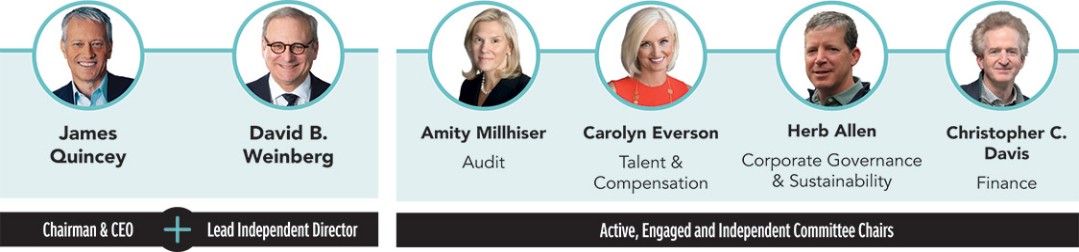
Since Mr. Quincey took on the combined role of Chairman of the Board and CEO, the Board has deemed it effective to have one person serve as Chairman and CEO, which can provide certain synergies and efficiencies that enhance the operations of the Board and, importantly, allow it to effectively execute its role in overseeing business strategy. The Company’s business is complex, and its products are sold in more than 200 countries and territories around the world. Most of the Company’s products are manufactured and sold by independent bottling partners throughout the world. The CEO maintains strong, hands-on relationships with the leaders of bottlers and remains close to the many facets of the Company’s global business. Because the CEO is the Board member closest to this vast and complex business, he or she is well positioned to identify many of the business issues that require Board attention and, as Chairman, can focus Directors’ attention on the most critical business matters. Further, in the Board’s experience, the combined role of Chairman and CEO has supported timely and unfiltered communication with the Board on these critical business issues. The Board also believes that there are benefits when the same person represents both the Company and the Board with bottlers, customers, consumers and other stakeholders throughout the world.
To balance the authority and influence inherent in the combined role of Chairman and CEO, the Board has been thoughtful in structuring the Lead Independent Director’s role with robust and clearly defined responsibilities. Importantly, the Board has considered best practices in corporate governance and feedback from shareowner engagement efforts.
| | |
The Coca-Cola Company | 28 | 2026 Proxy Statement |
| | | | | | | | | | |||||||
| Our |
| Voting |
| Governance |
| Share |
| Compensation |
| Audit Matters |
| Shareowner |
| Annexes |
|
As an indicator of the Lead Independent Director’s authority, the Board has designated the role as a Board-level key point of contact for shareowner and other stakeholder communications. Other duties of the Lead Independent Director include leading the performance evaluation of the Chairman and CEO; leading the annual Board evaluation process; collaborating on the structure and responsibilities of Board committees; presiding at executive sessions and at each meeting where the Chairman and CEO is not present; approving all Board agendas; and playing a key role in Board and management succession. David B. Weinberg, our current Lead Independent Director, brings strong strategic and financial expertise, extensive experience in international and cross-border investments, and a robust background in risk oversight and management. His unique qualifications not only enrich his effectiveness in his role but also enhance the Board’s overall governance and oversight capabilities. The Board believes that his distinct skillset greatly strengthens his contribution as the Lead Independent Director.
All Directors play an active role in overseeing the Company’s business both at the Board and committee levels. As part of each regularly scheduled Board meeting, the non-employee Directors meet in executive sessions, without the CEO present, which are chaired by the Lead Independent Director. These meetings allow non-employee Directors to discuss issues that are important to the Company, including the business and affairs of the Company, as well as matters concerning management, without any members of management present. Consistent with the Board’s commitment to good corporate governance practices, at least one executive session of the non-employee Directors each year includes a review of the Board’s leadership structure and consideration of whether the position of Chairman of the Board should be held by the CEO.
New Leadership Structure in Connection with CEO Transition
In December 2025, the Board determined that the roles of Chairman of the Board and CEO would be separated upon Henrique Braun’s succession to CEO, effective March 31, 2026. In connection with this transition, Mr. Quincey will continue to serve as Executive Chairman of the Board and Mr. Braun has been nominated for election as a Director at the 2026 Annual Meeting. David B. Weinberg will continue to serve as the Lead Independent Director.
As noted above, the Board has flexibility to choose a different Board leadership structure if and when it determines circumstances so warrant. The Board believes that instituting an orderly transition period while continuing the partnership between Mr. Quincey and Mr. Braun, with an adjusted focus for each, will enable both executives to apply their strongest skills to continue the sustained growth of our business. Mr. Braun, as CEO, will assume complete accountability for the Company’s strategic direction and operations, and Mr. Quincey, as Executive Chairman of the Board, will continue to lead the Board and focus on governance.
The Board will continue to periodically evaluate the Board leadership structure to ensure that the Board’s structure is appropriate in light of the needs of the business. Consistent with the Board’s commitment to good corporate governance practices, at least one executive session each year, consisting of solely the independent Directors, will include a review of the Board’s leadership structure and consideration of whether the position of Chairman of the Board should be held by the CEO.
| | |
The Coca-Cola Company | 29 | 2026 Proxy Statement |
| | | | | | | | | | |||||||
| Our |
| Voting |
| Governance |
| Share |
| Compensation |
| Audit Matters |
| Shareowner |
| Annexes |
|
Duties and Responsibilities
The duties and responsibilities of the Chairman of the Board, the Chief Executive Officer and the Lead Independent Director are described below and are set forth in the Company’s By-Laws and Corporate Governance Guidelines.
| | Chairman of the Board | | | | Lead Independent Director | |
| | ● Presides over meetings of the Board. ● Presides over meetings of shareowners. ● Consults and advises the Board and its committees on the business and affairs of the Company. ● Performs such other duties as may be assigned by the Board. | | | | ● Presides at all meetings of the Board at which the Chairman of the Board is not present, including all meetings of independent Directors and non-employee Directors. ● Encourages and facilitates the active participation of all Directors. ● When appropriate, serves as a liaison between the independent Directors and the Chairman of the Board on sensitive issues and other matters. ● Regularly meets with the Chairman of the Board to discuss items of importance, including with respect to strategic and risk oversight matters. ● Approves Board meeting materials for distribution to and consideration by the Board, including providing feedback or advising as to the scope, quality and timeliness of the flow of information provided to the Board. ● Approves Board meeting agendas after conferring with the Chairman of the Board and other members of the Board, as appropriate, and may add agenda items at his or her discretion. | ● Approves Board meeting schedules to assure that there is sufficient time for discussion of all agenda items. ● Has the authority to call meetings of the independent Directors. ● Leads the Board’s annual evaluation of the Chairman of the Board and CEO. ● Monitors and coordinates with management on corporate governance issues and developments and assists the Board and management in promoting strong corporate governance best practices. ● Available to advise the committee chairs in fulfilling their designated roles and responsibilities to the Board. ● Available for consultation and communication with shareowners when appropriate, upon reasonable request. ● Discusses with the Chairman of the Board relevant follow-up and feedback from executive sessions of the non-employee Directors. ● Performs such other functions as the Board or other Directors may request. |
| | | | | | | |
| | Chief Executive Officer | | ||||
| | ● Oversees the affairs of the Company, subject to the overall direction and supervision of the Board and its committees and subject to such powers as reserved by the Board. | | | | | |
| | | | | | | |
| | |
The Coca-Cola Company | 30 | 2026 Proxy Statement |
| | | | | | | | | | |||||||
| Our |
| Voting |
| Governance |
| Share |
| Compensation |
| Audit Matters |
| Shareowner |
| Annexes |
|
Board and Committee Evaluation Process
The Board recognizes that a robust and constructive evaluation process is an essential component of good corporate governance. The Corporate Governance and Sustainability Committee regularly discusses Board composition and effectiveness during its committee meetings. In addition, under the leadership of the Lead Independent Director, the Corporate Governance and Sustainability Committee oversees the Board’s annual evaluation process. The Corporate Governance and Sustainability Committee periodically reviews the format of the evaluation process, including whether to utilize a third-party facilitator, to ensure that actionable feedback is solicited on the operation and effectiveness of the Board, Board committees and Director performance.
| | 2025 Multi-Step Evaluation Process | |
| | | |
| |
| Committee Self-Evaluation Each committee conducted a separate, closed self-evaluation session. |
| | | |
| |
| One-On-One Discussions with Lead Independent Director The Lead Independent Director conducted separate, one-on-one sessions with each Director nominee to discuss feedback regarding the following: ● Board composition and structure ● Strategic and performance abilities ● Governance and organizational assessment ● Board interaction with management ● Meetings and materials ● Overall committee and Board functioning and effectiveness |
| | | |
| |
| Board Closed Session The results of each committee’s self-evaluation, the Lead Independent Director sessions and other feedback were discussed by the Board in a closed Board self-evaluation session. |
| | | |
| | | |
| | Incorporation of Feedback | |
| | Our multi-step evaluation process generates robust comments and discussion at all levels of the Board, including with respect to Board composition and processes. These results have led to changes designed to increase Board effectiveness and efficiency. For example, over the past few years, enhancements have been made regarding meeting materials and discussion topics; the structure of the Board; responsibilities of committees; committee and executive session discussions; committee reports to the Board; the Board evaluation process; the Director onboarding process; ongoing opportunities for continuing education for Directors; consideration of qualifications and experiences to be represented on the Board in the future; and hands-on experiences for Directors with our business, bottlers, senior leaders and emerging talent around the world. | |
| | | |


| | |
The Coca-Cola Company | 31 | 2026 Proxy Statement |
| | | | | | | | | | |||||||
| Our |
| Voting |
| Governance |
| Share |
| Compensation |
| Audit Matters |
| Shareowner |
| Annexes |
|
Board Committees
Our Board conducts a portion of its work through the committee structure, which helps ensure a deeper review and understanding of specific areas or issues and takes advantage of the various skills and expertise of our Directors. In 2025, the Board operated with five standing committees: the Audit Committee, the Talent and Compensation Committee, the Corporate Governance and Sustainability Committee, the Finance Committee and the Executive Committee.
Information about each committee, including membership information, as of December 31, 2025, is provided below.
The Board has adopted a written charter for each of these committees, each of which is available on the Company’s website, www.coca- colacompany.com, by clicking on “Investors,” then “Corporate Governance” and then “Documents.”
| | AUDIT COMMITTEE | ||||
| | Meetings Held in 2025: 9 Independence(1): 4 out of 4 | | |||
| |
AMITY Chair |
CHRISTOPHER C. |
CAROLINE J. |
David B. | |
| | Primary Responsibilities: ● Represents and assists the Board in fulfilling its oversight responsibility relating to the integrity of the Company’s financial statements and the financial reporting process, the systems of internal accounting and financial controls, the internal audit function and the annual independent audit of the Company’s financial statements. ● Oversees the Company’s ERM program and has direct oversight over certain risks within the ERM framework. Periodically receives reports on and discusses governance of the Company’s risk assessment and risk management processes and reviews significant risks and exposures identified to the Committee (whether financial, operating or otherwise) and management’s steps to address them. ● Oversees the Company’s compliance with legal and regulatory requirements; the Independent Auditors’ qualifications and independence; the performance of the Independent Auditors and the Company’s internal audit function; the Company’s ethical compliance programs, including the Company’s Codes of Business Conduct; the Company’s quality and food safety programs, workplace and distribution safety programs; and cybersecurity. ● In coordination and consultation with the Corporate Governance and Sustainability Committee, oversees certain processes related to the Company’s significant external sustainability disclosures, including the type and presentation of key sustainability disclosures, and internal controls and procedures supporting such disclosures. | ||||
| | Additional information regarding the Audit Committee can be found beginning on page 83. | ||||

| (1) | Each member who served on the Committee during 2025 is financially literate and met the independence requirements of the NYSE, the Securities Exchange Act of 1934, as amended (the “1934 Act”), and the Company’s Corporate Governance Guidelines. The Board designated each of Ms. Millhiser and Messrs. Davis and Weinberg as an “Audit Committee financial expert” during 2025. |
| | |
The Coca-Cola Company | 32 | 2026 Proxy Statement |
| | | | | | | | | | |||||||
| Our |
| Voting |
| Governance |
| Share |
| Compensation |
| Audit Matters |
| Shareowner |
| Annexes |
|
| | TALENT and COMPENSATION Committee | ||||
| | Meetings Held in 2025: 5 Independence(1): 4 out of 4 | ||||
| |
CAROLYN Chair |
BELA |
Maria Elena |
MAX | |
| | Primary Responsibilities: ● Oversees policies and strategies relating to talent, leadership and culture. ● Evaluates and approves compensation plans, policies and programs applicable primarily to the Company’s senior executive group, which includes all individuals subject to Section 16 of the 1934 Act. The Talent and Compensation Committee does not delegate any of its responsibilities regarding the consideration and determination of the senior executive group’s compensation. ● Approves all equity awards to employees, including stock options, performance share units (“PSUs”), restricted stock and restricted stock units (“RSUs”). ● Maintains sole authority to retain, terminate and approve fees and other terms of engagement of its compensation consultant and to obtain advice and assistance from internal or external legal, accounting or other advisors. ● Considers shareowner viewpoints on compensation. | ||||
| | | ||||


| (1) | Each member of the Committee meets the independence requirements of the NYSE, the Internal Revenue Code of 1986, as amended (the “Tax Code”), and the Company’s Corporate Governance Guidelines. In addition, each member is a “non-employee director” as defined by Rule 16b-3 under the 1934 Act. |
| (2) | Ms. Lagomasino will serve on the Committee until the 2026 Annual Meeting. See page 11 for further discussion. |
| (3) | Mr. Levchin was appointed to the Committee effective October 16, 2025. |
| | |
The Coca-Cola Company | 33 | 2026 Proxy Statement |
| | | | | | | | | | |||||||
| Our |
| Voting |
| Governance |
| Share |
| Compensation |
| Audit Matters |
| Shareowner |
| Annexes |
|
| | Corporate Governance and Sustainability Committee | ||||
| | Meetings Held in 2025: 6 Independence(1): 4 out of 4 | ||||
| |
HERB Chair |
ANA |
Maria Elena |
David B. | |
| | Primary Responsibilities: ● Considers and makes recommendations concerning Director nominees and the function and needs of the Board and its committees. ● Regularly reviews the Company’s Corporate Governance Guidelines and provides oversight of the corporate governance affairs of the Board and the Company consistent with the long-term best interests of the Company and its shareowners. ● Oversees the development and implementation of succession plans for the CEO and the most senior positions at the Company. ● Oversees the Company’s policies and programs and related risks concerning environmental, social, legislative, regulatory and public policy matters. ● Oversees the Company’s sustainability programs and goals and the Company’s progress toward achieving such goals, as well as monitors risks related to sustainability matters. ● Coordinates the annual Board, committee and Director evaluation processes. ● Considers shareowner viewpoints on corporate governance matters. | ||||
| | | ||||

| (1) | Each member of the Committee meets the independence requirements of the NYSE and the Company’s Corporate Governance Guidelines. |
| (2) | Ms. Lagomasino will serve on the Committee until the 2026 Annual Meeting. See page 11 for further discussion. |
| | Finance Committee | |||||
| | Meetings Held in 2025: 5 Independence: 5 out of 5 | | ||||
| |
CHRISTOPHER C. Chair |
HERB |
ANA |
CAROLYN |
THOMAS S. | |
| | Primary Responsibilities: ● Helps the Board fulfill its responsibilities relating to oversight of the Company’s financial affairs, including reviewing and recommending to the Board the Company’s dividend policy, capital expenditures, debt and other financings, major strategic investments and other transactions. ● Oversees the Company’s policies and procedures on risk management, hedging, swaps and other derivative transactions. | |||||
| | ||||||

| | |
The Coca-Cola Company | 34 | 2026 Proxy Statement |
| | | | | | | | | | |||||||
| Our |
| Voting |
| Governance |
| Share |
| Compensation |
| Audit Matters |
| Shareowner |
| Annexes |
|
| | Executive Committee | |||
| | Meetings Held in 2025: 0 Independence: 2 out of 3 | | ||
| |
James Chair |
CHRISTOPHER C. |
DAVID B. | |
| | Primary Responsibilities: ● Authorized to exercise the power and authority of the Board between meetings, except the powers reserved for the Board or the shareowners under the Delaware General Corporation Law. If matters are delegated to the Executive Committee by the Board, the Committee may act at a meeting or by written consent in lieu of a meeting. | |||
| | ||||

MEETINGS AND ATTENDANCE | | |
| | |
Regular meetings of the Board are held at such times as the Board may determine. Special meetings of the Board may be called by the Chairman, the Company’s Secretary or a majority of the Directors by written request to the Secretary. Committee meetings can be called by the committee’s chair or a majority of the committee members. | ||
In 2025, the Board held five meetings, and committees of the Board held a total of 25 meetings. Overall attendance at such meetings was approximately 99%. During 2025, each Director attended 75% or more of the aggregate of all meetings of the Board and the committees during the period in which he or she served. | OVERALL ATTENDANCE | |
~99% | ||
| | |
The Coca-Cola Company | 35 | 2026 Proxy Statement |
| | | | | | | | | | |||||||
| Our |
| Voting |
| Governance |
| Share |
| Compensation |
| Audit Matters |
| Shareowner |
| Annexes |
|
SHAREOWNER ENGAGEMENT
Our relationship with shareowners is an important part of our Company’s success. The Board and management believe they best execute their duties when they proactively listen to, seek to understand, and consider the opinions of our shareowners. We engage with our shareowners and the broader corporate governance community through a year-round engagement program, which is management-led and overseen by the Board. Our engagement program is designed to address questions and concerns, provide perspective on Company policies and practices, seek shareowner input and incorporate feedback, as appropriate.
| | Our Year-Round Engagement Program | ||||||
| | | | | | | ||
| |
| Who We Engage | |
| How We Engage | ||
| | We engage with a wide range of constituents, including the following: ● Institutional shareowners ● Retail shareowners ● Proxy advisory firms ● Sustainability rating firms ● Regulators ● Governance and sustainability thought leaders | | We utilize multiple channels for engagement, including the following: ● Quarterly investor calls and other investor-led conferences and presentations ● Company-hosted investor meetings, both in-person and virtual ● Annual Meeting of Shareowners ● Various quarterly and annual reporting and disclosures ● Participation in corporate governance events and with governance-focused organizations, providing valuable opportunities to engage with investors, peer companies, policymakers and others, to promote knowledge and constructive dialogue | ||||
| | | | | ||||
| |
| Who Is Involved | |
| Topics of Engagement | ||
| | ● Independent Directors ● Executive leadership team ● Senior management ● Subject matter experts | | We cover a broad range of business topics in these interactions, including Board composition and structure; executive compensation; business strategy; business performance and execution; sustainability; human capital management; and Company culture. | ||||
| | | | | ||||
| | In 2025, we engaged with shareowners collectively representing a majority of our Common Stock. Below is a selected sample of our engagements with shareowners and the broader corporate governance community. | ||||||
| | | | | ||||
| |
| 2025 Communication and Engagement Highlights | |||||
| | February ● 4th Quarter and Full Year 2024 Earnings ● Publication of 2024 Form 10-K ● Consumer Analyst Group of New York (CAGNY) Investor Conference March ● Publication of 2025 Proxy Statement ● Council of Institutional Investors Conference ● Harvard Law School Corporate Governance Roundtable | April ● 1st Quarter Earnings ● Shareowner outreach regarding voting matters in the 2025 Proxy Statement ● 2025 Annual Meeting of Shareowners June ● Deutsche Bank dbAccess Global Consumer Conference ● Harvard Law School Corporate Governance Roundtable July ● 2nd Quarter Earnings | September ● Barclays Global Consumer Staples Conference ● Council of Institutional Investors Conference ● Interfaith Center on Corporate Responsibility Annual Event October ● 3rd Quarter Earnings ● Wachtell Lipton / PJT Camberview Fall Engagement Summit December ● Morgan Stanley Global Consumer & Retail Conference | ||||
| | | ||||||


| | |
The Coca-Cola Company | 36 | 2026 Proxy Statement |
| | | | | | | | | | |||||||
| Our |
| Voting |
| Governance |
| Share |
| Compensation |
| Audit Matters |
| Shareowner |
| Annexes |
|
ADDITIONAL GOVERNANCE MATTERS
Public Policy Engagement
In accordance with the principles of the Company’s Code of Business Conduct and in strict compliance with applicable laws and regulations, we engage with government officials and stakeholders on legislative, regulatory, and public policy issues that impact our business.
As part of our commitment to transparency, we voluntarily disclose on our Company website, www.coca-colacompany.com, information on our lobbying activities, political contributions and memberships in organizations that engage in advocacy. These disclosures are intended to provide stakeholders with an understanding of the nature, scope and oversight of our public policy and political engagement.
The Company was again recognized as a Trendsetter, with a score of 95.7%, in the 2025 CPA-Zicklin Index of Corporate Political Disclosure and Accountability, an index issued annually and produced by the Center for Political Accountability in conjunction with the Zicklin Center for Governance and Business Ethics at The Wharton School of the University of Pennsylvania. Companies that receive a score of 90% or above, indicating robust disclosure and oversight, are identified as “Trendsetters.”
Additional information about our public policy engagement is available on the Company’s website, www.coca– colacompany.com, by clicking on “Investors,” then “Corporate Governance” and then “Political Engagement Policy.”
Special Meeting of Shareowners
Our By-Laws provide that a special meeting of shareowners may be called by the Board, the Chairman of the Board, the CEO, or the Secretary, if appropriately requested by a person (or group of persons) beneficially owning at least a 25% “net long position” of the Company’s Common Stock. A shareowner’s “net long position” is generally defined as the amount of Common Stock in which the shareowner holds a positive (also known as “long”) economic interest, reduced by the amount of Common Stock in which the shareowner holds a negative (also known as “short”) economic interest.
Global Insider Trading Compliance Policy and Procedures
The Company’s
Hedging, Short Sale and Pledging Policies
The Insider Trading Policy prohibits our Directors, officers who are subject to the reporting requirements of Section 16(a) of the 1934 Act (“Section 16 Officers”), and those employees, independent contractors and consultants who, as a result of their access to material nonpublic information, are from time to time designated as “Restricted Persons,” from (i) purchasing any financial instruments that are designed to hedge or offset any decrease in the market value of Company securities that were either granted as part of the individual’s compensation or that the individual holds directly or indirectly, (ii) engaging in any short sales of Company securities, or (iii) pledging Company securities as collateral for a loan, purchasing Company securities on margin or borrowing against Company securities held in a margin account. These prohibitions also extend to certain family members of such persons and any other individual or entity whose securities trading decisions are influenced or controlled by such persons. All other employees of the Company are discouraged from entering into hedging transactions or engaging in short sales involving Company securities or pledging Company securities.
Codes of Business Conduct
The Company maintains a Code of Business Conduct for non-employee Directors and a Code of Business Conduct that is applicable to the Company’s employees, including the Named Executive Officers. Our associates, bottling partners, suppliers, customers and consumers can confidentially and anonymously ask questions about our Codes of Business Conduct and other ethics and compliance issues, or report potential violations, through EthicsLine, a global internet and telephone hotline. The Codes of Business Conduct and information about EthicsLine are available on the Company’s website, www.coca-colacompany.com, by clicking on “Investors,” then “Corporate Governance” and then “Code of Business Conduct.” In the event the Company amends or waives any of the provisions of the Code of Business Conduct applicable to our principal executive officer, principal financial officer, principal accounting officer or controller, or persons performing similar functions, that relate to any element of the definition of “code of ethics” enumerated in Item 406(b) of Regulation S-K under the 1934 Act, the Company intends to disclose these actions on the Company’s website.
| | |
The Coca-Cola Company | 37 | 2026 Proxy Statement |
| | | | | | | | | | |||||||
| Our |
| Voting |
| Governance |
| Share |
| Compensation |
| Audit Matters |
| Shareowner |
| Annexes |
|
With the support of a team of global compliance professionals, our Chief Ethics and Compliance Officer is principally responsible for administering compliance with our Codes of Business Conduct. The Chief Ethics and Compliance Officer reports directly to the Company’s Global General Counsel. In addition, the Audit Committee meets with the Chief Ethics and Compliance Officer at least annually to discuss the effectiveness of the Company’s compliance programs and receives status updates of compliance issues at each committee meeting.
View the Company’s Governance Materials
You can view the Company’s governance materials, including the Certificate of Incorporation, By-Laws, Corporate Governance Guidelines and Board committee charters, on the Company’s website, www.coca-colacompany.com, by clicking on “Investors,” then “Corporate Governance” and then “Documents.” Instructions on how to obtain copies of these materials are included in the response to question 26 on page 104.
| COMMUNICATE WITH THE BOARD The Board has established a process to facilitate communication by shareowners and other interested parties with Directors. |
Communications can be addressed to Directors in care of the Office of the Secretary, The Coca-Cola Company, P.O. Box 92487, Atlanta, Georgia 30314 or by email to asktheboard@coca-cola.com.
Communications may be distributed to all Directors, or to any individual Director, as appropriate. At the direction of the Board, all mail received may be opened and screened for security purposes. In addition, items that are unrelated to the duties and responsibilities of the Board will not be distributed. Such items include, but are not limited to, the following:
· spam · junk mail and mass mailings · product complaints or inquiries | · new product suggestions · résumés and other forms of job | · surveys · business solicitations or advertisements |
Material that is trivial, obscene, unduly hostile, threatening or illegal, or similarly unsuitable items, will be excluded from distribution; however, any communication that is excluded will be made available to any independent, non-employee Director upon any such Director’s request.
To help answer many of the questions we receive about our Company and our products, we offer detailed information about common areas of interest on the “FAQs” page of our website, available at www.coca-colacompany.com/faqs.
DIRECTOR COMPENSATION
The Corporate Governance and Sustainability Committee is responsible for reviewing and making recommendations to the Board regarding all matters pertaining to compensation paid to Directors for Board, Lead Independent Director, committee and committee chair service. Director compensation is provided under The Coca-Cola Company Directors’ Plan (the “Directors’ Plan”). Directors who also serve as employees of the Company do not receive payment for service as Directors.
In making non-employee Director compensation recommendations, the Corporate Governance and Sustainability Committee takes various factors into consideration, including, but not limited to, the responsibilities of Directors generally and committee chairs specifically and the form and amount of compensation paid by comparable companies to their directors. The Corporate Governance and Sustainability Committee’s charter also authorizes the Committee to engage consultants or advisors, if and when it deems appropriate, in connection with its review and analysis of Director compensation. The Board reviews the recommendations of the Corporate Governance and Sustainability Committee and determines the form and amount of Director compensation.
No changes have been made to Director compensation since 2020.
| | |
The Coca-Cola Company | 38 | 2026 Proxy Statement |
| | | | | | | | | | |||||||
| Our |
| Voting |
| Governance |
| Share |
| Compensation |
| Audit Matters |
| Shareowner |
| Annexes |
|
2025 Annual Director Compensation
1BAnnual Retainers
2BAdditional Compensation $30,000 $30,000 $25,000 3B$20,000 | Cash retainers are paid on a quarterly basis. Under the Directors’ Plan, non-employee Directors have the option of deferring all or a portion of their cash compensation into share units that are paid out in cash after leaving the Board. The $200,000 annual equity retainer is credited in deferred share units. The number of share units awarded is equal to the number of shares of Common Stock that could be purchased on the open market for $200,000, or a prorated portion thereof, on April 1 (or the immediately preceding business day if April 1 is not a business day). Share units do not have voting rights but are credited with hypothetical dividends that are reinvested in additional units to the extent dividends on Common Stock are received by shareowners. Share units are paid out in cash on the later of (i) January 15 of the year following the year in which the Director leaves the Board or (ii) six months after the Director leaves the Board. Directors may elect to take their payout in a lump sum or in up to five annual installments. Directors do not receive fees for attending Board or committee meetings. Directors who serve on committees (other than as chair) do not receive additional compensation for committee service. Non-employee Directors are reimbursed for reasonable expenses incurred in connection with Board-related activities. |
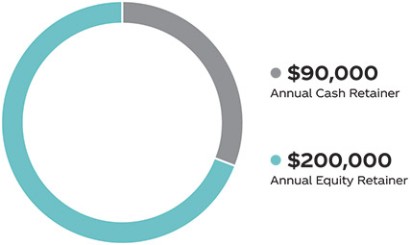
Highlights of Director Compensation Program ● Emphasis on Equity: Aligns the majority of Directors’ compensation with shareowner interests because the value of share units fluctuates up or down depending on the price of our Common Stock. ● Long-Term Focus: Focuses on the long term because share units are not paid until after the Director leaves the Board. ● Market Competitive: In line with peers and equitable based on the work required of directors serving at an entity of the Company’s size and scope. ● No Fees: No fees are paid for Board or committee meeting attendance. ● Stock Ownership Requirements: Since share units are not paid out until after the Director leaves the Board, all Directors hold their annual equity retainers until after retirement from Board service. As a result, after only three years of service, all Directors maintain an equity ownership level of at least five times the annual cash retainer. |
| | |
The Coca-Cola Company | 39 | 2026 Proxy Statement |
| | | | | | | | | | |||||||
| Our |
| Voting |
| Governance |
| Share |
| Compensation |
| Audit Matters |
| Shareowner |
| Annexes |
|
The following table details the total compensation of the Company’s non-employee Directors for the year ended December 31, 2025.
2025 Director Compensation Table
| | | | | | | | | | | | | | | | | | | | | |
| | | | | | | | | | | | | | Change in | | | | | | | |
| | | | | | | | | | | | | | Pension Value | | | | | | ||
| | | | | | | | | | | | | | and Nonqualified | | | | | | ||
| | Fees | | | | | | | | Non-Equity | | Deferred | | | | | | ||||
| | Earned or | | Stock | | Option | | Incentive Plan | | Compensation | | All Other | | | |||||||
| | Paid in Cash | | Awards | | Awards | | Compensation | | Earnings | | Compensation | | Total | |||||||
Name(1) | | ($) | | ($) | | ($) | | ($) | | ($) | | ($) | | ($) | |||||||
(a) | | (b) | | (c) | | (d) | | (e) | | (f) | | (g) | | (h) | |||||||
Herb Allen | | $ | 110,000 | | $ | 200,000 | | $ | 0 | | $ | 0 | | $ | 0 | | $ | 1,229 | | $ | 311,229 |
Bela Bajaria | | | 90,000 | | | 200,000 | | | 0 | | | 0 | | | 0 | | | 1,169 | | | 291,169 |
Ana Botín | |
| 90,000 | |
| 200,000 | |
| 0 | |
| 0 | |
| 0 | |
| 380 | |
| 290,380 |
Christopher C. Davis | |
| 110,000 | |
| 200,000 | |
| 0 | |
| 0 | |
| 0 | |
| 8,655 | |
| 318,655 |
Carolyn Everson | |
| 115,000 | |
| 200,000 | |
| 0 | |
| 0 | |
| 0 | |
| 21,216 | | | 336,216 |
Thomas S. Gayner | | | 90,000 | | | 200,000 | | | 0 | | | 0 | | | 0 | | | 1,169 | | | 291,169 |
Maria Elena Lagomasino | |
| 90,000 | |
| 200,000 | |
| 0 | |
| 0 | |
| 0 | |
| 16,811 | |
| 306,811 |
Max Levchin(2) | | | 36,000 | | | 80,000 | | | 0 | | | 0 | | | 0 | | | 508 | | | 116,508 |
Amity Millhiser | | | 120,000 | | | 200,000 | | | 0 | | | 0 | | | 0 | | | 17,439 | | | 337,439 |
Caroline J. Tsay | |
| 90,000 | |
| 200,000 | |
| 0 | |
| 0 | |
| 0 | |
| 10,402 | |
| 300,402 |
David B. Weinberg | |
| 120,000 | |
| 200,000 | |
| 0 | |
| 0 | |
| 0 | |
| 3,680 | |
| 323,680 |
| (1) | Mr. Quincey is a Company employee and therefore receives no compensation under the Directors’ Plan. |
| (2) | Mr. Levchin joined the Board on October 16, 2025. Therefore, the information reflects his service on the Board following such appointment. |
Fees Earned or Paid in Cash (Column (b))
The amounts reported in the Fees Earned or Paid in Cash column reflect the cash fees earned by each non-employee Director in 2025, whether or not such fees were deferred. In addition to the $90,000 annual cash fees (or a prorated portion thereof): (i) Mr. Weinberg received an additional $30,000 for service as Lead Independent Director; (ii) Ms. Millhiser received an additional $30,000 for service as Audit Committee Chair; (iii) Ms. Everson received an additional $25,000 for service as Talent and Compensation Committee Chair; and (iv) each of Messrs. Allen and Davis received an additional $20,000 for service as Chair of the Corporate Governance and Sustainability Committee and the Finance Committee, respectively.
The table below shows the non-employee Directors who deferred any portion of their 2025 cash compensation into share units. The number of share units is equal to the number of shares of Common Stock that could be purchased for the deferred amount based on the average of the high and low prices of a share of Common Stock on April 1, 2025.
| | |
Director | | Elective Deferral in Share Units |
Mr. Allen | | 1,537 |
Ms. Bajaria | | 125 |
Ms. Botín |
| 943 |
Mr. Davis |
| 1,537 |
Mr. Gayner | | 1,257 |
Ms. Lagomasino |
| 1,257 |
Ms. Millhiser | | 1,626 |
Ms. Tsay | | 1,257 |
Mr. Weinberg |
| 1,677 |
Stock Awards (Column (c))
The amounts reported in the Stock Awards column reflect the grant date fair value associated with each non-employee Director’s share units that are required to be deferred under the Directors’ Plan, calculated in accordance with the provisions of the Financial Accounting Standards Board Accounting Standards Codification 718, Compensation–Stock Compensation (“ASC Topic 718”).
| | |
The Coca-Cola Company | 40 | 2026 Proxy Statement |
| | | | | | | | | | |||||||
| Our |
| Voting |
| Governance |
| Share |
| Compensation |
| Audit Matters |
| Shareowner |
| Annexes |
|
The table below shows the number of outstanding share units held by each non-employee Director who served during 2025.
| | |
| | Outstanding Share Units |
Director | | as of 12/31/2025 |
Mr. Allen |
| 18,355 |
Ms. Bajaria | | 4,368 |
Ms. Botín |
| 80,512 |
Mr. Davis |
| 45,780 |
Ms. Everson |
| 12,013 |
Mr. Gayner | | 11,301 |
Ms. Lagomasino |
| 123,353 |
Mr. Levchin | | 1,192 |
Ms. Millhiser | | 11,902 |
Ms. Tsay |
| 35,334 |
Mr. Weinberg |
| 73,476 |
All Other Compensation (Column (g))
The amounts reported in the All Other Compensation column reflect, where applicable, Company matching gifts to nonprofit organizations and other charitable contributions; premiums for business travel accident insurance; and perquisites and other personal benefits, including the costs of Company products provided to Directors without charge, and gifts provided to Directors by the Company.
Further described below are the amounts reflected in the All Other Compensation column that are required by SEC rules to be separately identified for 2025.
Charitable Contributions
The Directors are eligible to participate in the Company’s matching gifts program, which is the same program available to all U.S.-based employees and retirees. In 2025, this program matched up to $10,000 of charitable contributions on a two-for-one basis (for a total match of $20,000) to most tax-exempt public charities, including most colleges and universities; private and public schools; youth development; civic organizations; arts and culture organizations; health and human service agencies; and environmental organizations. The total cost of matching contributions on behalf of the non-employee Directors for 2025 under the Company’s matching gifts program was $42,194.
| | | |
Director | | Matching Gifts | |
Ms. Everson | | $ | 20,000 |
Ms. Millhiser | | | 16,270 |
Ms. Tsay | | | 5,924 |
Insurance Premiums
Business travel accident insurance coverage of $200,000 is provided to all non-employee Directors while traveling on Company business, at a Company cost of $7.50 per Director per year.
Perquisites and Other Personal Benefits
To help expand the Directors’ knowledge of the Company’s products, the Company provides certain products to Directors’ offices without charge. In 2025, Mses. Lagomasino and Tsay and Messrs. Davis and Weinberg participated in the program. The total cost incurred by the Company in 2025 for products provided to non-employee Directors was $27,780.
Consistent with all attendees, Ms. Lagomasino and Messrs. Allen and Weinberg received gifts in connection with their attendance at a global system meeting. In addition, all non-employee Directors received gifts during certain Board meetings. Additionally, Mr. Levchin received a welcome gift when he joined the Board in 2025. The total cost incurred by the Company for the gifts provided to non-employee Directors in 2025 was $12,611.
| | |
The Coca-Cola Company | 41 | 2026 Proxy Statement |
| | | | | | | | | | |||||||
| Our |
| Voting |
| Governance |
| Share |
| Compensation |
| Audit Matters |
| Shareowner |
| Annexes |
|
DIRECTOR INDEPENDENCE AND RELATED PERSON TRANSACTIONS
Independence Standards
Under the NYSE listing standards and the Company’s Corporate Governance Guidelines, the Board must consist of a majority of independent Directors. In making independence determinations, the Board observes NYSE and SEC criteria and considers all relevant facts and circumstances. To be considered independent for these purposes, (i) the Director must meet the bright-line independence standards under the NYSE listing standards, and (ii) the Board must affirmatively determine that the Director otherwise has no material relationship with the Company directly, or as an officer, shareowner or partner of an organization that has a relationship with the Company.
To aid in the Director independence assessment process, the Board has adopted categorical standards that identify categories of relationships that the Board has determined would not affect a Director’s independence. These categorical standards, which are part of the Company’s Corporate Governance Guidelines, specify that the following will not be considered material relationships that would impair a Director’s independence:
Immaterial Sales/Purchases | The Director is an executive officer or employee, or any member of his or her immediate family is an executive officer, of any other organization that does business with the Company and the annual sales to, or purchases from, the Company are less than $1 million or 1% of the consolidated gross revenues of such organization, whichever is more. |
Immaterial Indebtedness | The Director or any member of his or her immediate family is an executive officer of any other organization which is indebted to the Company, or to which the Company is indebted, and the total amount of either company’s indebtedness to the other is less than $1 million or 1% of the total consolidated assets of the organization on which the Director or any member of his or her immediate family serves as an executive officer, whichever is more. |
Immaterial Position | The Director is a director or trustee, but not an executive officer, or any member of his or her immediate family is a director, trustee or employee, but not an executive officer, of any other organization (other than the Company’s outside auditing firm) that does business with, or receives donations from, the Company. |
Immaterial Ownership | The Director or any member of his or her immediate family holds less than a 10% interest in any organization that has a relationship with the Company. |
Immaterial Nonprofit Relationship | The Director or any member of his or her immediate family serves as an executive officer of a charitable or educational organization which receives contributions from the Company in a single fiscal year of less than $1 million or 2% of that organization’s consolidated gross revenues, whichever is more. |
Independence Assessment
The Board, through its Corporate Governance and Sustainability Committee, annually reviews all relevant relationships any Director nominee and any person who served as a Director during the prior year may have with the Company. As a result of its annual review, the Board has determined that none of the following Director nominees has a material relationship with the Company and, as a result, such Director nominees are independent: Herb Allen, Bela Bajaria, Ana Botín, Christopher C. Davis, Carolyn Everson, Thomas S. Gayner, Max Levchin, Amity Millhiser, Caroline J. Tsay and David B. Weinberg. In addition, the Board determined that Maria Elena Lagomasino, who will serve as a Director until the 2026 Annual Meeting, is independent. None of the Directors or Director nominees who were determined to be independent had any relationships that were outside the categorical standards identified above.
James Quincey has served as the Company’s CEO since May 1, 2017, and Henrique Braun has served as Chief Operating Officer since January 2025 and Executive Vice President since January 2024; accordingly, neither is considered independent.
All of the Directors who serve as members of the Audit Committee, Talent and Compensation Committee and Corporate Governance and Sustainability Committee are independent under our independence standards, the applicable rules of the SEC and the NYSE listing standards. All members of the Audit Committee and the Talent and Compensation Committee are also compliant with the enhanced independence requirements for audit committee members and compensation committee members, respectively.
| | |
The Coca-Cola Company | 42 | 2026 Proxy Statement |
| | | | | | | | | | |||||||
| Our |
| Voting |
| Governance |
| Share |
| Compensation |
| Audit Matters |
| Shareowner |
| Annexes |
|
The table below summarizes the relationships that were considered in connection with the independence determinations. None of the transactions described below were considered material relationships that impacted the applicable Director’s independence.
Director | Categorical Standard | Description of Relationship |
Ana Botín | Immaterial | The Board examined the Company’s relationship with Banco Santander, S.A. (“Banco Santander”), where Ana Botín, one of our Directors, is Executive Chair. The Board determined that the relationship was not material because (i) the amounts involved were less than 1% of the consolidated gross revenues of Banco Santander; (ii) the Company’s investment of excess cash with Banco Santander, primarily in time deposits which provided market rate returns, is part of the Company’s overall cash management and investment strategy, which includes banks other than Banco Santander; (iii) the Company’s payments to Banco Santander relate to banking fees, all in the ordinary course of business; and (iv) the Company has had a relationship with Banco Santander and its banking subsidiaries for many years prior to Ms. Botín’s service as a Director of the Company. |
Thomas S. Gayner | Immaterial | The Board examined the Company’s relationship with Markel, where Thomas S. Gayner, one of our Directors, is Chief Executive Officer and a Director. The Board determined that the relationship was not material because (i) the amount paid by the Company for insurance coverage, provided in the ordinary course of business, was less than $1 million; and (ii) the Company has had a relationship with Markel since prior to Mr. Gayner’s service as a Director of the Company. |
Related Person Transactions
The Board has adopted a written policy for the review of certain related person transactions between any Director, Director nominee, executive officer, any beneficial owner of more than 5% of the Company’s Common Stock and any immediate family member of any of the foregoing (collectively, the “Related Persons”) and the Company. For purposes of this policy, a “related person transaction” includes, subject to certain exceptions, any transaction, arrangement or relationship (or any series of similar transactions, arrangements or relationships) in which (i) the Company or any subsidiary is a participant; (ii) the amount involved exceeds $120,000 in any fiscal year; and (iii) any Related Person has or will have a direct or indirect material interest.
The policy is administered by the Corporate Governance and Sustainability Committee, which will approve only those transactions that are, in its judgment, appropriate or desirable under the circumstances. In approving a transaction, the Corporate Governance and Sustainability Committee may impose conditions it deems appropriate in its discretion. In determining whether or not to approve a related person transaction, the Corporate Governance and Sustainability Committee considers, among other factors it deems appropriate:
| ● | The business purpose of and the benefits to the Company of the transaction; |
| ● | The nature and extent of the Related Person’s interest in the transaction; |
| ● | The approximate dollar value of the amount involved in the transaction; |
| ● | Whether the transaction was undertaken in the ordinary course of the Company’s business; |
| ● | Whether the terms of the transaction are fair to the Company and on terms no less favorable to the Company than terms that could have been reached with an unrelated third party; |
| ● | The availability of other sources for comparable products or services; |
| ● | Whether the transaction would impair the independence of the non-employee Director; and |
| ● | Whether the transaction would present an improper conflict of interest for any Director, Director nominee or executive officer, taking into account the size of the transaction, the overall financial position of the applicable Related Person, the direct or indirect nature and extent of the interest in the transaction of the applicable Related Person, the ongoing nature of any proposed relationship and any other relevant factors. |
No Director may participate in the discussion or approval of a transaction in which that Director, or an immediate family member, has a direct or indirect interest.
In the event there are related person transactions that are ongoing, the Corporate Governance and Sustainability Committee will annually review the transactions and determine if it is in the best interests of the Company and its shareowners to continue, modify or terminate any related person transaction.
Since January 1, 2025, there has not been, nor is there currently proposed, any transaction in which the Company or any of its subsidiaries was or is a participant, in which the amount involved exceeded or will exceed $120,000 and in which any Related Person had or will have a direct or indirect material interest.
| | |
The Coca-Cola Company | 43 | 2026 Proxy Statement |
DIRECTORS AND EXECUTIVE OFFICERS
The following table sets forth information regarding beneficial ownership of Common Stock by each Director, each Director nominee, each individual named in the 2025 Summary Compensation Table on page 64, and our Directors, Director nominees and executive officers as a group, all as of March 2, 2026. Unless otherwise noted, voting power and investment power in Common Stock are exercisable solely by the named person.
| | | | | | |
| | Aggregate | | Percent of | | |
| | Number of Shares | | Outstanding | | |
Name | | Beneficially Owned | | Shares(1) | | Additional Information |
Herb Allen | | 19,282,444 |
| * | | Includes 99,054 shares held by Allen & Company LLC, 6,000,000 shares held by Allen & Company Incorporated over which Mr. Allen has sole voting power, 13,000,000 shares held by two family members over which Mr. Allen has sole voting power, 780 shares held by a family trust of which Mr. Allen is one of two trustees and 20,000 shares held by a foundation of which Mr. Allen is one of two directors. Does not include 18,355 share units deferred under the Directors’ Plan, which are settled in cash. |
Bela Bajaria |
| 2,100 |
| * |
| Shares held by family trust of which Ms. Bajaria is one of two trustees. Does not include 4,368 share units deferred under the Directors’ Plan, which are settled in cash. |
Ana Botín |
| 2,500 |
| * |
| Shares held by a Spanish limited company of which Ms. Botín and her husband are the indirect beneficial owners. Does not include 80,512 share units deferred under the Directors’ Plan, which are settled in cash. |
Christopher C. Davis |
| 20,000 |
| * |
| Does not include 45,780 share units deferred under the Directors’ Plan, which are settled in cash. |
Carolyn Everson |
| 1,582 |
| * |
| Does not include 12,013 share units deferred under the Directors’ Plan, which are settled in cash. |
Thomas S. Gayner | | 5,200 | | * | | Does not include 11,301 share units deferred under the Directors’ Plan, which are settled in cash. |
Maria Elena Lagomasino |
| 23,631 |
| * |
| Does not include 123,353 share units deferred under the Directors’ Plan, which are settled in cash. |
Max Levchin | | 14,267 | | * | | Does not include 1,192 share units deferred under the Directors’ Plan, which are settled in cash. |
Amity Millhiser |
| 400 |
| * |
| Shares held by a living trust of which Ms. Millhiser is sole trustee. Does not include 11,902 share units deferred under the Directors’ Plan, which are settled in cash. |
Caroline J. Tsay |
| 1,104 |
| * |
| Shares held by a living trust of which Ms. Tsay is sole trustee. Does not include 35,334 share units deferred under the Directors’ Plan, which are settled in cash. |
David B. Weinberg |
| 9,248,693 |
| * |
| Includes 1,684,210 shares held by family members over which Mr. Weinberg has sole dispositive power. Also includes 3,000,000 shares held by three family trusts, of which Mr. Weinberg is a current or contingent remainder beneficiary and one of three trustees but over which he also has sole dispositive power. Also includes 12,000 shares held by a family trust, of which Mr. Weinberg is neither a trustee nor a beneficiary but over which he has sole dispositive power. Also includes 3,540,000 shares held by two family limited partnerships, over which Mr. Weinberg has sole investment control and shares beneficial ownership interest. Also includes 115,852 shares held by two foundations, over which Mr. Weinberg shares investment power with other family members but over which he also has sole dispositive power, and 168,729 shares held by two foundations, over which other family members have investment power but over which Mr. Weinberg also has sole dispositive power. Does not include 73,476 share units deferred under the Directors’ Plan, which are settled in cash. |
James Quincey |
| 4,461,496 |
| * |
| Includes 44,678 shares held by a family member, 200 shares of restricted stock, 8,944 shares credited to Mr. Quincey under The Coca-Cola Company 401(k) Plan (the “401(k) Plan”) and 3,879,031 shares that may be acquired upon the exercise of options, which are presently exercisable or that will become exercisable on or before May 1, 2026. Does not include 35,443 share units credited under The Coca-Cola Company Supplemental 401(k) Plan (the “Supplemental 401(k) Plan”), which are settled in cash post employment. |
John Murphy |
| 1,618,783 |
| * |
| Includes 2,407 shares held by a family member, 200 shares of restricted stock, 1,122 shares credited to Mr. Murphy under the 401(k) Plan and 1,335,337 shares that may be acquired upon the exercise of options, which are presently exercisable or that will become exercisable on or before May 1, 2026. Does not include 8,944 share units credited under the Supplemental 401(k) Plan, which are settled in cash post employment. |
Manuel Arroyo |
| 869,679 |
| * |
| Includes 770,165 shares that may be acquired upon the exercise of options, which are presently exercisable or that will become exercisable on or before May 1, 2026. |
Henrique Braun |
| 643,876 |
| * |
| Includes 13,504 shares credited to Mr. Braun under the 401(k) Plan and 529,668 shares that may be acquired upon the exercise of options, which are presently exercisable or that will become exercisable on or before May 1, 2026. Does not include 8,962 share units credited under the Supplemental 401(k) Plan, which are settled in cash post employment. |
Jennifer Mann |
| 673,670 |
| * |
| Includes 8,169 shares credited to Ms. Mann under the 401(k) Plan and 458,101 shares that may be acquired upon the exercise of options, which are presently exercisable or that will become exercisable on or before May 1, 2026. Does not include 8,636 share units credited under the Supplemental 401(k) Plan, which are settled in cash post employment. |
All Directors, Director nominees and executive officers as a group (22 persons) |
| 38,886,151 |
| * |
| Includes 400 shares of restricted stock, 74,252 shares credited under the 401(k) Plan and 8,262,901 shares that may be acquired upon the exercise of options, which are presently exercisable or that will become exercisable on or before May 1, 2026. Does not include 95,483 share units credited under the Supplemental 401(k) Plan and 417,586 share units deferred under the Directors’ Plan, all of which will be settled in cash. |
* | Less than 1% of outstanding shares of Common Stock. |
| (1) | Share units credited under the Directors’ Plan and the Supplemental 401(k) Plan are not included as outstanding shares in calculating these percentages. |
The Coca-Cola Company | 44 | 2026 Proxy Statement |

| | | | | | | | | | |||||||
| Our |
| Voting |
| Governance |
| Share |
| Compensation |
| Audit Matters |
| Shareowner |
| Annexes |
|
PRINCIPAL SHAREOWNERS
Set forth in the table below is information about the number of shares held by persons we know to be the beneficial owners of more than 5% of the outstanding shares of Common Stock.
| | | | | |
| | Aggregate Number of | | Percent of | |
Name and Address | | Shares Beneficially Owned | | Outstanding Shares(4) |
|
Berkshire Hathaway Inc.(1) 3555 Farnam Street, Omaha, Nebraska 68131 |
| 400,000,000 | | 9.29 | % |
The Vanguard Group(2) 100 Vanguard Blvd., Malvern, Pennsylvania 19355 |
| 370,726,586 |
| 8.61 | % |
BlackRock, Inc.(3) 50 Hudson Yards, New York, New York 10001 |
| 313,228,689 |
| 7.28 | % |
| (1) | Berkshire Hathaway Inc., a diversified holding company, has informed the Company that, as of December 31, 2025, it held an aggregate of 400,000,000 shares of Common Stock through subsidiaries. |
| (2) | The information is based on a Schedule 13G/A filed by The Vanguard Group with the SEC on February 13, 2024, reporting beneficial ownership as of December 29, 2023. The Vanguard Group reported that it has sole dispositive power with respect to 353,337,284 shares of Common Stock, shared voting power with respect to 5,118,916 shares of Common Stock, shared dispositive power with respect to 17,389,302 shares of Common Stock and no sole voting power. |
| (3) | The information is based on a Schedule 13G/A filed by BlackRock, Inc. with the SEC on January 26, 2024, reporting beneficial ownership as of December 31, 2023. BlackRock, Inc. reported that it has sole voting power with respect to 282,784,394 shares of Common Stock, sole dispositive power with respect to 313,228,689 shares of Common Stock and no shared voting or dispositive power. |
| (4) | The ownership percentages set forth in this column are based on the assumption that each of the principal shareowners continued to own the number of shares reflected in the table above on March 2, 2026. |
| | |
The Coca-Cola Company | 45 | 2026 Proxy Statement |
| | | ITEM 2: ADVISORY VOTE TO APPROVE EXECUTIVE COMPENSATION | | |
| | | What am I voting on? | | |
| | | Shareowners are being asked to approve, on an advisory basis, the compensation of the Named Executive Officers as described in the Compensation Discussion and Analysis beginning on page 48 and the Compensation Tables beginning on page 64. | | |
| | | The Board of Directors recommends a vote FOR the approval, on an advisory basis, of the executive compensation presented in this Proxy Statement. |
| |
| | | | | |
In deciding how to vote on this proposal, the Board encourages you to read the Compensation Discussion and Analysis beginning on page 48 and the Compensation Tables beginning on page 64. The Talent and Compensation Committee has made several key enhancements in recent years to our compensation programs to continue to improve the alignment among compensation designs and outcomes, the Company’s business and talent strategies, and the long-term interests of our shareowners.
The Board recommends that shareowners vote FOR the following resolution:
“RESOLVED, that the shareowners approve, on an advisory basis, the compensation of the Company’s Named Executive Officers, as disclosed in the Proxy Statement, including the Compensation Discussion and Analysis, the Compensation Tables and the related narrative disclosure.”
The Talent and Compensation Committee takes very seriously its role in the governance of the Company’s compensation programs and values thoughtful input from shareowners. Because your vote is advisory, it will not be binding upon the Board. The Board values shareowners’ opinions, however, and the Talent and Compensation Committee will consider the outcome of the advisory vote when considering future executive compensation decisions. The Board has adopted a policy of providing for annual advisory votes from shareowners on executive compensation. The next such vote will occur at the 2027 Annual Meeting of Shareowners.

| | | | | | | | | | |||||||
| Our |
| Voting |
| Governance |
| Share |
| Compensation |
| Audit Matters |
| Shareowner |
| Annexes |
|
LETTER FROM THE TALENT AND COMPENSATION COMMITTEE
“The Committee remains focused on aligning the Company’s compensation programs with strong performance, effective leadership, and long-term value creation.” | | 2025 Overview We are proud of our executives’ leadership in driving our 2025 business results and positioning the Company to continue to drive balanced, profitable growth and deliver long-term value to our shareowners. The Company’s strong business performance resulted in above-target payouts under the 2025 annual incentive program. For the 2023-2025 PSU program, performance resulted in an above-target payout, and total shareholder return (“TSR”) exceeded the 75th percentile of the TSR comparator group, resulting in an additional 25% increase in PSU awards earned. Please see page 54 to learn more about the Company’s performance and outcomes compared to our incentive targets. In setting the design and targets for the 2025 incentive programs, the Committee determined to place a greater emphasis on core financial outcomes aligned to the Company’s strategy and operating priorities. For 2025, the Business Performance Factor for the annual incentive program was equally weighted between net operating revenue growth and operating income growth. For the 2025-2027 PSU program, net operating revenue growth, earnings per share growth, and free cash flow are equally weighted. The 2025-2027 PSU program also retains the TSR modifier, which reduces or increases the PSU award based on performance against the TSR comparator group. Consistent with the approach followed in previous years, the Committee set incentive targets for the 2025 annual incentive program and the 2025-2027 PSU program at the midpoint of the Company’s externally communicated long-term growth plan. Key Leadership Transitions Overseeing executive leadership compensation and talent development remains a core responsibility of this Committee. In 2026, the Company will implement several important leadership and organizational transitions, including the previously announced transition of the Chief Executive Officer role from James Quincey to Henrique Braun, changes in operational leadership, and the creation of a new enterprise-wide role to accelerate digital transformation. We believe these actions reflect the strength of the Company’s leadership pipeline and position the organization for continued long-term success. Thank you for your continued engagement and support of our programs. | |
|
| | |
CAROLYN EVERSON | BELA BAJARIA | ||
|
| ||
MARIA ELENA LAGOMASINO
| MAX LEVCHIN
| | |




| | | | | | | | | | |||||||
| Our |
| Voting |
| Governance |
| Share |
| Compensation |
| Audit Matters |
| Shareowner |
| Annexes |
|
COMPENSATION DISCUSSION AND ANALYSIS
EXECUTIVE COMPENSATION SUMMARY
This Compensation Discussion and Analysis provides a detailed description of our executive compensation philosophy and program designs, the compensation decisions that the Talent and Compensation Committee (referred to as the “Committee” in this Compensation Discussion and Analysis) has made under those programs, and the key factors considered in making those decisions.
Named Executive Officers | ||||||||
This Compensation Discussion and Analysis focuses on the compensation of our Named Executive Officers for 2025. The titles | ||||||||
JAMES QUINCEY | | JOHN MURPHY | | MANUEL ARROYO | | HENRIQUE BRAUN | | JENNIFER MANN |
| |
| |
| |
| |
|
Chairman of the Board Officer(1) | | President and Chief Financial Officer | | Executive Vice President Marketing Officer(2) | | Executive Vice President and Chief Operating Officer(1) | | Executive Vice President America operating unit |



| (1) | Effective March 31, 2026, Mr. Quincey will serve as Executive Chairman of the Board and Mr. Braun will serve as Chief Executive Officer of the Company. |
| (2) | Effective March 31, 2026, Mr. Arroyo will serve as Executive Vice President and Chief Marketing and Customer Commercial Officer of the Company. |
Business Performance Highlights
2025 Pay for Performance
In 2025, the Committee set annual incentive targets at the midpoint of the Company’s publicly stated long-term growth plan, consistent with our historical approach and our commitment to aligning our executives’ interests with those of our shareowners. As shown in the charts below, performance under the annual incentive program met or exceeded both the long-term growth plan and the targets we set, resulting in above-target annual incentive payouts for our executives. For more information, see page 54.
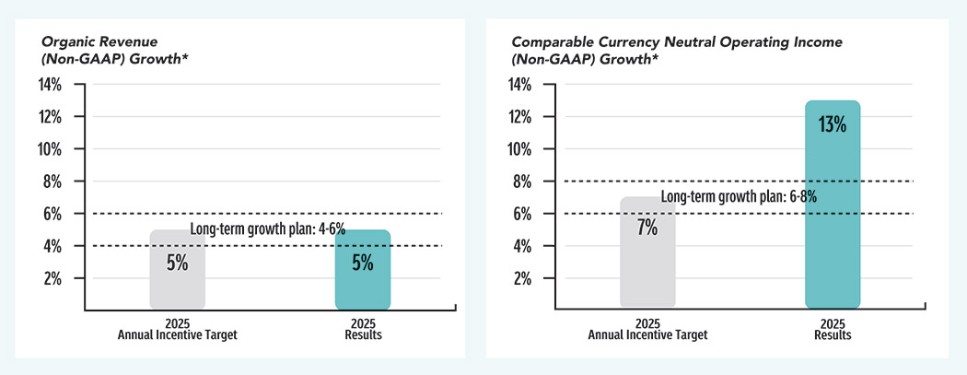
* | Organic revenues is a non-GAAP financial measure that excludes or has otherwise been adjusted for the impact of acquisitions and divestitures, as applicable, and the impact of fluctuations in foreign currency exchange rates. Organic revenue (non-GAAP) growth is referred to as “net operating revenue growth” in our annual incentive program. Comparable currency neutral operating income is a non-GAAP financial measure that excludes or has otherwise been adjusted for items impacting comparability and the impact of fluctuations in foreign currency exchange rates. Comparable currency neutral operating income (non-GAAP) growth, further adjusted for structural changes, is referred to as “operating income growth” in our annual incentive program. These further structural adjustments to comparable currency neutral operating income (non-GAAP) growth resulted in 14% growth as measured under the annual incentive program for “operating income growth.” See Annex C on page 109 for reconciliations of non-GAAP financial measures to our results as reported under GAAP. For more information on the non-GAAP financial measures chosen by the Committee for our Named Executive Officers’ compensation programs, see page 53. |
The Coca-Cola Company | 48 | 2026 Proxy Statement |
| | | | | | | | | | |||||||
| Our |
| Voting |
| Governance |
| Share |
| Compensation |
| Audit Matters |
| Shareowner |
| Annexes |
|
With respect to long-term incentives, performance under the 2023-2025 PSU program reflects the strong momentum the Company has built over the past several years. All financial performance measures in the PSU program exceeded the maximum performance levels. Our sustainability measures reflected threshold performance or below. As a result, the 2023-2025 PSU program delivered an above-target payout. In addition, the relative TSR modifier was applied for the performance period, as the Company’s TSR ranked above the 75th percentile of its TSR comparator group. For more information, see page 56.
Returns to Shareowners
The Company remains focused on achieving long-term earnings per share growth. In 2025, earnings per share reached $3.04, representing an increase of approximately 35% since 2021. In February 2026, the Company announced a 3.9% increase in the dividend per share of its Common Stock, marking the Company’s 64th consecutive annual dividend increase. In 2025, the Company returned $8.8 billion to shareowners in the form of dividends.
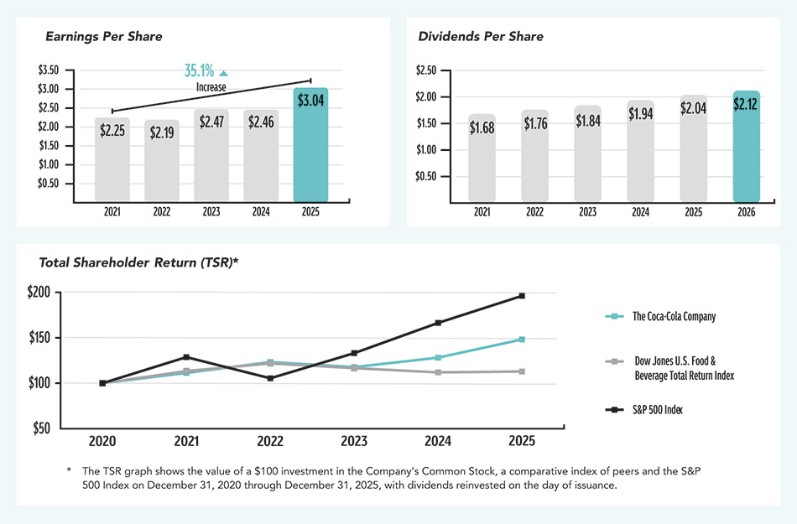
2025 Compensation Outcomes
The Committee is accountable for making executive compensation decisions that are in the best long-term interests of our shareowners. We strive to achieve this through adherence to the Company’s compensation philosophy and core principles and by carefully considering feedback received from shareowners to continually enhance our compensation programs. In 2025, 94% of our CEO’s total direct compensation and 89% of the other Named Executive Officers’ total direct compensation, on average, was performance-based.
The below charts show the breakdown of the elements of total direct compensation for our Named Executive Officers in 2025.
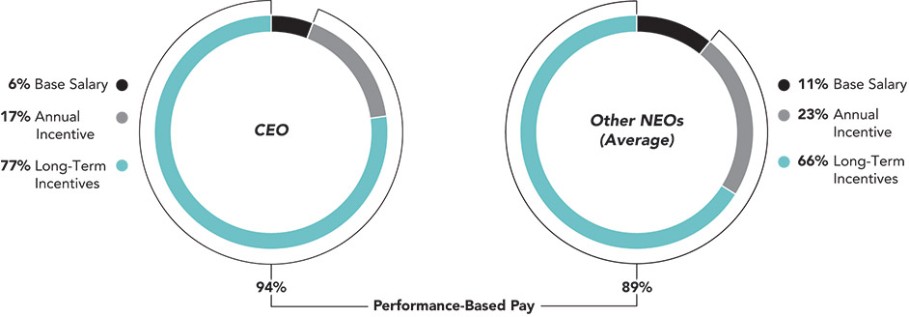
The Coca-Cola Company | 49 | 2026 Proxy Statement |
| | | | | | | | | | |||||||
| Our |
| Voting |
| Governance |
| Share |
| Compensation |
| Audit Matters |
| Shareowner |
| Annexes |
|
OUR COMPENSATION PHILOSOPHY AND CORE PRINCIPLES
| | While we consider many factors in our pay decisions, we are guided by the following philosophies and core principles: | ||||
| | | | | | |
| |
| Pay for Performance | |
| Alignment with Shareowners |
| | The vast majority of pay for executive officers is at-risk and performance-based, with measures aligned to the Company’s long-term growth plan. In 2025, performance was assessed by evaluating the following: ● The Company’s financial performance, including results against long-term growth targets ● The Company’s non-financial performance, including results against predefined frameworks ● Return to shareowners over time, both on an absolute basis and relative to our peers | | Our compensation programs are designed to align our executives’ interests with those of our shareowners. The vast majority of pay for our Named Executive Officers is tied to Company performance. We also maintain stock ownership guidelines for executive officers and remain committed to responsible equity usage. Our robust governance practices enable us to be good stewards of equity incentives. | ||
| | | | | ||
| |
| Simplicity and Transparency | |
| Development of Programs that Drive Long-Term Profitable Growth |
| | Our compensation programs include clear performance measures and line of sight for employees. | | We invest in and reward talent with the greatest potential to drive the long-term profitable growth of our Company, while holding employees accountable to the Company’s strategy and values. | ||
| | | | | ||
| |
| Recognition of Individual Performance | |
| Consideration of the Coca-Cola System |
| | Our compensation programs reward individual performance in a number of areas that contribute to our growth and success. For example, the Company’s executives are responsible for achievement of non-financial goals, which are critical to the long-term success of our business, reflect our external responsibility as global leaders, and add value for our shareowners and other stakeholders. Company executives’ individual performance against our cultural values and leadership behaviors is taken into consideration in our compensation programs. Executives are thus motivated to deliver results that align with Company values and shareowner interests. | | Our employees are required to operate and have influence in the context of our broad and complex global Coca-Cola system, which includes our approximately 200 bottling partners around the world. While the Company had $47.9 billion in 2025 reported net operating revenues and employed approximately 65,900 people as of December 31, 2025, the Coca-Cola system generates more than $180 billion in annual revenues, operates in more than 200 countries and territories, and employs approximately 700,000 people. Our executives and employees must not only manage our business but also support our bottling partners and other partners across the globe. System-wide alignment and a shared vision of success are critical to driving long-term growth. | ||
| | | | | ||
| |
| Alignment of Approach Across the Workforce | |||
| | Our people, at every level, are our most important asset. The Committee takes seriously the Company’s goal to structure pay programs, from the CEO down through the entire workforce, in a manner that reinforces the Company’s growth agenda. The Committee also understands that CEO pay should be perceived as reasonable relative to overall employee pay. The compensation approach used to set CEO and Named Executive Officer pay is the same approach used in determining compensation for the broader workforce, including pay competitiveness and the use of performance-based measures that reward exceptional financial performance. In its discretion in determining CEO and Named Executive Officer pay, the Committee may also consider other factors that it regularly reviews, including shareowner and employee feedback, the shareowner advisory vote on executive compensation, and CEO pay ratio, among other things. | ||||
| | | | | ||


The Coca-Cola Company | 50 | 2026 Proxy Statement |
| | | | | | | | | | |||||||
| Our |
| Voting |
| Governance |
| Share |
| Compensation |
| Audit Matters |
| Shareowner |
| Annexes |
|
Talent and Compensation Committee Year-Round Process
We have a robust year-round engagement, planning, review and approval process to oversee the Company’s strategies relating to executive compensation, talent, leadership and culture. When evaluating pay reported in the 2025 Summary Compensation Table against Company performance, it is important to consider the timing of compensation decisions and to identify which performance period informs each of the annual and long-term incentive awards. For instance:
| ● | Annual incentive awards reported for 2025 were decided in February 2026 and reflect performance throughout 2025 against targets and goals set in February 2025; and |
| ● | Long-term incentive awards reported for 2025 were granted in February 2025, with vesting over a three- to four-year period, and are designed to incentivize and reward the individual’s potential to drive future growth for the Company. |
Highlights from our 2025 agenda are set forth below.
JANUARY - MARCH |
| APRIL - JUNE |
● Reviewed overall robustness and rigor of performance measures and targets ● Finalized performance measures and targets for upcoming performance cycles ● Approved annual and long-term incentive award opportunities for executive officers ● Reviewed key components of talent, leadership and culture strategy | | ● Reviewed results of “say-on-pay” advisory vote ● Conducted shareowner outreach to gather feedback on the “say-on-pay” advisory vote |
| |
|
OCTOBER - DECEMBER |
| JULY - SEPTEMBER |
● Reviewed key components related to talent, leadership and culture strategy ● Reviewed risk assessment of compensation programs ● Benchmarked compensation program designs and pay opportunities against the compensation comparator group | | ● Reviewed program designs for the upcoming year ● Evaluated and set compensation comparator group to be used for upcoming year |


Summary of Executive Compensation Practices
| What We Do | ||
● Base the vast majority of executive pay on business performance and shareowner returns; pay is not guaranteed ● Align pay outcomes with individual and Company performance ● Set robust incentive targets derived from long-term growth plan ● Maintain an equity burn rate of 0.4% or less | ● Apply share ownership and share retention policies ● Provide limited perquisites with sound business rationale ● Include “double-trigger” change in control provisions in equity awards ● Prohibit short sales, hedging and pledging of Company stock by executive officers and Directors | ● Provide competitive pay opportunities compared to an appropriate set of peer companies ● Measure our relative performance on TSR against a predetermined peer group ● Regularly assess the risk-reward balance of our compensation programs to mitigate undue risks in our programs ● Include clawback provisions in our compensation programs | |
| |||
| What We Don’t Do | ||
● No employment contracts unless required by law ● No dividends or dividend equivalents on unearned PSUs or RSUs | ● No repricing of underwater stock options ● No tax gross-ups for personal aircraft use or financial planning | ● No special change in control severance provisions for executive officers ● No tax gross-ups related to change in control | |
The Coca-Cola Company | 51 | 2026 Proxy Statement |
| | | | | | | | | | |||||||
| Our |
| Voting |
| Governance |
| Share |
| Compensation |
| Audit Matters |
| Shareowner |
| Annexes |
|
ELEMENTS OF EXECUTIVE COMPENSATION
We generally provide three elements of total direct compensation to our Named Executive Officers: base salary, annual incentive and long-term incentive, which are described below. In addition, we provide limited perquisites (see page 59) and standard retirement and benefit plans (see page 62).
| | Element | | Form | | Key Features |
| | Base Salary | | Cash | | Fixed cash compensation based on the market-competitive value of the skills and knowledge required for each role. Base salary is reviewed and adjusted when appropriate to maintain market competitiveness. Increases in base salary are not automatic or guaranteed. |
Performance-Based | | Annual Incentive | | Cash | | Variable cash compensation designed to reward results from the prior year. The 2025 annual incentive program is based on the following: ● Company and operating unit financial measures (net operating revenue growth and operating income growth) ● Individual performance |
| Long-Term Incentive | | Stock Options | | Equity awards designed to motivate executives and reward potential to drive long-term growth, as well as to align the interests of employees with those of shareowners. Grants for Named Executive Officers are awarded in the form of stock options and PSUs. Performance measures for the PSUs granted in 2025 were as follows: ● Net operating revenue growth ● EPS growth ● Free cash flow ● Relative TSR modifier | |
| | Performance Stock Units (PSUs) | |
Important Facts About Our 2025 Incentive Targets
RIGOR OF INCENTIVE TARGETS | | | CHOICE OF INCENTIVE MEASURES | |
| | | ||
The Committee recognizes the importance of achieving an appropriate balance between rewarding executives for strong performance over both the short term and long term and establishing realistic but rigorous targets that continue to attract, motivate and retain executives. In 2025, the Committee continued to dedicate time to assess the robustness and rigor of our incentive targets, considering the following: ● Performance levels in line with our long-term growth plan and shareowner expectations ● The likelihood of achieving various levels of performance, including consideration of macroeconomic factors ● Measures, program designs and results at companies in our comparator group | | The key financial measures in our incentive plans align with our growth strategy, are widely used to evaluate the success of our business by investors, are prevalent among our compensation comparator group, and are highly correlated with long-term value creation. To evaluate performance in a manner consistent with the way management evaluates our operating results and trends, the key financial measures in our annual and long-term incentive plans are measured on a non-GAAP basis. We make certain adjustments when calculating these results, including adjustments to account for the impact of foreign currency exchange rate fluctuations, items impacting comparability, changes in financial accounting reporting regulations, and certain acquisitions and divestitures. Our long-term incentive program is also adjusted for impacts arising from the Statutory Notice of Deficiency from the United States Internal Revenue Service (“IRS”) received on September 17, 2015 (the “2015 Notice of Deficiency”), if applicable. Our incentive targets are currency neutral because the Committee believes these targets should measure the underlying results of the business and that business leaders should be encouraged to make decisions that help drive long-term sustainable growth rather than those which address short-term currency fluctuations. This philosophy has been in place for many years, and we review this regularly, as it is an important concern for global companies like ours with significant exposure to foreign currency exchange rate fluctuations. | ||
| | | | |
Base Salary
Base salary is fixed cash compensation delivered in return for day-to-day job responsibilities, leadership skills and experience. Market-competitive base salaries help attract, motivate and retain executive talent. Base salary is not intended to reward past performance.
The Coca-Cola Company | 52 | 2026 Proxy Statement |
| | | | | | | | | | |||||||
| Our |
| Voting |
| Governance |
| Share |
| Compensation |
| Audit Matters |
| Shareowner |
| Annexes |
|
The Committee annually reviews the base salaries of our Named Executive Officers and adjusts when appropriate based on market competitiveness and other relevant factors. The Committee may also make periodic adjustments in connection with promotions or changes in responsibility.
The table below outlines the base salaries for the Named Executive Officers as of December 31, 2024 and December 31, 2025, respectively. In connection with Mr. Braun’s promotion to Executive Vice President and Chief Operating Officer, his base salary was increased, effective January 1, 2025. In April 2025, adjustments were made to the salaries of Messrs. Murphy and Arroyo and Ms. Mann to align with market competitiveness.
| | | | | | |
| | Base Salary | | Base Salary | ||
| | (12/31/2024) | | (12/31/2025) | ||
Name | | ($) | | ($) | ||
Mr. Quincey* | | $ | 1,675,000 | | $ | 1,675,000 |
Mr. Murphy | |
| 1,108,640 | |
| 1,152,986 |
Mr. Arroyo | |
| 724,130 | |
| 738,613 |
Mr. Braun | |
| 735,000 | |
| 1,050,000 |
Ms. Mann | |
| 730,080 | |
| 900,000 |
Effective March 31, 2026, (i) in connection with Mr. Quincey’s transition to Executive Chairman of the Board, his base salary will be $1,200,000; and (ii) in connection with Mr. Braun’s appointment to Chief Executive Officer of the Company, his base salary will be $1,450,000.
Annual Incentive Compensation
Annual cash incentives are determined under the Annual Incentive Plan and are designed to reward annual performance and individual contributions that support business results and strategy. Awards for our Named Executive Officers are determined based on a formula with predefined financial measures (the “Business Performance Factor”), aligned with the Company’s long-term growth strategy, as well as each executive’s individual performance (the “Individual Performance Amount”).
| | | | |||||
| | | | | | | | |
BASE SALARY |
| TARGET PERCENTAGE |
| BUSINESS PERFORMANCE FACTOR |
| INDIVIDUAL PERFORMANCE AMOUNT |
| ANNUAL INCENTIVE AMOUNT |
| | | |


Business Performance Factor
Actual awards under the Annual Incentive Plan for the Named Executive Officers are primarily driven by the Business Performance Factor, which follows a formulaic calculation utilizing financial performance targets determined at the outset of the performance period. The Committee selects financial performance measures and targets that it believes are consistent with the Company’s strategic goals and which are designed to be challenging but achievable.
For 2025, the Committee selected net operating revenue growth and operating income growth as the financial performance measures used to determine the Business Performance Factor.
Historically, our philosophy in determining appropriate annual incentive targets has been to set targets at the midpoint of the Company’s publicly stated long-term growth plan of 4% to 6% for organic revenue (non-GAAP) growth and 6% to 8% for comparable currency neutral operating income (non-GAAP) growth. This aligns our compensation programs to our investors’ growth and value creation expectations. Consistent with this practice, for 2025, the Committee set the targets at the midpoint of the Company’s long-term growth plan for both metrics.
For Messrs. Quincey, Murphy, Arroyo and Braun, the Committee approved a Business Performance Factor design that was weighted 50% for overall Company net operating revenue growth and 50% for overall Company operating income growth (together, “Overall Company Performance”). For Ms. Mann, who had responsibility for the Company’s North America operating unit (“NAOU”) in 2025, the Committee approved a Business Performance Factor design that was weighted 2/3 for Overall Company Performance and 1/3 for the performance of the NAOU, measured by the net operating revenue growth and operating income growth of the NAOU, each weighted equally.
Actual net operating revenue and operating income growth results were rounded to the nearest half percent. The payout for each performance measure was then weighted to determine the final Business Performance Factor. For 2025, the Business Performance Factor could range from 0% to 200% of the target incentive: a minimum threshold must have been achieved, and the maximum performance level was set to be difficult.
The Coca-Cola Company | 53 | 2026 Proxy Statement |
| | | | | | | | | | |||||||
| Our |
| Voting |
| Governance |
| Share |
| Compensation |
| Audit Matters |
| Shareowner |
| Annexes |
|
The overall financial targets and results for the Company for 2025 were as follows:
Performance Measure | Target* | Actual Performance | Result | Weighting | Weighted Result |
| | | | | |
Net Operating Revenue |
| 5.0% | 100% |
| 50% |
| | | | |
|
| | | | | |
Operating Income Growth** |
| 14.0% | 200% |
| 100% |
| | | | |
|
Business Performance Factor | 150% | ||||






* | The specific targets for the NAOU are not disclosed because they relate to business operations in a specific geography, and disclosure could result in competitive harm. |
** | Net operating revenue growth, as outlined in our annual incentive program, is organic, which is a non-GAAP financial measure that excludes or has otherwise been adjusted for the impact of acquisitions, divestitures and structural changes, as applicable, and the impact of fluctuations in foreign currency exchange rates. Operating income growth, as outlined in our annual incentive program, is comparable currency neutral (adjusted for structural changes), which is a non-GAAP financial measure that excludes or has otherwise been adjusted for items impacting comparability, the impact of fluctuations in foreign currency exchange rates, and the impact of structural changes, as applicable. Items impacting comparability include asset impairments, transaction gains/losses, restructuring and other items, and certain tax matters. Structural changes generally refer to acquisitions and divestitures of bottling operations, including the impact of intercompany transactions between our operating segments. Operating income growth of 14%, as measured under our annual incentive program, differs from comparable currency neutral operating income (non-GAAP) growth of 13% (see page 48) due to adjustments for these structural changes. Using these adjusted measures of net operating revenue growth and operating income growth is appropriate because they provide a more consistent comparison against the prior year. |
The base salary, target annual incentive and 2025 Business Performance Factor for each of our Named Executive Officers were as follows:
| | | | | | | | | | | |
| | | | | | | Target | | Business | | |
| | Base Salary | | | | Annual | | Performance | | ||
| | (12/31/2025) | | Target | | Incentive | | Factor | | ||
Name | | ($) | | (%) | | ($) | | (%) | | ||
Mr. Quincey* | | $ | 1,675,000 |
| 200 | % | $ | 3,350,000 |
| 150 | % |
Mr. Murphy | |
| 1,152,986 |
| 150 | % |
| 1,729,479 |
| 150 | % |
Mr. Arroyo | |
| 738,613 |
| 125 | % |
| 923,266 |
| 150 | % |
Mr. Braun* | |
| 1,050,000 |
| 175 | % |
| 1,837,500 |
| 150 | % |
Ms. Mann** | |
| 900,000 |
| 100 | % |
| 900,000 |
| 152 | % |
* | Effective March 31, 2026, (i) in connection with Mr. Quincey’s transition to Executive Chairman of the Board, his base salary will be $1,200,000 and his target annual incentive will remain 200%; and (ii) in connection with Mr. Braun’s appointment to Chief Executive Officer of the Company, his base salary will be $1,450,000 and his target annual incentive will be 200%. |
** | For Ms. Mann, the Business Performance Factor was weighted 2/3 for Overall Company Performance (at 150%) and 1/3 for the performance of the NAOU, measured by the net operating revenue growth and operating income growth of the NAOU (at 155%). |
Individual Performance Amount
For the Individual Performance Amount, the Committee considers each Named Executive Officer’s individual contributions to overall Company results and operational measures, achievement of key strategic objectives and contributions toward evolving the Company’s organization and culture. An Individual Performance Amount may be awarded based on an assessment of an executive’s individual performance throughout the year, as guided by the individual’s scorecard. The scorecard provides a framework to clearly define specific action items in support of the Company’s key objectives. The maximum percentage of an individual’s target award that could have been awarded for individual performance in 2025 was 30%. No Named Executive Officer received an Individual Performance Amount for 2025.
The Coca-Cola Company | 54 | 2026 Proxy Statement |
| | | | | | | | | | |||||||
| Our |
| Voting |
| Governance |
| Share |
| Compensation |
| Audit Matters |
| Shareowner |
| Annexes |
|
Long-Term Incentive Compensation
The Company’s long-term incentive compensation programs are designed to reward performance over the longer term and align the interests of employees with those of shareowners. In 2025, all long-term incentive awards were equity-based for our Named Executive Officers.
Long-Term Incentive Awards: Amounts and Performance Measures
The Committee sets awards for long-term incentive compensation at the executive officer level. In 2025, these awards were informed by market survey data and the pay practices of our compensation comparator group. The Committee does not target a specific percentile ranking against our compensation comparator group and may grant long-term incentive awards based on a variety of factors, including individual performance and to reflect support of the larger Coca-Cola system.
Once the value of the 2025 long-term incentive award was determined, the Committee granted the long-term incentive award to our executive officers as a combination of PSUs, with a three-year performance and vesting period, and stock options, with a four-year pro rata vesting period. The Committee determined that PSUs and stock options, rather than RSUs, were the most appropriate equity vehicles for our executive officers, as they put a greater portion of total compensation at risk if the Company does not deliver growth to its shareowners. Due to the rules governing how the grant date fair value of long-term incentive awards must be calculated for GAAP purposes, the 2025 Summary Compensation Table may not reflect the same PSU and stock option values described below.
How PSU Amounts and Targets Were Determined
| ● | To determine the number of PSUs awarded, the target dollar value of the PSU grant was divided by a 30-day average closing stock price. |
| ● | For PSU awards granted in 2025, performance measures were equally weighted among net operating revenue growth, earnings per share growth and free cash flow. Performance targets for growth in these measures were derived from our long-term growth plan and set by the Committee after a detailed review, which included benchmarking performance and evaluating the practices of comparator companies. |
| ● | For PSU awards granted in 2025, participants would receive 50% of the award at the threshold level of performance per measure, 100% of the award at the target level of performance per measure and 200% of the award at the maximum level of performance per measure, prior to application of the relative TSR modifier. |
PSU Relative TSR Modifier
● The number of shares earned from PSU awards will be reduced or increased if TSR over the performance period, relative to a predefined TSR comparator group, falls outside of a predefined range. Specifically, after the performance results are certified, the award will be modified up or down as shown in the graphic to the right, if applicable. ● For awards granted in 2023 and after, the TSR comparator group is comprised of the companies listed in the S&P 500 Consumer Staples Index. ● If there is no change to the PSU payout because the relative TSR modifier is not applicable, PSU payouts can range from 0% to 200%. If the threshold level or greater is achieved for each of the performance measures, and if the relative TSR modifier is applicable, PSU payouts can range from 38% to 250%. | |
|
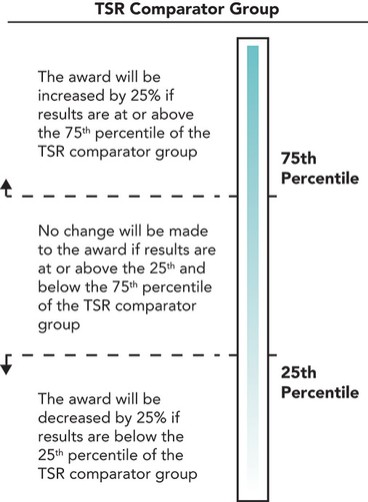
The Coca-Cola Company | 55 | 2026 Proxy Statement |
| | | | | | | | | | |||||||
| Our |
| Voting |
| Governance |
| Share |
| Compensation |
| Audit Matters |
| Shareowner |
| Annexes |
|
How Stock Option Award Amounts Were Determined
| ● | When determining the number of stock options awarded, a Black-Scholes value is calculated, and floor and ceiling “guardrails” are then calculated based on a 30-day average closing stock price. These guardrails help manage our burn rate and mitigate against excessively high or low Black-Scholes values. |
| ● | For stock option grants in 2025, our floor guardrail, which valued options at 20% of the 30-day average closing stock price, was used to determine the number of stock options to grant by dividing the target dollar value for the grant by this guardrail value. This resulted in fewer stock options being granted than would have been granted using a pure Black-Scholes model. |
2025 Long-Term Incentive Awards
The Committee approved the below long-term incentive awards for the Named Executive Officers in February 2025. For Messrs. Quincey, Murphy and Braun, the Committee allocated the value of the long-term incentive awards equally between PSUs and stock options. All other employees eligible for long-term incentive awards, including Mr. Arroyo and Ms. Mann, were given the opportunity to elect the allocation of their long-term incentive award within predefined parameters. In line with their respective elections, the Committee allocated the value of the long-term incentive awards for Mr. Arroyo as 2/3 PSUs and 1/3 stock options, and equally between PSUs and stock options for Ms. Mann.
| | | | | | | |
| | | | | 2025‑2027 | | |
| | 2025 Long-Term | | Performance | | | |
| | Incentive Award | | Share Units | | Options | |
Name | | ($) | | (#) | | (#) | |
Mr. Quincey | | $ | 22,868,364 |
| 172,970 |
| 864,850 |
Mr. Murphy | |
| 6,913,669 |
| 52,293 |
| 261,466 |
Mr. Arroyo | |
| 3,840,114 |
| 37,540 |
| 93,878 |
Mr. Braun | |
| 6,913,669 |
| 52,293 |
| 261,466 |
Ms. Mann | |
| 5,318,255 |
| 40,226 |
| 201,128 |
Status of PSU Programs
2023-2025 PSUs
(1) (2) (3) (4) (5)
Weighting | | Measure | Threshold | Target | Maximum | Status | |||
| | Compound Annual Growth in Net Operating Revenues | 3.0% | 5.0% | 7.0% | ● Net operating revenue compound annual growth, EPS compound annual growth and cumulative free cash flow were each above the maximum performance level. ● Packaging was below the threshold performance level. Water was at the threshold performance level. ● Company performance resulted in an initial payout calculation of 183%. In addition, the relative TSR modifier was applied, as total shareowner return was above the 75th percentile for the performance period. ● Final payout was certified in February 2026 at 229%. | |||
30% | | | | | | | |||
|
| | |||||||
| | | | | | | |||
| | | | | | ||||
| | | | | | ||||
| | Compound Annual Growth in EPS | 6.0% | 8.0% | 10.0% | ||||
30% | | | | | | | |||
|
| | |||||||
| | | | | | | |||
| | | | | | ||||
| | | | | | ||||
| | Cumulative Free Cash Flow (in billions) | $26.2 | $30.2 | $34.2 | ||||
30% | | | | | | | |||
|
| | |||||||
| | | | | | | |||
| | | | | | ||||
| | | | | | ||||
| | Packaging: Global rPET Usage Rate | 22.5% | 26.5% | 31.0% | ||||
5% | | | | | | | |||
|
| | |||||||
| | | | | | | |||
| | | | | | ||||
| | | | | | ||||
| | Water: Watershed Leadership Locations Replenishment Rate | 89.1% | 95.0% | 105.1% | ||||
5% | | | | | | | |||
|
| | |||||||
| | | | | | | |||
| | | | | | | |||

The Coca-Cola Company | 56 | 2026 Proxy Statement |
| | | | | | | | | | |||||||
| Our |
| Voting |
| Governance |
| Share |
| Compensation |
| Audit Matters |
| Shareowner |
| Annexes |
|
2024-2026 PSUs
(1) (2) (3) (4) (5)
Weighting | | Measure | Threshold | Target | Maximum | Status | |||
| | Compound Annual Growth in Net Operating Revenues | 3.0% | 5.0% | 7.0% | ● Payout is projected to be above target. ● Company performance over the remaining year of the performance period will determine the number of shares earned, if any. ● Results will be certified in February 2027, including applying the relative TSR modifier, if applicable. | |||
30% | | | | | | | |||
|
| | |||||||
| | | | | | | |||
| | | | | | ||||
| | | | | | ||||
| | Compound Annual Growth in EPS | 6.0% | 8.0% | 10.0% | ||||
30% | | | | | | | |||
|
| | |||||||
| | | | | | | |||
| | | | | | ||||
| | | | | | ||||
| | Cumulative Free Cash Flow (in billions) | $28.9 | $32.9 | $36.9 | ||||
30% | | | | | | | |||
|
| | |||||||
| | | | | | | |||
| | | | | | ||||
| | | | | | ||||
| | Packaging: Global rPET Usage Rate | 23.5% | 27.5% | 32.0% | ||||
5% | | | | | | | |||
|
| | |||||||
| | | | | | | |||
| | | | | | ||||
| | | | | | ||||
| | Water: Watershed Leadership Locations Replenishment Rate | 100.0% | 110.0% | 115.1% | ||||
5% | | | | | | | |||
|
| | |||||||
| | | | | | | |||
| | | | | | | |||
2025-2027 PSUs
(1) (2) (3) (4)
Weighting | | Measure | Threshold | Target | Maximum | Status | |||
| | Compound Annual Growth in Net Operating Revenues | 3.0% | 5.0% | 7.0% | ● Payout is projected to be above target. ● Company performance over the remaining two years of the performance period will determine the number of shares earned, if any. ● Results will be certified in February 2028, including applying the relative TSR modifier, if applicable. | |||
1/3 | | | | | | | |||
|
| | |||||||
| | | | | | | |||
| | | | | | ||||
| | | | | | ||||
| | Compound Annual Growth in EPS | 6.0% | 8.0% | 10.0% | ||||
1/3 | | | | | | | |||
|
| | |||||||
| | | | | | | |||
| | | | | | ||||
| | | | | | ||||
| | Cumulative Free Cash Flow (in billions) | $31.8 | $35.8 | $39.8 | ||||
1/3 | | | | | | | |||
|
| | |||||||
| | | | | | | |||
| | | | | | | |||
| (1) | Participants receive 50% of the award at the threshold level of performance per measure, 100% of the award at the target level of performance per measure and 200% of the award at the maximum level of performance per measure before the application of the TSR modifier. Results are rounded, and the number of shares is extrapolated on a linear basis between performance levels for net operating revenue growth, EPS growth and cumulative free cash flow. For the environmental sustainability performance measures, if applicable, results are rounded, and the number of shares is not extrapolated between performance levels. |
| (2) | The PSU program provides for comparable currency neutral net operating revenue (non-GAAP) growth to be based on a three-year compound annual growth target tied to Company performance. This measure differs from net operating revenue growth reported under GAAP, primarily due to the impact of currency and items impacting comparability. The calculation of comparable currency neutral net operating revenue (non-GAAP) growth for the 2023-2025 period was adjusted, and the 2024-2026 and 2025-2027 periods will be adjusted, to exclude acquisitions, divestitures and structural changes that are significant to the Company as a whole, if applicable. The 2024-2026 and 2025-2027 periods will also be adjusted to exclude the impact of accounting changes, if applicable, and for any unusual items that are significant to the Company as a whole that are approved by the Committee, if applicable. |
| (3) | The PSU program provides for comparable currency neutral EPS (non-GAAP) growth to be based on a three-year compound annual growth target tied to Company performance. This measure differs from EPS reported under GAAP, primarily due to the impact of currency and items impacting comparability. The calculation of comparable currency neutral EPS (non-GAAP) growth for the 2023-2025 period was adjusted, and the 2024-2026 and 2025-2027 periods will be adjusted, to exclude acquisitions, divestitures and structural changes that are significant to the Company as a whole and impacts resulting from the application of the tax court rulings and/or settlements arising from the 2015 Notice of Deficiency, if applicable. The 2024-2026 and 2025-2027 periods will also be adjusted to exclude the impact of accounting changes, if applicable, and for any unusual items that are significant to the Company as a whole that are approved by the Committee, if applicable. |
The Coca-Cola Company | 57 | 2026 Proxy Statement |
| | | | | | | | | | |||||||
| Our |
| Voting |
| Governance |
| Share |
| Compensation |
| Audit Matters |
| Shareowner |
| Annexes |
|
| (4) | The PSU program provides for free cash flow (non-GAAP) to be based on a cumulative three-year absolute target amount tied to Company performance. Free cash flow is a non-GAAP financial measure that represents net cash provided by operating activities less purchases of property, plant and equipment. The net income component of net cash provided by operating activities for the 2023-2025 period was adjusted, and the 2024-2026 and 2025-2027 periods will be adjusted, for the impact of currency. Free cash flow (non-GAAP) for the 2023-2025 period was adjusted, and the 2024-2026 and 2025-2027 periods will be adjusted, to exclude acquisitions, divestitures and structural changes that are significant to the Company as a whole and impacts resulting from the application of the tax court rulings and/or settlements arising from the 2015 Notice of Deficiency, if applicable. The 2024-2026 and 2025-2027 periods will be adjusted for the impact of accounting changes and certain cash payments for pension plan contributions, if applicable, and for any unusual items that are significant to the Company as a whole that are approved by the Committee, if applicable. |
| (5) | The PSU program provides for the environmental sustainability performance measure to be equally weighted based on the achievement of predefined goals related to the Company’s water security strategy (watershed leadership locations replenishment rate) and its packaging strategy (global rPET usage rate), both of which strategies were in place for the 2023-2025 period and are expected to be in place for the remainder of the 2024-2026 period. “Watershed leadership locations replenishment rate” is the ratio of replenish project volumetric benefits (located within “leadership locations” minors basins and/or their water supply watersheds) divided by the replenishment required in the “leadership locations” (its total water use less its beneficial wastewater discharge). “Leadership locations” or “high-risk locations” is a Company designation for locations of Coca-Cola system manufacturing facilities that satisfy the criteria of a water risk assessment. “Global rPET usage rate” is defined as the percent of rPET (recycled polyethylene terephthalate) procured for use in our global primary consumer PET packaging (non-refillable PET bottles and refillable PET bottles). The environmental sustainability calculations for the 2023-2025 period were adjusted, and the 2024-2026 period will be adjusted, to exclude acquisitions, divestitures and structural changes that are significant to the Company as a whole, if applicable. The 2024-2026 period will also be adjusted for any unusual items that are significant to the Company as a whole that are approved by the Committee, if applicable. |
Other Long-Term Incentive Awards
The vast majority of equity awards are granted as part of the long-term incentive awards in
From time to time, we establish additional performance-based programs related to specific performance goals to motivate and reward for specific initiatives. No Named Executive Officer received such an award in 2025.
Policies and Practices Related to the Grant of Certain Equity Awards
The Company grants equity awards, including stock options.
Equity Scorecard
We adhere to strong equity governance under The Coca-Cola Company 2024 Equity Plan (the “2024 Equity Plan”). We maintain an annual burn rate of 0.4% or less, which provides greater certainty as to the availability of shares used for equity awards. To manage dilution, it is our intention to use the proceeds from stock option exercises by employees to repurchase shares over time, although such proceeds may at times be used for other corporate purposes. As a result, actual dilution is expected to continue to be less than 1% per year. This approach provides us the flexibility to consider share repurchases in the context of our overall capital allocation strategy. The adjacent chart illustrates our historical burn rate. | | Historical Burn Rate |
|
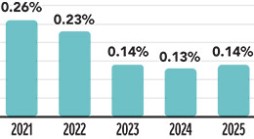
For transparency, we also provide an Equity Scorecard for the Company:
2025 Equity Scorecard
Category | 2025 |
Actual Burn Rate | 0.14% |
Actual Dilution | 0.04% |
Overhang The total number of shares underlying equity awards already granted from the 2024 Equity Plan and other plans in place prior to adoption of the 2024 Equity Plan, plus those available for future grants, on a fully diluted basis. | 5.80% |
| (1) | Calculated by dividing the number of net shares issued to employees during the year by the number of shares of Common Stock outstanding. The number of net shares issued represents the difference between the total number of shares issued and the number of shares repurchased solely using proceeds from employee stock option exercises. Does not include additional share repurchases which further mitigate dilution. |
The Coca-Cola Company | 58 | 2026 Proxy Statement |
| | | | | | | | | | |||||||
| Our |
| Voting |
| Governance |
| Share |
| Compensation |
| Audit Matters |
| Shareowner |
| Annexes |
|
Perquisites and Other Personal Benefits
We provide a limited number of perquisites and other personal benefits to our Named Executive Officers. The table below summarizes and provides the business rationale for each of the perquisites and other personal benefits provided to the Named Executive Officers in 2025. The Committee believes these perquisites are reasonable and consistent with market practice.
For more information about these perquisites and other personal benefits, and their values, see the discussion beginning on page 66.
Category | Business Rationale |
Aircraft Usage | To allow travel time of our Chairman and CEO, our President and Chief Financial Officer and our Executive Vice President and Chief Operating Officer to be used productively for the Company; for security purposes due to the high-profile and global nature of our business and well-recognized brands; and to ensure availability to respond to business priorities from any location around the world. Following the Company’s CEO transition in March 2026, the Executive Chairman, the CEO and the President and Chief Financial Officer will continue to have access to this perquisite. |
International Service Program | To promote global mobility and development opportunities for individuals working outside their home country. |
Financial and Tax Planning | To address complex tax and financial situations of our executive officers. |
Other | Executive physicals are made available to our executive officers. Club membership privileges are provided to Mr. Murphy and Ms. Mann, primarily for business purposes but also for occasional personal purposes. Gifts and other amenities are occasionally provided to our executive officers in connection with certain Company-sponsored meetings and events. |
HOW WE MAKE COMPENSATION DECISIONS
Shareowner Engagement and Results of 2025 Advisory Vote on Executive Compensation
The Company has a long-standing shareowner outreach program and routinely interacts with shareowners on a number of matters, including executive compensation (see page 36).
The Committee takes the feedback from these engagement efforts, as well as the results of our “say-on-pay” proposals, seriously. At the 2026 Annual Meeting, we are again holding an advisory vote to approve executive compensation and will continue to consider the results of the advisory vote when making future compensation decisions. Last year, the Company’s say-on-pay proposal received support from approximately 92% of the votes cast. | | 2025 SAY-ON-PAY RESULTS |
| ~92% approval |
Through our continued focus on engagement, we have confirmed that shareowners generally approve of our pay-for-performance philosophy and the design of our executive compensation programs. In these engagements, we have committed to continue to maintain our focus on designing programs from a pay-for-performance perspective and to follow our strong governance practices. We remain encouraged by the ongoing feedback we receive from shareowners and are committed to continuing our shareowner outreach program as it relates to our executive compensation programs.
Decision-Making Process
Role of the Committee
The Committee reviews and discusses the Board’s annual evaluation of the Chairman and CEO and makes preliminary determinations about his base salary, annual incentive, long-term incentive compensation, and other awards as appropriate. The Committee then discusses the compensation recommendations with the full Board and approves final compensation decisions after this discussion.
Role of the Chief Executive Officer
For the other Named Executive Officers, the CEO considers performance and makes individual recommendations to the Committee on base salary, annual incentive, long-term incentive compensation, and other awards as appropriate. The Committee reviews, discusses, modifies and approves, as appropriate, these compensation recommendations.
Committee Resources and Tools
The Committee uses several resources and tools, including data about market competitiveness, to make compensation decisions in line with our compensation philosophy.
The Coca-Cola Company | 59 | 2026 Proxy Statement |
| | | | | | | | | | |||||||
| Our |
| Voting |
| Governance |
| Share |
| Compensation |
| Audit Matters |
| Shareowner |
| Annexes |
|
Compensation Comparator Group
We use a comparator group of companies when making certain compensation decisions. This comparator group is used as a reference point, but compensation paid at other companies is only one factor in the decision-making process. As noted above, our employees operate in the much larger Coca-Cola system, but when comparing size with comparator companies, we utilize only the net operating revenues and market capitalization of the Company. In collaboration with the Committee’s compensation consultant, Meridian Compensation Partners, LLC (“Meridian”), we routinely review the selection criteria and companies in our comparator group.
The table below shows our criteria for choosing the compensation comparator group and how such group is used.
| | | | | | | |
| | | Compensation Comparator Group Considerations | ||||
| | | | | | | |
| | | How We Chose the Compensation Comparator Group ● Comparable size to the Company based on net operating revenues and market capitalization ● Major global presence with sales and operations outside of the United States ● Large consumer products business ● Market-leading brands or category positions as defined by Interbrand ● Financially strong companies ● Available compensation data | | How We Use the Compensation Comparator Group* ● As an input in developing base salary ranges, annual incentive targets and long-term incentive award ranges ● To evaluate share utilization by reviewing overhang levels and annual burn rate ● To benchmark the form, mix and design of equity incentives awarded to employees ● To benchmark share ownership guidelines ● To assess the competitiveness of total direct compensation awarded to executive officers ● To assess talent and recruitment practices ● To compare Company performance and validate whether executive compensation programs are aligned with Company performance ● As an input in designing compensation plans, benefits and perquisites | ||
| | | | | | | |
| | | 2025 Compensation Comparator Group** | | | ||
| | | ● Abbott Laboratories ● Archer-Daniels-Midland Company ● Colgate-Palmolive Company ● Danone S.A. ● Intel Corporation ● Johnson & Johnson | | ● Kimberly-Clark Corporation ● The Kraft Heinz Company ● McDonald’s Corporation ● Mondelēz International, Inc. ● Nestlé S.A. ● NIKE, Inc. | | ● PepsiCo, Inc. ● Pfizer Inc. ● Philip Morris International Inc. ● The Procter & Gamble Company ● Starbucks Corporation ● Unilever PLC |
| | | | | | | |
| | | * Since some of the comparator group companies are not U.S.-based, a subgroup of the companies may be used for some purposes when data is not publicly available for the non-U.S.-based companies. ** In 2025, in collaboration with Meridian, the Committee approved the following updates to the compensation comparator group to be effective in 2026: the addition of Anheuser-Busch InBev SA/NV and the removal of Danone S.A. and Intel Corporation. | ||||
| | | | | | | |
Role of the Compensation Consultant
Compensation Consultant Independence
The Committee is authorized by its charter to employ independent compensation consultants and other advisors. In 2025, the Committee engaged Meridian to serve as its independent consultant with respect to executive compensation programs. Meridian reports directly to the Committee.
In accordance with the Committee’s Independent Compensation Consultant Policy (the “ICC Policy”), prior to the retention of a compensation consultant (or any other external advisor), and annually thereafter, the Committee assesses the independence of the compensation consultant. Under the ICC Policy, a consultant is considered independent if:
| ● | The individual consultant and any consulting firm or organization that employs the consultant are independent of the Company; |
| ● | The individual consultant does not provide services or products of any kind to the Company or its affiliates or to their management, other than in its capacity as an advisor to the Board and its committees; and |
| ● | The consulting firm or individual consultant does not provide any other services to the Company without the prior written consent of the Committee. |
The Coca-Cola Company | 60 | 2026 Proxy Statement |
| | | | | | | | | | |||||||
| Our |
| Voting |
| Governance |
| Share |
| Compensation |
| Audit Matters |
| Shareowner |
| Annexes |
|
The Committee assessed Meridian’s independence under the ICC Policy, including considering the following factors specified in the NYSE listing standards: (i) the provision of other services by the consulting firm to the Company; (ii) the amount of fees paid as a percentage of the total revenue of the consulting firm; (iii) the policies and procedures of the consulting firm that are designed to prevent conflicts of interest; (iv) any business or personal relationship of the consultant with a member of the Committee; (v) any stock of the Company owned by the consultant; and (vi) any business or personal relationship of the consultant or consulting firm with an executive officer of the Company. Meridian provided the Committee with confirmation of its independent status under the ICC Policy. Based on this evaluation, the Committee has determined that Meridian met the criteria for independence.
COMPENSATION CONSULTANT DUTIES | |
| |
● Reports directly to the Committee with regular interface with the Committee Chair ● Attends all meetings of the Committee, including executive sessions without management present ● Reviews the Company’s executive compensation strategy and programs to ensure appropriateness and market competitiveness ● Provides research, data analyses, survey information and design expertise in developing compensation programs for executives and incentive programs for eligible employees ● Regularly updates the Committee on market trends, changing practices, and legislation pertaining to executive compensation and benefits ● Advises the Committee on the appropriate comparator group for compensation and benefit programs | |
Risk Considerations
| ● | The Committee reviews the risks and rewards associated with the Company’s compensation programs. The programs are designed with features that the Committee believes mitigate risk without diminishing the incentive nature of the compensation. Our compensation programs encourage and reward prudent business judgment and appropriate risk-taking over both the short term and the long term. |
| ● | The Company’s incentive compensation programs contain appropriate risk mitigation features, including award caps, multiple performance measures, clawback features and ranges of awards. In addition, the share ownership and retention guidelines mitigate risk. |
| ● | In 2025, the Company conducted, and both the compensation consultant and the Committee reviewed, a global risk assessment of our compensation programs. The risk assessment included conducting a global inventory of incentive plans and programs and considered factors such as the plan measures, number of participants, maximum payments and risk mitigation factors. Management and the Committee do not believe that any of the Company’s compensation programs create risks that are reasonably likely to have a material adverse impact on the Company. As such, the Company did not make any material adjustments to its compensation policies and practices as a result of the global risk assessment. |
ADDITIONAL COMPENSATION INFORMATION
Share Ownership Guidelines
● Share ownership guidelines align executives’ long-term financial interests with those of shareowners. ● All Named Executive Officers are in compliance with the share ownership guidelines. ● Shares are valued based on the average closing price of Common Stock for the prior one-year period. ● Stock options do not count toward the ownership guidelines, and PSUs count only after the performance criteria have been met. ● To ensure compliance with the ownership guidelines, the Committee may direct that up to 50% of the annual incentive be withheld if an executive is not compliant. In addition, the Committee may mandate the retention of 100% of net shares after settlement of taxes and transaction fees. | 2025 Share Ownership Guidelines for NEOs |
|
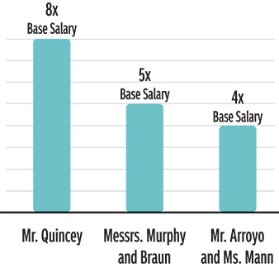
Share Retention Policy
| ● | To ensure that our executives exhibit a strong commitment to Company stock, we have adopted a share retention policy. Our share retention policy applies in conjunction with the share ownership guidelines described above. |
The Coca-Cola Company | 61 | 2026 Proxy Statement |
| | | | | | | | | | |||||||
| Our |
| Voting |
| Governance |
| Share |
| Compensation |
| Audit Matters |
| Shareowner |
| Annexes |
|
| ● | Executive officers who have not yet met their share ownership objective must retain 50% of the shares (after paying taxes) obtained from option exercises or from the release of performance shares or restricted stock awards until the earlier of the date on which the share ownership objective is met or separation from the Company. |
| ● | Limited exceptions apply for donations of stock to charities, educational institutions or family foundations and for sales or divisions of property in the case of divorce, disability or death. The Committee is authorized to grant waivers in exceptional circumstances. |
Hedging, Short Sale and Pledging Policies
| ● | The Insider Trading Policy prohibits our Directors, Section 16 Officers, and certain other insiders from (i) purchasing any financial instruments that are designed to hedge or offset any decrease in the market value of Company securities, (ii) engaging in any short sales of Company securities or (iii) pledging Company securities as collateral for a loan, purchasing Company securities on margin or borrowing against Company securities held in a margin account. |
| ● | For a more detailed discussion of the Company’s hedging, short sale and pledging policies, see page 37. |
Clawback Policy
| ● | The Company maintains a clawback policy to align with listing rules adopted by NYSE as required by the SEC. The policy applies to all executive officers (as defined under the applicable rules) and requires the Company to seek to recoup certain incentive-based compensation, whether cash- or equity-based, from current or former officers and in the event that the Company is required to prepare an accounting restatement due to the material noncompliance of the Company with any financial reporting requirement under the securities laws. |
| ● | In addition, under certain other circumstances, the Company’s incentive compensation, including equity compensation, is subject to recoupment. These clawback provisions apply while an individual is employed and, if an employee separates from employment, until the later of one year from separation and payment of the applicable compensation. These clawback provisions allow the Company to recoup payments if an employee or former employee engages in certain prohibited activities, which include violation of any Company policy (including the Company’s Code of Business Conduct), actions that result in reputational harm to the Company, disclosure of confidential information or trade secrets, acceptance of employment with competitors or solicitation of Company employees. These provisions apply regardless of whether these actions result in an accounting restatement. |
Retirement and Benefit Plans
| ● | Named Executive Officers generally participate in the same retirement and benefit plans as the broader population of non-union employees, as applicable. These plans provide for basic retirement needs and serve as a safety net to protect against the financial catastrophes that can result from illness, disability or death. Additional details of these plans are described in the Summary of Plans in Annex B beginning on page 106. |
| ● | Retirement plans generally include pension plans, retirement savings plans, and deferred compensation plans. There are no special or enhanced pension formulas for the Named Executive Officers. See the 2025 Pension Benefits table on page 71 for the value of accumulated pension benefits for the Named Executive Officers. |
| ● | Benefit plans generally include medical, dental, and disability plans. |
Change in Control
| ● | The Company has change in control provisions in its annual and long-term incentive plans and some of its retirement plans in which the Named Executive Officers participate. Equity plans include “double-trigger” change in control provisions. |
| ● | Change in control provisions apply equally to all plan participants. There are no special change in control agreements or arrangements with any of the Named Executive Officers, and we do not provide a tax gross-up for any change in control situation. |
| ● | The change in control provisions are intended to address the concern that, in the event the Company is considering a change in control transaction, the employees involved in considering the transaction might otherwise be motivated to act in their own interests rather than the interests of the shareowners. |
| ● | For a more detailed discussion of change in control provisions, see the Payments on Termination or Change in Control section beginning on page 73. |
Tax and Accounting Implications of Compensation
We are generally entitled to a U.S. federal income tax deduction with respect to compensation income paid to our service providers, subject to limitation under Tax Code Section 162(m) with respect to certain compensation in excess of $1 million paid in any one year to each of certain of our current and former executive officers. Generally, under GAAP, compensation is expensed as earned. Equity compensation is expensed in accordance with ASC Topic 718, which is generally over the vesting period. While the Committee considers tax and accounting implications as factors when considering executive compensation, they are not the only factors considered. Other important considerations may outweigh tax or accounting considerations. In addition, the Committee reserves the right to establish compensation arrangements that may not be fully tax-deductible under applicable tax laws.
The Coca-Cola Company | 62 | 2026 Proxy Statement |
| | | | | | | | | | |||||||
| Our |
| Voting |
| Governance |
| Share |
| Compensation |
| Audit Matters |
| Shareowner |
| Annexes |
|
cOMPENSATION COMMITTEE REPORT
The Talent and Compensation Committee has reviewed and discussed the Compensation Discussion and Analysis required by Item 402(b) of Regulation S-K with management. Based on such review and discussions, the Talent and Compensation Committee recommended to the Board of Directors that the Compensation Discussion and Analysis be included in this Proxy Statement and incorporated by reference into the Form 10-K.
| | | |
|
|
|
|
CAROLYN EVERSON Chair | BELA BAJARIA | MARIA ELENA LAGOMASINO | MAX LEVCHIN |
|
|
|
|


COMPENSATION COMMITTEE interlocks and insider participation
The Talent and Compensation Committee is composed solely of the four independent Directors listed above. No member of the Talent and Compensation Committee is a current, or during 2025 was a former, officer or employee of the Company or any of its subsidiaries. During 2025, no member of the Talent and Compensation Committee had a relationship that must be described under the SEC rules relating to disclosure of related person transactions. In 2025, none of our executive officers served on the board of directors or compensation committee of any entity that had one or more of its executive officers serving on the Board or the Talent and Compensation Committee.
The Coca-Cola Company | 63 | 2026 Proxy Statement |
| | | | | | | | | | |||||||
| Our |
| Voting |
| Governance |
| Share |
| Compensation |
| Audit Matters |
| Shareowner |
| Annexes |
|
COMPENSATION TABLES
The following tables, footnotes and narratives discuss the compensation of our Named Executive Officers.
2025 Summary Compensation Table
| | | | | | | | | | | | | | | | | | | | | | | | | | |
| | | | | | | | | | | | | | | | | | | Change in | | | | | | | |
| | | | | | | | | | | | | | | | | | | Pension | | | | | | | |
| | | | | | | | | | | | | | | | | | | Value and | | | | | | | |
| | | | | | | | | | | | | | | | Non-Equity | | Nonqualified | | | | | | | ||
| | | | | | | | | | | | | | | | Incentive | | Deferred | | | | | | | ||
| | | | | | | | | | Stock | | Option | | Plan | | Compensation | | All Other | | | | |||||
| | | | Salary | | Bonus | | Awards | | Awards | | Compensation | | Earnings | | Compensation | | Total | ||||||||
Name and Principal Position(1) | | Year | | ($) | | ($) | | ($) | | ($) | | ($) | | ($) | | ($) | | ($) | ||||||||
(a) | | (b) | | (c) | | (d) | | (e) | | (f) | | (g) | | (h) | | (i) | | (j) | ||||||||
James Quincey(2) |
| 2025 | | $ | 1,675,000 | | $ | 0 | | $ | 12,516,109 | | $ | 10,352,255 | | $ | 5,025,000 | | $ | 1,108,486 | | $ | 531,315 | | $ | 31,208,165 |
Chairman of the Board and |
| 2024 | | | 1,656,250 | | | 0 | | | 9,549,022 | | | 8,588,282 | | | 6,365,000 | | | 996,674 | | | 847,056 | | | 28,002,284 |
Chief Executive Officer |
| 2023 | | | 1,600,000 | | | 0 | | | 8,299,550 | | | 7,217,020 | | | 6,080,000 | | | 921,282 | | | 625,056 | |
| 24,742,908 |
John Murphy |
| 2025 | | | 1,141,900 | | | 0 | | | 3,783,921 | | | 3,129,748 | | | 2,594,219 | | | 853,963 | | | 251,955 | | | 11,755,706 |
President and |
| 2024 | | | 1,097,980 | | | 0 | | | 3,103,416 | | | 2,791,195 | | | 3,159,624 | | | 818,601 | | | 232,001 | |
| 11,202,817 |
Chief Financial Officer |
| 2023 | | | 1,055,750 | |
| 0 | |
| 3,227,606 | |
| 2,806,614 | |
| 3,038,100 | |
| 725,785 | |
| 272,290 | |
| 11,126,145 |
Manuel Arroyo(3) |
| 2025 | | | 734,992 | | | 0 | | | 2,716,394 | | | 1,123,720 | | | 1,384,899 | | | 321,641 | | | 412,241 | | | 6,693,887 |
Executive Vice President and | | 2024 | | | 717,168 | | | 0 | | | 2,227,878 | | | 1,002,166 | | | 1,719,809 | | | 299,775 | | | 7,117,056 | |
| 13,083,851 |
Chief Marketing Officer | | 2023 | | | 689,585 | |
| 0 | |
| 1,844,338 | |
| 1,603,782 | |
| 1,653,665 | |
| 276,429 | |
| 587,344 | |
| 6,655,143 |
Henrique Braun(4) |
| 2025 | | | 1,050,000 | | | 0 | | | 3,783,921 | | | 3,129,748 | | | 2,756,250 | | | 479,430 | | | 443,253 | | | 11,642,602 |
Executive Vice President and | | 2024 | | | 726,250 | | | 0 | | | 1,671,066 | | | 1,502,946 | | | 1,837,500 | | | 297,443 | | | 324,601 | |
| 6,359,806 |
Chief Operating Officer |
| 2023 | | | 700,000 | |
| 0 | |
| 1,613,831 | |
| 1,403,312 | |
| 1,662,500 | |
| 321,024 | |
| 1,246,446 | | | 6,947,113 |
Jennifer Mann |
| 2025 | | | 857,520 | | | 0 | | | 2,910,753 | | | 2,407,502 | | | 1,368,000 | | | 343,398 | | | 118,260 | | | 8,005,433 |
Executive Vice President and |
| 2024 | | | 723,060 | | | 0 | | | 1,312,964 | | | 1,180,884 | | | 1,460,160 | | | 183,736 | | | 110,252 | |
| 4,971,056 |
President, North America operating unit |
| 2023 | | | 695,250 | |
| 0 | |
| 1,152,704 | |
| 1,002,361 | |
| 1,333,800 | |
| 264,308 | |
| 65,504 | | | 4,513,927 |
| (1) | Principal position reflects position held as of December 31, 2025. |
| (2) | Effective March 31, 2026, Mr. Quincey will serve as Executive Chairman of the Board. |
| (3) | Effective March 31, 2026, Mr. Arroyo will serve as Executive Vice President and Chief Marketing and Customer Commercial Officer. |
| (4) | Effective March 31, 2026, Mr. Braun will serve as Chief Executive Officer. |
Salary (Column (c))
The amounts reported in the Salary column represent the base salary earned by each of the Named Executive Officers in the applicable year.
Bonus (Column (d))
The amounts reported in the Bonus column represent any cash-based guaranteed or discretionary bonuses, retention bonuses, hiring bonuses, or relocation bonuses not based on any predefined performance targets. No such bonuses were awarded to any of the Named Executive Officers in 2025, 2024 or 2023.
Stock Awards (Column (e))
The amounts reported in the Stock Awards column represent the grant date fair value of stock awards determined pursuant to ASC Topic 718. For 2025, all of the stock awards reported in the Stock Awards column are PSUs granted under the 2024 Equity Plan, which pay in stock if predefined performance targets are met over the applicable performance period.
If a PSU award’s threshold level is not achieved, no shares are earned. For PSU awards granted in 2025, if the threshold level or greater is achieved for each of the performance measures, the number of shares earned ranges from 50% to 200% of the target number of shares. In addition, the PSUs are subject to a relative TSR modifier. The relative TSR modifier will decrease or increase the number of shares earned by 25% if TSR over the performance period relative to a predefined TSR comparator group falls outside of a predefined range. See page 55 for more information about the relative TSR modifier.
The Coca-Cola Company | 64 | 2026 Proxy Statement |
| | | | | | | | | | |||||||
| Our |
| Voting |
| Governance |
| Share |
| Compensation |
| Audit Matters |
| Shareowner |
| Annexes |
|
The 2025 amounts in the Summary Compensation Table above reflect the value of the PSU awards at the target (or 100%) level. The table below provides the potential value of the PSU awards at the threshold, target and maximum levels. The measures, targets and status of the PSU programs are described beginning on page 55.
| | | | | | | | | |
| | 2025‑2027 Performance | |||||||
| | Share Units Granted 02/27/2025 | |||||||
| | Value at Threshold | | Value at Target (100%) | | Value at Maximum | |||
Name | | Level (50%)(1)(2) | | (Reported in Column (e) Above)(1) | | Level (200%)(1) | |||
Mr. Quincey | | $ | 6,258,055 | | $ | 12,516,109 | | $ | 25,032,218 |
Mr. Murphy | | | 1,891,925 | | | 3,783,921 | | | 7,567,843 |
Mr. Arroyo | | | 1,358,197 | | | 2,716,394 | | | 5,432,789 |
Mr. Braun | | | 1,891,925 | | | 3,783,921 | | | 7,567,843 |
Ms. Mann | | | 1,455,377 | | | 2,910,753 | | | 5,821,507 |
| (1) | Pursuant to the relative TSR modifier on PSU awards, the number of shares earned will be decreased or increased by 25% if TSR over the applicable performance period relative to the S&P 500 Consumer Staples Index (see page 55) falls outside of a predefined range. |
| (2) | Assumes threshold achievement for all performance measures. |
For information on the assumptions used by the Company in calculating the value of the awards, see Note 13 to the Company’s consolidated financial statements in the Form 10-K. To see the value actually received by the Named Executive Officers upon vesting of stock in 2025, refer to the 2025 Option Exercises and Stock Vested table on page 70. Additional information on all outstanding stock awards is reflected in the 2025 Outstanding Equity Awards at Fiscal Year-End table beginning on page 69.
Option Awards (Column (f))
The amounts reported in the Option Awards column represent the grant date fair value of stock option awards calculated in accordance with ASC Topic 718. For 2025, all of the stock option awards reported in the Option Awards column were granted under the 2024 Equity Plan.
For information on the assumptions used by the Company in calculating these amounts, see Note 13 to the Company’s consolidated financial statements in the Form 10-K. To see the value actually received upon exercise of options by the Named Executive Officers in 2025, refer to the 2025 Option Exercises and Stock Vested table on page 70. Additional information on all outstanding option awards is reflected in the 2025 Outstanding Equity Awards at Fiscal Year-End table beginning on page 69.
Non-Equity Incentive Plan Compensation (Column (g))
The amounts reported in the Non-Equity Incentive Plan Compensation column reflect the amounts earned by each Named Executive Officer under the Company’s Annual Incentive Plan. The Annual Incentive Compensation section of the Compensation Discussion and Analysis, which begins on page 48, describes how the 2025 Annual Incentive Plan awards to the Named Executive Officers were determined.
Change in Pension Value and Nonqualified Deferred Compensation Earnings (Column (h))
The amounts reported for each year in the Change in Pension Value and Nonqualified Deferred Compensation Earnings column are comprised of changes in the actuarial present value of the accumulated pension benefits of each of the Named Executive Officers under the applicable pension plan during such year.
Pension values may fluctuate significantly from year to year depending on a number of factors, including age, years of service, average annual earnings and the assumptions used to determine the present value, such as the discount rate. The assumptions used by the Company in calculating the change in pension value are described on page 71.
The Company cautions that the values reported in the Change in Pension Value and Nonqualified Deferred Compensation Earnings column are theoretical, as those amounts are calculated pursuant to SEC requirements and are based on assumptions used in preparing the Company’s audited financial statements for the applicable fiscal years. The Company’s retirement plans utilize a different method of calculating actuarial present value for the purpose of determining a lump sum payment, if any. The change in pension value from year to year as reported in the table is subject to market volatility and may not represent the value that a Named Executive Officer will actually accrue or receive under the Company’s retirement plans during any given year.
None of the Named Executive Officers received above-market or preferential earnings (as these terms are defined by the SEC) on their nonqualified deferred compensation accounts.
The material provisions of the Company’s retirement plans and deferred compensation plans in which the Named Executive Officers participate are described in the Summary of Plans in Annex B beginning on page 106.
The Coca-Cola Company | 65 | 2026 Proxy Statement |
| | | | | | | | | | |||||||
| Our |
| Voting |
| Governance |
| Share |
| Compensation |
| Audit Matters |
| Shareowner |
| Annexes |
|
All Other Compensation (Column (i))
The amounts reported in the All Other Compensation column reflect, for each Named Executive Officer, the sum of (i) the incremental cost to the Company of all perquisites and other personal benefits; (ii) the amount of any tax reimbursements; (iii) the amount contributed by the Company to applicable Company 401(k) and savings plans; and (iv) the dollar value of life insurance premiums paid by the Company. The material provisions of the Company 401(k) and savings plans in which the Named Executive Officers participate are described in the Summary of Plans in Annex B beginning on page 106.
The following table outlines those perquisites and other personal benefits and additional all other compensation required by SEC rules to be separately quantified for 2025. A dash indicates that the Named Executive Officer received the perquisite or personal benefit, but the amount was not required to be disclosed under SEC rules. The narrative following the table describes all categories of perquisites and other personal benefits provided by the Company in 2025.
| | | | | | | | | | | | | | | | | | | | | |
| | Perquisites and Other Personal Benefits | | Additional All Other Compensation | |||||||||||||||||
| | | | | | | | Financial | | | | | | | | Company Contributions | | | | ||
| | Aircraft | | International Service | | and Tax | | | | | Tax | | to Company 401(k) and | | Life Insurance | ||||||
Name | | Usage | | Program Benefits | | Planning | | Other | | Reimbursement | | Savings Plans | | Premiums | |||||||
Mr. Quincey | | $ | 212,150 | | $ | — | | $ | — | | $ | — | | $ | 0 | | $ | 281,400 | | $ | 3,048 |
Mr. Murphy | |
| — | |
| — | |
| — | |
| 39,056 | |
| 15,399 | |
| 150,553 | |
| 3,048 |
Mr. Arroyo | |
| 0 | |
| 393,041 | |
| — | |
| — | |
| 0 | |
| 0 | |
| 2,210 |
Mr. Braun | |
| 297,326 | |
| — | |
| — | |
| — | |
| 10,752 | |
| 101,063 | |
| 2,240 |
Ms. Mann | |
| — | |
| 0 | |
| — | |
| 38,814 | |
| 629 | |
| 74,269 | |
| 2,228 |
Aircraft Usage
The Company operates leased aircraft to allow employees to safely and efficiently travel for business purposes around the world. Given the Company’s significant global presence, we believe it is a business imperative for senior leaders to be on the ground at our global operations. The Company aircraft allow employees to be far more productive than if commercial flights were utilized, as the aircraft provide a confidential and highly productive environment in which to conduct business without the schedule constraints imposed by commercial airline service.
The Company aircraft have been made available to the Named Executive Officers for their personal use in the following situations and subject to the following considerations:
| ● | Use of the Company aircraft is the Board’s strongly preferred method for all travel by Messrs. Quincey, Murphy and Braun for both business and personal travel. This is for security purposes due to the high-profile and global nature of our business and well-recognized brands, as well as to ensure that they can be immediately available to respond to business priorities from any location around the world. This arrangement also allows travel time to be used productively for the Company. Messrs. Quincey, Murphy and Braun, and their immediate family members traveling with them, used the Company aircraft for a reasonable number of personal trips in 2025. Personal use of the Company aircraft results in imputed taxable income. None of Messrs. Quincey, Murphy or Braun is provided a tax reimbursement for personal use of aircraft. |
| ● | No other Named Executive Officers use the Company aircraft for personal purposes except in limited circumstances. In 2025, no other Named Executive Officer used the Company aircraft solely for personal purposes. |
| ● | Spouses and guests of Named Executive Officers may travel on the Company aircraft when the aircraft is already going to a specific destination for a Company business purpose. This use has minimal cost to the Company and, where applicable, a nominal amount is included in the All Other Compensation table above. Income is imputed to the Named Executive Officer for income tax purposes, but no tax reimbursement is provided unless the Company determines that such persons are traveling for a business purpose. |
| ● | In determining the incremental cost to the Company of personal use of the Company aircraft, the Company calculates the average direct variable operating costs on an hourly basis, aggregating these costs across all aircraft for the year, including all costs that may vary by the hours flown. For Company aircraft, items included in the calculation of this cost are as shown below; when the Company charters flights, it calculates this cost by allocating the cost of the charter flight attributed to the incremental personal use. |
| ● | aircraft fuel and oil; |
| ● | travel, lodging and other expenses for crew; |
| ● | prorated amount for routine repairs and maintenance; |
| ● | prorated amount for rental fee on airplane hangar (when away from home base); |
| ● | catering; |
| ● | logistics (landing fees, permits, etc.); and |
| ● | the amount, if any, of disallowed tax deductions associated with such use. |
The Coca-Cola Company | 66 | 2026 Proxy Statement |
| | | | | | | | | | |||||||
| Our |
| Voting |
| Governance |
| Share |
| Compensation |
| Audit Matters |
| Shareowner |
| Annexes |
|
When an aircraft is already flying to a destination for business purposes, only the direct variable costs associated with the additional passenger (for example, catering) are included in determining the aggregate incremental cost to the Company.
While it happens rarely, if an aircraft travels empty before picking up or after dropping off a passenger flying for personal reasons, this “deadhead” segment would be included in the incremental cost attributable to overall travel.
International Service Program Benefits
The Company provides benefits to globally mobile employees under various international service programs, the material provisions of which are described on page 108. These programs are designed to relocate and support employees who are sent on an assignment outside of their home country. The purpose of the programs is to make sure that economic considerations do not play a role when the Company requests that an employee move outside his or her home country. This helps the Company quickly meet its business needs around the world and develop its employees.
Mr. Quincey participated in an international service program through April 30, 2017 because he was a citizen of the United Kingdom who relocated to the United States. Certain benefits related to his participation in the program were paid in 2025 and may be paid in future years.
Mr. Murphy participated in an international service program through December 31, 2020 because he was a citizen of Ireland who relocated to the United States in January 2019. Certain benefits related to his participation in the program were paid in 2025 and may be paid in future years.
Mr. Arroyo participated in an international service program for all of 2025 because he is a citizen of Spain based in the United States since August 2023. Certain benefits related to his participation in the program were paid in 2025 and will continue to be paid in future years.
Mr. Braun, a dual citizen of the United States and Brazil, participated in an international service program through March 31, 2023 while he was based in Brazil. He relocated to the United States in April 2023. Certain benefits related to his participation in the program were paid in 2025 and may be paid in future years.
The international service programs-related costs to the Company in 2025 were as follows:
| | | | | | | | | | | | | | | |
Name | | Home Leave | | Housing Allowance | | Cost of Living Allowance | | Tax Equalization(1) | | Other Program Allowances | |||||
Mr. Quincey | | $ | 0 | | $ | 0 | | $ | 0 | | $ | 13,937 | | $ | 0 |
Mr. Murphy | |
| 0 | |
| 0 | |
| 0 | |
| 13,523 | |
| 0 |
Mr. Arroyo | | | 40,346 | | | 242,476 | | | 9,190 | | | 0 | | | 101,029 |
Mr. Braun | | | 0 | | | 0 | | | 0 | | | 13,523 | | | 0 |
| (1) | The tax equalization amount, which includes tax preparation services, may differ significantly from year to year due to differences in timing of payments and tax reporting years in various countries. For Mr. Arroyo, these payments did not result in a net reportable benefit for 2025. |
Financial and Tax Planning
The Company provides a taxable reimbursement to the Named Executive Officers for financial planning services, which may include tax preparation and estate planning services. No tax gross-ups are provided to the Named Executive Officers for this benefit.
Other Perquisites
The Company makes available executive physicals to its executives, including the Named Executive Officers. In 2025, the Company paid for club membership privileges for Mr. Murphy and Ms. Mann, which are used primarily for business purposes but also for occasional personal purposes. The Company does not incur any additional cost for Mr. Murphy’s or Ms. Mann’s use of their club membership for personal purposes. In 2025, gifts and other amenities were occasionally provided to our executive officers in connection with certain Company-sponsored meetings and events.
Tax Reimbursement
The amounts reported in the table on page 66 represent tax reimbursements for certain Named Executive Officers. All amounts for 2025 are related to business use of the Company aircraft. No Named Executive Officer is provided a tax reimbursement for personal use of aircraft, but Named Executive Officers are provided a tax reimbursement for taxes incurred when a spouse or significant other travels for business purposes. These taxes are incurred because of the IRS’s extremely limiting rules concerning business travel by non-employees. It is sometimes necessary for spouses or significant others to accompany Named Executive Officers to business functions. In contrast to personal use, the Company does not believe an employee should pay personally when spousal or significant other travel is required or important for business purposes.
To calculate taxable income, the Standard Industry Fare Level rates set by the IRS are used. Where a tax reimbursement is authorized, it is calculated using the highest marginal federal tax rate, the applicable state rate and Medicare rates. The rate used to calculate taxable income has no relationship to the incremental cost to the Company associated with the use of the Company aircraft.
The Coca-Cola Company | 67 | 2026 Proxy Statement |
| | | | | | | | | | |||||||
| Our |
| Voting |
| Governance |
| Share |
| Compensation |
| Audit Matters |
| Shareowner |
| Annexes |
|
Company Contributions to Company 401(k) and Savings Plans
The Company makes matching contributions to Named Executive Officers who participate in applicable Company 401(k) or savings plans on the same terms and using the same formulas as other participating employees. In 2025, all of the Named Executive Officers except for Mr. Arroyo participated in the 401(k) Plan and Supplemental 401(k) Plan.
The amounts reported in the table on page 66 represent the following Company contributions in 2025:
| ● | Mr. Quincey – $12,250 to the 401(k) Plan and $269,150 to the Supplemental 401(k) Plan |
| ● | Mr. Murphy – $12,250 to the 401(k) Plan and $138,303 to the Supplemental 401(k) Plan |
| ● | Mr. Braun – $12,250 to the 401(k) Plan and $88,813 to the Supplemental 401(k) Plan |
| ● | Ms. Mann – $5,400 to the 401(k) Plan and $68,869 to the Supplemental 401(k) Plan |
In 2025, Mr. Arroyo participated in the Mobile Employees Retirement Plan (the “Mobile Plan”), which is included in the 2025 Pension Benefits table on page 71.
Life Insurance Premiums
The Company provides life insurance to its U.S.-based employees, including the Named Executive Officers. In 2025, this coverage was equal to the lesser of 2.0 times base pay or $2,000,000. The amounts reported in the table on page 66 represent the premiums paid for this insurance by the Company.
2025 Grants of Plan-Based Awards
| | | | | | | | | | | | | | | | | | | | | | | | | | | | |
| | | | | | | | | | | | | | | | | | | | | Exercise | | Closing | | Grant Date | |||
| | | | | | | | | | | | | | | | | | | All Other Option | | or | | Price | | Fair | |||
| | | | Estimated Future Payouts Under | | Estimated Future Payouts Under | | Awards: Number | | Base Price | | on | | Value of Stock | ||||||||||||||
| | | | Non-Equity Incentive Plan Awards | | Equity Incentive Plan Awards | | of Securities | | of Option | | Grant | | and Option | ||||||||||||||
| | | | Threshold | | Target | | Maximum | | Threshold | | Target | | Maximum | | Underlying Options | | Awards | | Date | | Awards | ||||||
Name | | Grant Date | | ($) | | ($) | | ($) | | (#) | | (#) | | (#) | | (#) | | ($/Sh) | | ($/Sh) | | ($) | ||||||
(a) | | (b) | | (c) | | (d) | | (e) | | (f) | | (g) | | (h) | | (j) | | (k) | | | | (l) | ||||||
James Quincey |
| — | | $ | 0 | | $ | 3,350,000 | | $ | 6,700,000 | | | | | | |
| | | | | | | |
| | |
|
| 2/27/2025 | | | | | | | | | | | 86,485 | | 172,970 | | 345,940 |
| | | | | | | | | $ | 12,516,109 |
|
| 2/27/2025 | | | | | | | | | | | | | | | |
| 864,850 | | $ | 70.98 | | $ | 70.87 | |
| 10,352,255 |
John Murphy |
| — | | | 0 | | | 1,729,479 | | | 3,458,958 | | | | | | |
| | | | | | | | |
| |
|
| 2/27/2025 | | | | | | | | | | | 26,146 | | 52,293 | | 104,586 |
| | | | | | | | |
| 3,783,921 |
|
| 2/27/2025 | | | | | | | | | | | | | | | |
| 261,466 | | | 70.98 | | | 70.87 | |
| 3,129,748 |
Manuel Arroyo |
| — | | | 0 | | | 923,266 | | | 1,846,532 | | | | | | |
| | | | | | | | |
| |
|
| 2/27/2025 | | | | | | | | | | | 18,770 | | 37,540 | | 75,080 |
| | | | | | | | |
| 2,716,394 |
|
| 2/27/2025 | | | | | | | | | | | | | | | |
| 93,878 | | | 70.98 | | | 70.87 | |
| 1,123,720 |
Henrique Braun |
| — | | | 0 | | | 1,837,500 | | | 3,675,000 | | | | | | |
| | | | | | | | |
| |
|
| 2/27/2025 | | | | | | | | | | | 26,146 | | 52,293 | | 104,586 |
| | | | | | | | |
| 3,783,921 |
|
| 2/27/2025 | | | | | | | | | | | | | | | |
| 261,466 | | | 70.98 | | | 70.87 | |
| 3,129,748 |
Jennifer Mann |
| — | | | 0 | | | 900,000 | | | 1,800,000 | | | | | | |
| | | | | | | | |
| |
|
| 2/27/2025 | | | | | | | | | | | 20,113 | | 40,226 | | 80,452 |
| | | | | | | | |
| 2,910,753 |
|
| 2/27/2025 | | | | | | | | | | | | | | | |
| 201,128 | | | 70.98 | | | 70.87 | |
| 2,407,502 |
Estimated Future Payouts Under Non-Equity Incentive Plan Awards (Annual Incentive) (Columns (c), (d) and (e))
The amounts represent the possible awards under the Annual Incentive Plan as described beginning on page 53. Actual payments under these awards were determined in February 2026, paid in March 2026, and are included in the Non-Equity Incentive Plan Compensation column (column (g)) of the 2025 Summary Compensation Table.
Estimated Future Payouts Under Equity Incentive Plan Awards (PSUs) (Columns (f), (g) and (h))
The awards represent PSUs granted in February 2025. The performance period is from January 1, 2025 to December 31, 2027 for the PSU awards. The awards are subject to a relative TSR modifier. The grant date fair value is included in the Stock Awards column (column (e)) of the 2025 Summary Compensation Table. For additional details of the PSU awards granted in 2025, see the discussion beginning on page 55.
All Other Option Awards and Exercise Price of Option Awards (Stock Options) (Columns (j) and (k))
The awards represent stock options granted in February 2025. These options have a term of 10 years from the grant date and vest 25% on each of February 27, 2026, February 26, 2027, February 29, 2028, and February 28, 2029. The exercise price of stock options is the average of the high and low prices of a share of Common Stock on the grant date.
The Coca-Cola Company | 68 | 2026 Proxy Statement |
| | | | | | | | | | |||||||
| Our |
| Voting |
| Governance |
| Share |
| Compensation |
| Audit Matters |
| Shareowner |
| Annexes |
|
2025 Outstanding Equity Awards at Fiscal Year-End
| | | | | | | | | | | | | | | | | | | |
| | Option Awards | | Stock Awards | |||||||||||||||
| | | | | | | | | | | | | | | | Equity Incentive | | Equity Incentive | |
| | | | | | | | | | | | | | | | Plan Awards: | | Plan Awards: | |
| | Number of | | Number of | | | | | | | Number of | | Market Value | | Number of | | Market or Payout | ||
| | Securities | | Securities | | | | | | | Shares or | | of Shares or | | Unearned Shares, | | Value of Unearned | ||
| | Underlying | | Underlying | | Option | | | | Units of Stock | | Units of Stock | | Units or Other | | Shares, Units or | |||
| | Unexercised | | Unexercised | | Exercise | | Option | | That Have Not | | That Have Not | | Rights That Have | | Other Rights That | |||
| | Options (#) | | Options (#) | | Price | | Expiration | | Vested | | Vested | | Not Vested | | Have Not Vested | |||
Name | | Exercisable | | Unexercisable | | ($) | | Date | | (#) | | ($) | | (#) | | ($) | |||
(a) | | (b) | | (c) | | (e) | | (f) | | (g) | | (h)* | | (i) | | (j)* | |||
James Quincey | | 337,824 | (1) | | | $ | 40.8900 | | 2/15/2027 | | 335,913 | (10) | $ | 23,483,678 | | 680,114 | (11) | $ | 47,546,770 |
| | 444,296 | (2) | | | | 44.4750 | | 2/15/2028 | | | | | | | | | | |
| | 527,087 | (3) | | | | 45.4350 | | 2/21/2029 | | | | | | | | | | |
| | 486,651 | (4) | | | | 59.4850 | | 2/20/2030 | | | | | | | | | | |
| | 554,597 | (5) | | | | 50.4383 | | 2/18/2031 | | | | | | | | | | |
| | 511,794 | (6) | 170,599 | (6) | | 61.3400 | | 2/17/2032 | | | | | | | | | | |
| | 366,718 | (7) | 366,719 | (7) | | 60.0200 | | 2/25/2033 | | | | | | | | | | |
| | 208,859 | (8) | 626,577 | (8) | | 60.2750 | | 2/28/2034 | | | | | | | | | | |
| | | | 864,850 | (9) | | 70.9775 | | 2/27/2035 | | | | | | | | | | |
John Murphy | | 99,437 | (1) | | | | 40.8900 | | 2/15/2027 | | 130,633 | (12) | | 9,132,553 | | 213,192 | (13) | | 14,904,253 |
| | 152,483 | (2) | | | | 44.4750 | | 2/15/2028 | | | | | | | | | | |
| | 193,265 | (3) | | | | 45.4350 | | 2/21/2029 | | | | | | | | | | |
| | 162,217 | (4) | | | | 59.4850 | | 2/20/2030 | | | | | | | | | | |
| | 184,866 | (5) | | | | 50.4383 | | 2/18/2031 | | | | | | | | | | |
| | 170,598 | (6) | 56,866 | (6) | | 61.3400 | | 2/17/2032 | | | | | | | | | | |
| | 142,612 | (7) | 142,613 | (7) | | 60.0200 | | 2/25/2033 | | | | | | | | | | |
| | 67,879 | (8) | 203,638 | (8) | | 60.2750 | | 2/28/2034 | | | | | | | | | | |
| | | | 261,466 | (9) | | 70.9775 | | 2/27/2035 | | | | | | | | | | |
Manuel Arroyo | | 57,581 | (2) | | | | 44.4750 | | 2/15/2028 | | 74,647 | (14) | | 5,218,572 | | 153,046 | (15) | | 10,699,446 |
| | 115,959 | (3) | | | | 45.4350 | | 2/21/2029 | | | | | | | | | | |
| | 126,824 | (4) | | | | 59.4850 | | 2/20/2030 | | | | | | | | | | |
| | 151,254 | (5) | | | | 50.4383 | | 2/18/2031 | | | | | | | | | | |
| | 93,072 | (6) | 31,024 | (6) | | 61.3400 | | 2/17/2032 | | | | | | | | | | |
| | 81,493 | (7) | 81,493 | (7) | | 60.0200 | | 2/25/2033 | | | | | | | | | | |
| | 24,371 | (8) | 73,116 | (8) | | 60.2750 | | 2/28/2034 | | | | | | | | | | |
| | | | 93,878 | (9) | | 70.9775 | | 2/27/2035 | | | | | | | | | | |
Henrique Braun | | 55,500 | (1) | | | | 40.8900 | | 2/15/2027 | | 65,317 | (16) | | 4,566,311 | | 163,066 | (17) | | 11,399,944 |
| | 38,387 | (2) | | | | 44.4750 | | 2/15/2028 | | | | | | | | | | |
| | 43,081 | (3) | | | | 45.4350 | | 2/21/2029 | | | | | | | | | | |
| | 38,342 | (4) | | | | 59.4850 | | 2/20/2030 | | | | | | | | | | |
| | 53,779 | (5) | | | | 50.4383 | | 2/18/2031 | | | | | | | | | | |
| | 41,365 | (6) | 13,789 | (6) | | 61.3400 | | 2/17/2032 | | | | | | | | | | |
| | 71,306 | (7) | 71,307 | (7) | | 60.0200 | | 2/25/2033 | | | | | | | | | | |
| | 36,550 | (8) | 109,651 | (8) | | 60.2750 | | 2/28/2034 | | | | | | | | | | |
| | | | 261,466 | (9) | | 70.9775 | | 2/27/2035 | | | | | | | | | | |
Jennifer Mann | | 80,820 | (3) | | | | 45.4350 | | 2/21/2029 | | 46,654 | (18) | | 3,261,581 | | 126,400 | (19) | | 8,836,624 |
| | 70,786 | (4) | | | | 59.4850 | | 2/20/2030 | | | | | | | | | | |
| | 67,224 | (5) | | | | 50.4383 | | 2/18/2031 | | | | | | | | | | |
| | 41,365 | (6) | 13,789 | (6) | | 61.3400 | | 2/17/2032 | | | | | | | | | | |
| | 50,993 | (7) | 50,933 | (7) | | 60.0200 | | 2/25/2033 | | | | | | | | | | |
| | 28,718 | (8) | 86,154 | (8) | | 60.2750 | | 2/28/2034 | | | | | | | | | | |
| | | | 201,128 | (9) | | 70.9775 | | 2/27/2035 | | | | | | | | | | |
* | Market values in columns (h) and (j) were determined by multiplying the number of shares of stock or units, as applicable, by $69.91, the closing price of Common Stock on December 31, 2025, the last trading day of the year. |
| (1) | These options were granted on February 16, 2017. The options vested 25% on the first, second, third and fourth anniversaries of the grant date. |
| (2) | These options were granted on February 15, 2018. The options vested 25% on the first, second, third and fourth anniversaries of the grant date. |
| (3) | These options were granted on February 21, 2019. The options vested 25% on the first, second, third and fourth anniversaries of the grant date. |
| (4) | These options were granted on February 20, 2020. The options vested 25% on the first, second, third and fourth anniversaries of the grant date. |
| (5) | These options were granted on February 18, 2021. The options vested 25% on the first, second, third and fourth anniversaries of the grant date. |
| (6) | These options were granted on February 17, 2022. The options vest 25% on the first, second, third and fourth anniversaries of the grant date. |
| (7) | These options were granted on February 27, 2023. The options vest 25% on February 29, 2024, February 28, 2025, February 27, 2026 and February 26, 2027. |
| (8) | These options were granted on February 28, 2024. The options vest 25% on February 28, 2025, February 27, 2026, February 26, 2027 and February 29, 2028. |
| (9) | These options were granted on February 27, 2025. The options vest 25% on February 27, 2026, February 26, 2027, February 29, 2028 and February 28, 2029. |
| (10) | Reflects 335,913 PSUs earned upon satisfaction of the performance measures under the 2023-2025 PSU program. |
| (11) | Reflects 334,174 PSUs for the 2024-2026 PSU program at the maximum award level and 345,940 PSUs for the 2025-2027 PSU program at the maximum award level. |
| (12) | Reflects 130,633 PSUs earned upon satisfaction of the performance measures under the 2023-2025 PSU program. |
The Coca-Cola Company | 69 | 2026 Proxy Statement |
| | | | | | | | | | |||||||
| Our |
| Voting |
| Governance |
| Share |
| Compensation |
| Audit Matters |
| Shareowner |
| Annexes |
|
| (13) | Reflects 108,606 PSUs for the 2024-2026 PSU program at the maximum award level and 104,586 PSUs for the 2025-2027 PSU program at the maximum award level. |
| (14) | Reflects 74,647 PSUs earned upon satisfaction of the performance measures under the 2023-2025 PSU program. |
| (15) | Reflects 77,966 PSUs for the 2024-2026 PSU program at the maximum award level and 75,080 PSUs for the 2025-2027 PSU program at the maximum award level. |
| (16) | Reflects 65,317 PSUs earned upon satisfaction of the performance measures under the 2023-2025 PSU program. |
| (17) | Reflects 58,480 PSUs for the 2024-2026 PSU program at the maximum award level and 104,586 PSUs for the 2025-2027 PSU program at the maximum award level. |
| (18) | Reflects 46,654 PSUs earned upon satisfaction of the performance measures under the 2023-2025 PSU program. |
| (19) | Reflects 45,948 PSUs for the 2024-2026 PSU program at the maximum award level and 80,452 PSUs for the 2025-2027 PSU program at the maximum award level. |
2025 Option Exercises and Stock Vested
| | | | | | | | | | |
| | Option Awards | | Stock Awards | ||||||
| | Number of Shares | | Value Realized | | Number of Shares | | Value Realized | ||
| | Acquired on Exercise | | on Exercise | | Acquired on Vesting | | on Vesting | ||
Name | | (#) | | ($) | | (#) | | ($) | ||
(a) | | (b) | | (c) | | (d) | | (e) | ||
James Quincey | | 266,403 | | $ | 7,605,114 | | 259,310 | | $ | 18,169,852 |
John Murphy | | 38,751 | | | 1,107,465 | | 86,436 | | | 6,056,571 |
Manuel Arroyo | | 0 | | | 0 | | 94,285 | | | 6,606,550 |
Henrique Braun | | 50,545 | | | 1,385,757 | | 41,904 | | | 2,936,213 |
Jennifer Mann | | 0 | | | 0 | | 41,904 | | | 2,936,213 |
Option Awards (Columns (b) and (c))
The following table provides details of the stock options exercised in 2025.
| | | | | | | | | |
| | | | Options | | Exercise | | Value Realized | |
Name | | Grant Date | | Exercised | | Date | | on Exercise | |
Mr. Quincey |
| 2/18/2016 |
| 266,403 |
| 5/30/2025 | | $ | 7,605,113 |
Mr. Murphy | | 2/18/2016 | | 38,751 | | 5/7/2025 | | | 1,107,465 |
Mr. Braun | | 2/18/2016 | | 50,545 | | 11/11/2025 | | | 1,385,757 |
Stock Awards (Columns (d) and (e))
The following table provides details of the stock awards that vested and the value realized in 2025.
| | | | | | | | | | | | | | |
| | | | | | Number of | | Stock Price on | | Value Realized | | | ||
Name | | Grant Date | | Release Date | | Shares | | Release Date(1) | | on Release | | Description | ||
Mr. Quincey |
| 2/17/2022 | | 2/20/2025 | | 259,310 | | $ | 70.07 | | $ | 18,169,852 | | Shares underlying a PSU award |
Mr. Murphy |
| 2/17/2022 | | 2/20/2025 | | 86,436 | | | 70.07 | | | 6,056,571 | | Shares underlying a PSU award |
Mr. Arroyo |
| 2/17/2022 | | 2/20/2025 | | 94,285 | | | 70.07 | | | 6,606,550 | | Shares underlying a PSU award |
Mr. Braun |
| 2/17/2022 | | 2/20/2025 | | 41,904 | | | 70.07 | | | 2,936,213 | | Shares underlying a PSU award |
Ms. Mann |
| 2/17/2022 | | 2/20/2025 | | 41,904 | | | 70.07 | | | 2,936,213 | | Shares underlying a PSU award |
| (1) | Represents the closing price of Common Stock on the trading day prior to the release date. |
The Coca-Cola Company | 70 | 2026 Proxy Statement |
| | | | | | | | | | |||||||
| Our |
| Voting |
| Governance |
| Share |
| Compensation |
| Audit Matters |
| Shareowner |
| Annexes |
|
2025 Pension Benefits
| | | | | | | | | | |
| | | | Number of | | Present Value of | | Payments During | ||
| | | | Years Credited | | Accumulated Benefit | | Last Fiscal Year | ||
Name | | Plan Name | | Service (#) | | ($) | | ($) | ||
(a) | | (b) | | (c) | | (d) | | (e) | ||
James Quincey |
| Mobile Plan |
| 11.1 | (1) | $ | 2,786,125 | | $ | 0 |
|
| TCCC Pension Plan |
| 11.6 | | | 359,061 | | | 0 |
|
| TCCC Supplemental Pension Plan | | — | (2) | | 4,797,059 | | | 0 |
John Murphy |
| Mobile Plan |
| 32.5 | (3) | | 9,262,169 | | | 0 |
|
| TCCC Pension Plan |
| 5.0 | | | 149,982 | | | 0 |
|
| TCCC Supplemental Pension Plan | | — | (2) | | 1,343,567 | | | 0 |
Manuel Arroyo |
| Mobile Plan | | 8.4 | (4) | | 1,704,268 | | | 0 |
Henrique Braun |
| TCCC Pension Plan |
| 29.8 | | | 848,391 | | | 0 |
|
| TCCC Supplemental Pension Plan | | — | (2) | | 1,892,397 | | | 0 |
Jennifer Mann |
| TCCC Pension Plan | | 28.2 | | | 670,798 | | | 0 |
|
| TCCC Supplemental Pension Plan | | — | (2) | | 1,581,672 | | | 0 |
| (1) | In May 2017, Mr. Quincey stopped participating in an international service program and localized to the United States. As a result, he began participating again in the TCCC Pension Plan and the TCCC Supplemental Pension Plan (each as defined below) and stopped accruing benefits in the Mobile Plan. Mr. Quincey’s total years of service with the Company is 29.3 years. He participated in the Coca-Cola UK Stakeholder Pension Plan (the “UK Savings Plan”) for a portion of this time. |
| (2) | The same years of service apply to both the TCCC Pension Plan and the TCCC Supplemental Pension Plan, as these plans work in tandem. |
| (3) | In January 2021, Mr. Murphy stopped participating in an international service program and localized to the United States. As a result, he began participating in the TCCC Pension Plan and the TCCC Supplemental Pension Plan and stopped accruing benefits in the Mobile Plan. |
| (4) | Mr. Arroyo had a prior period of employment with the Company for which his benefits in the Mobile Plan were fully distributed. The service shown reflects service from 2017 when he rejoined the Company and began participating again in the Mobile Plan. Mr. Arroyo’s total years of service with the Company is 27.9 years. He participated in a savings plan in Spain (the “Spanish Savings Plan”) for a portion of this time. |
The Company provides retirement benefits from various plans to its employees, including the Named Executive Officers. Due to the Company’s global operations, it maintains different plans to address different market conditions, various legal and tax requirements, and different groups of employees.
In 2025, all of the Named Executive Officers except for Mr. Arroyo participated in or had a benefit under The Coca-Cola Company Pension Plan (the “TCCC Pension Plan”) and The Coca-Cola Company Supplemental Pension Plan (the “TCCC Supplemental Pension Plan”). In 2025, Mr. Arroyo participated in the Mobile Plan. Messrs. Quincey and Murphy have a benefit under the Mobile Plan for the period they were covered under an international service program. Additional details of these plans are described in the Summary of Plans in Annex B beginning on page 106. The table above reflects the present value of accumulated benefits for each of the Named Executive Officers under the applicable plans.
Compensation used for determining pension benefits under the TCCC Pension Plan, the TCCC Supplemental Pension Plan and the Mobile Plan generally includes only base salary and annual cash incentives. The amounts reflected for each plan represent the present value of the maximum benefit payable under the applicable plans. In some cases, the payments may be reduced for early retirement or by benefits paid by other Company-sponsored retirement plans, statutory payments or Social Security.
The Company generally does not grant additional years of benefit service, and no Named Executive Officer has been credited with additional years of benefit service.
The discount rate assumption used by the Company in calculating the present value of accumulated benefits was 5.33% for the TCCC Pension Plan and 5.24% for the TCCC Supplemental Pension Plan. For information on additional assumptions used by the Company in calculating the present value of accumulated benefits, see Note 14 to the Company’s consolidated financial statements in the Form 10-K. The calculations assume that the Named Executive Officer continues to live at least until the earliest age at which an unreduced benefit is payable.
The Company’s retirement plans utilize a different method of calculating actuarial present value for the purpose of determining a lump sum payment, if any. The traditional pension benefit under the TCCC Supplemental Pension Plan is paid in the form of an annuity if the employee has reached at least age 55 with 10 years of service (or reached at least age 60 with any amount of service) at the time of his or her separation from the Company. Therefore, Messrs. Quincey and Braun are required to take the traditional pension benefit portion of their TCCC Supplemental Pension Plan benefit in the form of an annuity.
The Coca-Cola Company | 71 | 2026 Proxy Statement |
| | | | | | | | | | |||||||
| Our |
| Voting |
| Governance |
| Share |
| Compensation |
| Audit Matters |
| Shareowner |
| Annexes |
|
2025 Nonqualified Deferred Compensation
The following table provides information on the Named Executive Officers’ participation in The Coca-Cola Company Deferred Compensation Plan (the “Deferred Compensation Plan”) and the Supplemental 401(k) Plan, as applicable. These plans either allow eligible employees to defer part of their base salary and annual incentive on a voluntary basis or make employees whole when the Company matching contribution is limited under the tax-qualified plan. The Company matching contribution under the Supplemental 401(k) Plan is provided at the same rate as the Company matching contribution under the 401(k) Plan. The Company does not match any additional voluntary deferrals.
Additional details of the Deferred Compensation Plan and the Supplemental 401(k) Plan are described in the Summary of Plans in Annex B beginning on page 106.
| | | | | | | | | | | | | | | | | |
| | | | Executive | | Registrant | | Aggregate | | Aggregate | | Aggregate | |||||
| | | | Contributions | | Contributions | | Earnings | | Withdrawals/ | | Balance | |||||
| | | | in Last FY | | in Last FY | | in Last FY | | Distributions | | at Last FYE | |||||
Name | | Plan Name | | ($) | | ($) | | ($) | | ($) | | ($) | |||||
(a) | | | | (b) | | (c) | | (d) | | (e) | | (f) | |||||
James Quincey |
| Deferred Compensation Plan |
| | N/A | | | N/A | | | N/A | | | N/A | | | N/A |
|
| Supplemental 401(k) Plan |
| | N/A | | $ | 269,150 | | $ | 304,624 | | $ | 0 | | $ | 2,477,800 |
John Murphy |
| Deferred Compensation Plan |
| | N/A | | | N/A | | | N/A | | | N/A | | | N/A |
|
| Supplemental 401(k) Plan |
| | N/A | | | 138,303 | | | 69,021 | | | 0 | | | 625,254 |
Manuel Arroyo |
| Deferred Compensation Plan |
| | N/A | | | N/A | | | N/A | | | N/A | | | N/A |
Henrique Braun |
| Deferred Compensation Plan |
| | N/A | | | N/A | | | N/A | | | N/A | | | N/A |
|
| Supplemental 401(k) Plan |
| | N/A | | | 88,813 | | | 74,498 | | | 0 | | | 626,546 |
Jennifer Mann |
| Deferred Compensation Plan | | | N/A | | | N/A | | | N/A | | | N/A | | | N/A |
|
| Supplemental 401(k) Plan | |
| N/A | | | 68,869 | | | 73,622 | | | 0 | | | 603,713 |
Executive Contributions in Last Fiscal Year (Column (b))
All of the Named Executive Officers except for Mr. Arroyo were eligible to participate in the Deferred Compensation Plan in 2025; however, none of them chose to contribute.
Registrant Contributions in Last Fiscal Year (Column (c))
All Company matching contributions shown are included in the “All Other Compensation” column of the 2025 Summary Compensation Table.
Aggregate Earnings in Last Fiscal Year (Column (d))
The earnings reflected in column (d) represent deemed investment earnings or losses from voluntary deferrals and Company contributions, as applicable. The Deferred Compensation Plan and the Supplemental 401(k) Plan do not guarantee a return on deferred amounts. For these plans, no amounts included in column (d) are reported in the 2025 Summary Compensation Table because the plans do not provide for above-market or preferential earnings.
Aggregate Balance at Last Fiscal Year-End (Column (f))
The amounts reflected in column (f), with the exception of amounts reflected in columns (b), (c) and (d), if any, have been reported in prior proxy statements of the Company.
The Coca-Cola Company | 72 | 2026 Proxy Statement |
| | | | | | | | | | |||||||
| Our |
| Voting |
| Governance |
| Share |
| Compensation |
| Audit Matters |
| Shareowner |
| Annexes |
|
PAYMENTS ON TERMINATION OR CHANGE IN CONTROL
General
Most of the Company’s plans and programs contain specific provisions detailing how payments are treated upon termination or change in control. The specific termination and change in control provisions under these plans, which are described below, apply to all participants in each plan.
The termination scenarios described in this section include voluntary separation, involuntary separation, disability and death. For more information on the plans described below, see Summary of Plans in Annex B beginning on page 106.
Change in Control
The change in control provisions in the various Company plans were adopted to mitigate the concern that, in the event the Company is considering a change in control transaction, the employees involved in considering the transaction might otherwise be motivated to act in their own interests rather than the interests of the shareowners. Thus, the change in control provisions are designed with the intention of ensuring that employees are neither harmed nor given a windfall in the event of a change in control. The Company’s plans generally provide that a change in control may occur upon (i) a greater than 20% change in ownership of the Company; (ii) a change of the majority of the Board within a two-year period; or (iii) certain merger and consolidation transactions. As described below, Company equity plans include “double-trigger” change in control provisions.
The Company does not have individual change in control agreements, and no tax gross-up is provided for any taxes incurred as a result of a change in control payment. The Board can determine prior to the potential change in control that no change in control will be deemed to have occurred.
Severance Plan
All of the Named Executive Officers are covered by The Coca-Cola Company Severance Plan (the “TCCC Severance Plan”).
Termination, Death, Disability
Generally, benefits are payable under the TCCC Severance Plan when an employee is terminated involuntarily due to certain circumstances, such as an internal reorganization or position elimination. The maximum cash severance benefit under this plan is two years of base pay, payable as a lump sum.
Change in Control
There are no separate change in control provisions included in the TCCC Severance Plan.
Annual Incentive Plan
All of the Named Executive Officers were eligible to participate in the Annual Incentive Plan in 2025.
Termination, Death, Disability
Generally, participants employed on December 31 of a given calendar year are eligible to receive a cash incentive for that year, regardless of whether employment continues through the payment date. In addition, the following Company employees generally receive a prorated incentive based on actual Company performance and the portion of the year actually worked: (i) those who terminate employment prior to December 31, 2025, were employed before January 1, 2012 and are at least 55 years of age, or are at least 65 years of age regardless of hire date; (ii) those who die; or (iii) those who move to an affiliate of the Company.
Change in Control
Upon a change in control, participants receive the target amount of the annual incentive after the end of the performance year. This amount is prorated if the participant leaves during the year.
Deferred Compensation Plan
All of the Named Executive Officers except for Mr. Arroyo were eligible to participate in the Deferred Compensation Plan in 2025; however, none of them chose to contribute.
Termination, Death, Disability
Under the Deferred Compensation Plan, employees who terminate employment after age 50 with five years of service to the Company, or after age 55, receive payments based on elections made at the time they elected to defer compensation. Other employees receive a lump sum after termination. Individuals who are designated as “specified employees” under Tax Code Section 409A may not receive payments for at least six months following termination of employment to the extent the amounts were deferred after January 1, 2005. There are no enhanced benefits payable under the Deferred Compensation Plan upon a participant’s death or disability.
The Coca-Cola Company | 73 | 2026 Proxy Statement |
| | | | | | | | | | |||||||
| Our |
| Voting |
| Governance |
| Share |
| Compensation |
| Audit Matters |
| Shareowner |
| Annexes |
|
Change in Control
Upon a change in control, any Company discretionary contributions to the Deferred Compensation Plan vest. No Named Executive Officer received a Company discretionary contribution in 2025.
Equity Plans
All of the Named Executive Officers participated in the Company’s equity plans in 2025.
Termination
The treatment of equity upon termination of employment depends on the reason for the termination, the employee’s age at termination and, for awards granted prior to 2022, length of service at termination. For awards granted in 2022 and later, continued vesting provisions apply in the event of an involuntary termination or participation in a Company-sponsored voluntary separation program. The tables below detail the termination provisions of the various equity award types.
Award Type | Voluntary Separation Prior to Meeting Age | Separation After Meeting Age Requirement | Involuntary Separation (1) |
Stock Options | Employees have six months to exercise vested options. Unvested options are forfeited. | All options held at least 12 months vest. Employees have the full remaining term to exercise the options. | For stock options granted prior to 2022, all options held at least 12 months must be exercised before the earlier of (i) four years from the separation date or (ii) the original expiration date, if certain age and service requirements are met. For stock options granted in 2022 and 2023, employees have six months to exercise vested options. For stock options granted in 2024 or later, employees have 12 months to exercise vested options. Unvested options are forfeited for all awards. |
Restricted Stock / | Unvested awards are forfeited. | Most grants held at least 12 months vest upon meeting age requirement. Other unvested awards are forfeited. | Most grants with a vest date within 10 months after the date of termination shall continue to vest. Other unvested awards are forfeited. |
PSUs | All PSUs are forfeited if separation occurs prior to certification of results and release of PSUs. | For grants held at least 12 months, the employee receives the same number of earned shares as active employees after the results are certified. | For grants with a vest date within 10 months after the date of termination, the employee receives the same number of earned shares as active employees after the results are certified. Other unvested awards are forfeited. |
| (1) | Applicable for involuntary separations due to specific circumstances, such as an internal reorganization, position elimination, or participation within a Company-sponsored voluntary separation program. |
Death
If an employee dies, all options vest if the options have been accepted. For options granted in 2022 and later, the employee’s estate has one year to exercise the options; for options granted prior to 2022, the employee’s estate has five years to exercise the options. Provided they have been accepted, restricted stock and RSUs vest and are released to the employee’s estate. Provided the PSUs have been accepted, if death occurs during the performance period, the employee’s estate receives a cash payment equal to the value of the target number of shares. For PSUs for which performance has been certified, the employee’s estate receives a cash payment based on the certified results.
Disability
If an employee terminates employment because of disability, all options vest and the employee has the full remaining term to exercise the options. Restricted stock and RSUs vest and are released to the employee. For PSUs in the performance period, the employee receives a number of shares equal to the number of shares that the employee would have earned based on actual performance after the end of the performance period.
The Coca-Cola Company | 74 | 2026 Proxy Statement |
| | | | | | | | | | |||||||
| Our |
| Voting |
| Governance |
| Share |
| Compensation |
| Audit Matters |
| Shareowner |
| Annexes |
|
Change in Control
The treatment of equity awards upon a change in control is governed by the 2014 Equity Plan or the 2024 Equity Plan, as applicable. The table below details the “double-trigger” change in control provisions of the various equity award types if awards are assumed by the successor company. If awards are not assumed by the successor company, accelerated vesting generally occurs upon a change in control.
Award Type | Treatment |
Stock Options | Options vest if an employee is terminated without cause within one year following the change in control. |
Restricted Stock / RSUs | Shares vest if an employee is terminated without cause within one year following the change in control. |
PSUs | PSUs vest if an employee is terminated without cause within two years following the change in control (i) at the target level if the change in control occurs during the first half of the performance period and (ii) based on actual performance if the change in control occurs during the second half of the performance period. In each case, the final payout is prorated based on time worked during the performance period. |
Retirement and 401(k) Plans
All of the Named Executive Officers except for Mr. Arroyo were eligible to participate in the TCCC Pension Plan, the TCCC Supplemental Pension Plan, the 401(k) Plan and the Supplemental 401(k) Plan in 2025. Mr. Arroyo participated in the Mobile Plan in 2025. Mr. Quincey has a benefit under the UK Savings Plan related to a prior period of employment. Mr. Arroyo has a benefit under the Spanish Savings Plan related to a prior period of employment.
Termination, Death, Disability
No payments may be made under the TCCC Pension Plan or the TCCC Supplemental Pension Plan until an employee has separated from service and met eligibility requirements. Generally, no payments may be made under the 401(k) Plan, the Supplemental 401(k) Plan or the Mobile Plan until separation from service, except distributions may be taken from the 401(k) Plan after age 59½ and distributions related to mandatory tax payments may be made under the Mobile Plan, whether or not the employee has terminated employment.
Individuals who are designated as “specified employees” under Tax Code Section 409A may not receive payments from the TCCC Supplemental Pension Plan, the Supplemental 401(k) Plan or the Mobile Plan for at least six months following termination of employment.
There are no enhanced benefits payable under the TCCC Pension Plan, the TCCC Supplemental Pension Plan, the 401(k) Plan, the Supplemental 401(k) Plan, the Mobile Plan, the UK Savings Plan or the Spanish Savings Plan upon a participant’s death or disability.
Change in Control
The TCCC Pension Plan and the TCCC Supplemental Pension Plan contain change in control provisions that affect all participants equally, including the participating Named Executive Officers. These provisions provide an enhanced benefit to vested participants for benefits accrued under the defined benefit formula if certain conditions are met, including that the employee must actually leave the Company within two years of a change in control. A change in control has no effect on the cash balance portion of the TCCC Pension Plan, and there are no additional credited years of service. Upon a change in control under the TCCC Pension Plan and the TCCC Supplemental Pension Plan, the earliest retirement age is reduced, resulting in an enhanced benefit for participants who have not reached the earliest retirement age. Ms. Mann would receive the enhanced benefit based on the reduced retirement age, but no other Named Executive Officer would receive such an enhanced benefit.
The 401(k) Plan, the Supplemental 401(k) Plan, the Mobile Plan, the UK Savings Plan and the Spanish Savings Plan do not have special provisions for a change in control.
The Coca-Cola Company | 75 | 2026 Proxy Statement |
| | | | | | | | | | |||||||
| Our |
| Voting |
| Governance |
| Share |
| Compensation |
| Audit Matters |
| Shareowner |
| Annexes |
|
Quantification of Payments Upon Termination or Change in Control
The following table and footnotes describe the potential payments to the Named Executive Officers upon termination of employment or a change in control of the Company as of December 31, 2025.
The table does not include the following:
| ● | compensation or benefits previously earned by the Named Executive Officers or equity awards that are fully vested; |
| ● | the value of pension benefits that are disclosed in the 2025 Pension Benefits table beginning on page 71, except for any pension enhancement triggered by the event, if applicable; |
| ● | the amounts payable under deferred compensation plans that are disclosed in the 2025 Nonqualified Deferred Compensation table on page 72; or |
| ● | the value of any benefits (such as retiree health coverage, life insurance and disability coverage) provided on the same basis to substantially all other employees in the country in which the relevant Named Executive Officer works. |
| | | | | | | | | | | | | | | |
| | Voluntary | | Involuntary | | | | | | | | Change in | |||
| | Separation | | Termination | | Death | | Disability | | Control | |||||
| | ($) | | ($) | | ($) | | ($) | | ($) | |||||
| | (a) | | (b) | | (c) | | (d) | | (e) | |||||
Mr. Quincey | | | | | | | | | | | | | | | |
Severance Payments | | $ | 0 | | $ | 3,350,000 | | $ | 0 | | $ | 0 | | $ | 0 |
Annual Incentive(1) | |
| 0 | | | 0 | | | 0 | | | 0 | | | 3,350,000 |
Stock Options(2) | |
| 11,125,954 | | | 11,125,954 | | | 11,125,954 | | | 11,125,954 | | | 11,125,954 |
PSUs and Restricted Stock Units(3) | |
| 0 | | | 0 | | | 34,028,273 | | | 0 | | | 43,089,098 |
Pension Enhancement | |
| 0 | | | 0 | | | 0 | | | 0 | | | 0 |
TOTAL | |
| 11,125,954 | | | 14,475,954 | | | 45,154,227 | | | 11,125,954 | | | 57,565,052 |
Mr. Murphy | | | | | | | | | | | | | | | |
Severance Payments | |
| 0 | | | 2,305,972 | | | 0 | | | 0 | | | 0 |
Annual Incentive(1) | |
| 0 | | | 0 | | | 0 | | | 0 | | | 1,729,479 |
Stock Options(2) | |
| 3,859,836 | | | 3,859,836 | | | 3,859,836 | | | 3,859,836 | | | 3,859,836 |
PSUs and Restricted Stock Units(3) | |
| 0 | | | 0 | | | 11,440,142 | | | 0 | | | 15,412,918 |
Pension Enhancement | |
| 0 | | | 0 | | | 0 | | | 0 | | | 0 |
TOTAL | |
| 3,859,836 | | | 6,165,808 | | | 15,299,978 | | | 3,859,836 | | | 21,002,233 |
Mr. Arroyo | |
|
|
| |
|
| |
|
| |
|
| |
|
Severance Payments | | | 0 | | | 1,477,226 | | | 0 | | | 0 | | | 0 |
Annual Incentive(1) | | | 0 | | | 0 | | | 0 | | | 0 | | | 923,266 |
Stock Options(2) | | | 0 | | | 0 | | | 1,776,314 | | | 1,776,314 | | | 1,776,314 |
PSUs and Restricted Stock Units(3) | | | 0 | | | 0 | | | 7,628,579 | | | 0 | | | 9,727,068 |
Pension Enhancement | | | 0 | | | 0 | | | 0 | | | 0 | | | 0 |
TOTAL | |
| 0 | | | 1,477,226 | | | 9,404,893 | | | 1,776,314 | | | 12,426,648 |
Mr. Braun | |
|
|
| |
|
| |
|
| |
|
| |
|
Severance Payments | |
| 0 | | | 2,100,000 | | | 0 | | | 0 | | | 0 |
Annual Incentive(1) | |
| 0 | | | 0 | | | 0 | | | 0 | | | 1,837,500 |
Stock Options(2) | |
| 0 | | | 0 | | | 1,879,885 | | | 1,879,885 | | | 1,879,885 |
PSUs and Restricted Stock Units(3) | |
| 0 | | | 0 | | | 7,694,015 | | | 0 | | | 8,510,424 |
Pension Enhancement | |
| 0 | | | 0 | | | 0 | | | 0 | | | 0 |
TOTAL | |
| 0 | | | 2,100,000 | | | 9,573,900 | | | 1,879,885 | | | 12,227,809 |
Ms. Mann | |
|
|
| |
|
| |
|
| |
|
| |
|
Severance Payments | | | 0 | | | 1,800,000 | | | 0 | | | 0 | | | 0 |
Annual Incentive(1) | | | 0 | | | 0 | | | 0 | | | 0 | | | 900,000 |
Stock Options(2) | | | 0 | | | 0 | | | 1,451,993 | | | 1,451,993 | | | 1,451,993 |
PSUs and Restricted Stock Units(3) | | | 0 | | | 0 | | | 5,842,588 | | | 0 | | | 6,340,418 |
Pension Enhancement | | | 0 | | | 0 | | | 0 | | | 0 | | | 572,188 |
TOTAL | |
| 0 | | | 1,800,000 | | | 7,294,581 | | | 1,451,993 | | | 9,264,599 |
| (1) | Except upon a change in control, no amounts are included for the Annual Incentive Plan because the Named Executive Officers would be entitled to the same payment regardless of whether the event occurred. Upon a change in control, the target annual incentive amount is guaranteed (subject to proration if the participant leaves before the end of the year). |
| (2) | Represents the intrinsic value of the acceleration of vesting of any stock options that vest upon the event. Intrinsic value is the difference between the exercise price of the stock option and the closing price of Common Stock, which was $69.91 on December 31, 2025, the last trading day of the year. |
| (3) | No amounts are included for the 2023-2025, 2024-2026, or 2025-2027 PSU programs for Voluntary Separation, Involuntary Termination and Disability because the PSUs remain subject to performance requirements even after the event. See page 56 for the status of these PSU programs. |
The Coca-Cola Company | 76 | 2026 Proxy Statement |
| | | | | | | | | | |||||||
| Our |
| Voting |
| Governance |
| Share |
| Compensation |
| Audit Matters |
| Shareowner |
| Annexes |
|
Voluntary Separation (Column (a))
Amounts are included under “Stock Options” for Messrs. Quincey and Murphy because they have satisfied the age requirement, if applicable, for acceleration of vesting of certain equity awards held for at least 12 months.
Involuntary Termination (Column (b))
Amounts are included under “Stock Options” for Messrs. Quincey and Murphy because they have satisfied the age requirement, if applicable, for acceleration of vesting of certain equity awards held for at least 12 months.
Death (Column (c))
Amounts are included under “Stock Options” and “PSUs and Restricted Stock Units” because death triggers acceleration of vesting of certain equity awards. The amounts for “PSUs and Restricted Stock Units” reflect the value of the target number of shares granted under the 2023-2025, 2024-2026 and 2025-2027 PSU programs.
Disability (Column (d))
Amounts are included under “Stock Options” because termination of employment caused by disability triggers acceleration of vesting or continued vesting of certain equity awards.
Change in Control (Column (e))
Amounts are included under “Stock Options” and “PSUs and Restricted Stock Units” because a change in control triggers acceleration of vesting of certain equity awards under certain conditions. Because equity awards have “double-trigger” change in control provisions, the table above assumes that both a change in control and a subsequent involuntary termination of employment have occurred. The amounts for “PSUs and Restricted Stock Units” reflect (i) the value of the number of shares granted under the 2023-2025 PSU program reflecting final payout certified in February 2026; (ii) the value of the number of shares granted under the 2024-2026 PSU program at the maximum award level, prorated for two years of the performance period; and (iii) the value of the number of shares granted under the 2025-2027 PSU program at the target award level, prorated for one year of the performance period. A termination may also result in a severance payment under the TCCC Severance Plan, which is not assumed for purposes of Column (e).
EQUITY COMPENSAtion plan information
All numbers in the following table are as of December 31, 2025.
| | | | | | | | |
| | | | | | | Number of Securities Remaining | |
| | Number of Securities to be | | | | | Available for Future Issuance | |
| | Issued Upon Exercise | | Weighted-Average Exercise | | Under Equity Compensation | | |
| | of Outstanding Options, | | Price of Outstanding Options, | | Plans (Excluding Securities | | |
| | Warrants and Rights | | Warrants and Rights | | Reflected in Column (a)) | | |
Plan Category | | (a) | | (b) | | (c) |
| |
Equity Compensation Plans Approved by Security Holders |
| 36,210,321 | (1) | $ | 55.74 | (2) | 244,576,901 | (3) |
Equity Compensation Plans Not Approved by Security Holders |
| 0 | |
| N/A |
| 0 | |
TOTAL |
| 36,210,321 | | | |
| 244,576,901 | |
| (1) | Includes 26,380,052 shares issuable pursuant to outstanding options under the 2024 Equity Plan and the 2014 Equity Plan. The weighted-average exercise price of such options is $55.74. Also includes 242,000 awards of shares outstanding under the Company’s Global Employee Stock Purchase Plan (“GESPP”) and 9,588,269 full-value awards of shares outstanding under the 2024 Equity Plan, the 2014 Equity Plan and the 1989 Restricted Stock Award Plan, including shares that may be issued pursuant to outstanding PSUs, based on certified financial results, where applicable, and otherwise assuming the target award is met. |
| (2) | The weighted-average remaining contractual life of the outstanding options is 5.3 years. |
| (3) | Includes 230,397,359 shares that may be issued pursuant to future awards under the 2024 Equity Plan, including shares that may be issued pursuant to outstanding PSUs, based on certified financial results, where applicable, and otherwise assuming the target award is met. The 2024 Equity Plan uses a fungible share pool under which each share issued pursuant to an option reduces the number of shares available by one share, and each share issued pursuant to awards other than options reduces the number of shares available by three shares. The maximum term of the options is 10 years. See Long-Term Incentive Compensation beginning on page 55 for more information. Also includes 14,179,542 shares that may be issued from the GESPP. |
Share units credited under the Supplemental 401(k) Plan and the Directors’ Plan are not included in the table above since payouts under those plans are in cash.
The Coca-Cola Company | 77 | 2026 Proxy Statement |
| | | | | | | | | | |||||||
| Our |
| Voting |
| Governance |
| Share |
| Compensation |
| Audit Matters |
| Shareowner |
| Annexes |
|
The Company or its applicable subsidiary provides a matching contribution in Common Stock under various plans throughout the world. No shares are issued by the Company under any of these plans, and therefore these plans are not included in the table above. Shares are purchased on the open market by a third-party trustee. These plans are exempt from the shareowner approval requirements of the NYSE.
The Company also sponsors certain tax-advantaged employee share purchase plans in certain jurisdictions outside the United States. The Company does not grant or issue Common Stock pursuant to these plans but does facilitate the acquisition of Common Stock by employees in a cost-efficient manner. These plans are not equity compensation plans.
PAY RATIO DISCLOSURE
As required by SEC rules, we are providing the information below to explain the relationship between the annual total compensation of Mr. Quincey, who served as the Company’s Chief Executive Officer in 2025, and the annual total compensation of the median employee of the Company, excluding our CEO. We identified the median employee using our employee population as of October 1, 2025.
The median annual total compensation disclosed below is based on the Company’s global workforce and is not designed to capture the median compensation of the Company’s U.S. employees. In addition, employees in flexible, part-time roles, such as certain employees at retail stores operated by Costa Limited, our coffee business, lower the annual total compensation for our median employee. Our compensation philosophy is to pay competitively to market and provide fair compensation regardless of the locale. The compensation approach used to determine compensation for our broader workforce is the same approach we use when setting CEO pay, including consideration of pay competitiveness and the use of performance-based incentives that reward exceptional business performance in each jurisdiction consistent with market practice. For more information regarding our compensation philosophy, see page 50.
For 2025, the median annual total compensation of all employees (other than the CEO) of the Company and its consolidated subsidiaries was $17,947. Mr. Quincey’s annual total compensation for 2025, as reported under the “Total” column (column (j)) in the 2025 Summary Compensation Table, was $31,208,165. Based on this information, for 2025, the ratio of the compensation of the CEO to the median annual total compensation of all other employees was estimated to be 1,739 to 1.
To identify, and to determine the annual total compensation of, the median employee, we used the following methodology:
| ● | We collected the payroll data of all employees globally, whether employed on a full-time, part-time, temporary or seasonal basis as of October 1, 2025. We did not make any cost-of-living adjustments to compensation. |
| ● | We annualized the compensation of all permanent full-time and part-time employees who were hired by the Company and its consolidated subsidiaries between January 1 and October 1, 2025. |
| ● | We applied an exchange rate as of October 1, 2025 to convert all foreign currencies into U.S. dollars. |
| ● | We used total base pay as of October 1, 2025 as our consistently applied compensation measure. We identified all employees within 5% of the median and, from this group, used statistical sampling to select an employee as a reasonable representative of our median employee. |
Using this methodology, we determined that our median employee was a part-time, hourly barista employed in the United Kingdom by Costa Limited, with an annual total compensation of $17,947 for 2025, calculated in accordance with the requirements of Item 402(c)(2)(x) of Regulation S-K. This calculation includes base pay and an employer retirement contribution.
We believe our pay ratio presented above is a reasonable estimate. The SEC rules for identifying the median employee and calculating the pay ratio allow companies to use different methodologies, exemptions, estimates and assumptions that reflect their employee populations and compensation practices. As a result, our pay ratio may not be comparable to the pay ratio reported by other companies.
The Coca-Cola Company | 78 | 2026 Proxy Statement |
| | | | | | | | | | |||||||
| Our |
| Voting |
| Governance |
| Share |
| Compensation |
| Audit Matters |
| Shareowner |
| Annexes |
|
PAY VERSUS PERFORMANCE DISCLOSURE
This disclosure has been prepared in accordance with the SEC’s pay versus performance rules in Item 402(v) of Regulation S-K under the 1934 Act (“Item 402(v)”) and does not necessarily reflect value actually realized by the Named Executive Officers or the Talent and Compensation Committee’s methods for evaluating compensation decisions in light of Company or individual performance. For discussion of how the Talent and Compensation Committee seeks to align pay with performance when making compensation decisions, please review the Compensation Discussion and Analysis beginning on page 48.
The following tables and related disclosures provide information about (i) the total compensation (“SCT Total”) of our principal executive officer (“PEO”) and our non-PEO Named Executive Officers (such non-PEO Named Executive Officers, collectively, the “Other NEOs”) as presented in the Summary Compensation Table on page 64, (ii) the “compensation actually paid” (“CAP”) to our PEO and our Other NEOs, as calculated pursuant to Item 402(v), (iii) certain financial performance measures, and (iv) the relationship of CAP to those financial performance measures.
| | | | | | | | | | | | | | | | | | | | | | | | |
| | | | | | | | Average | | | | | | | | | | | | | | | | |
| | | | | | | | Summary | | Average | | | | | | | | | | | | | ||
| | | | | | | | Compensation | | Compensation | | | | | | | | | | | | | ||
| | | | | | | | Table Total | | Actually Paid | | Value of Initial Fixed $100 | | | | | | | ||||||
| | Summary | | | | | for non-PEO | | to non-PEO | | Investment on | | | | | | | |||||||
| | Compensation | | Compensation | | Named | | Named | | 12/31/2020 Based on | | Net | | | | |||||||||
| | Table Total for | | Actually Paid to |
| Executive |
| Executive | | Total | | | Peer Group Total | | Income | | Organic |
| ||||||
| | PEO | | PEO |
| Officers |
| Officers | | Shareholder | | Shareholder | | ($) | | Revenue Growth | | |||||||
Year | | ($) | | ($) |
| ($) | | ($) | | Return | | Return | | (millions) | | (non-GAAP) | | |||||||
(a) | | (b) | | (c) | | (d) | | (e) | | (f) | | (g) | | (h) | | (i) | | |||||||
2025 | | $ | | $ | | $ | | $ | | $ | | $ | | $ |
| % | ||||||||
2024 | | | | | | | | | | | | | | | | % | ||||||||
2023 | | | | | | | | | | | | | | | | % | ||||||||
2022 | |
| |
| |
| |
| |
| |
| |
|
| % | ||||||||
2021 | |
| |
| |
| |
| |
| |
| |
|
| % | ||||||||
Names of PEO and Other NEOs (Column (b); Column (c); Column (d); Column (e))
2025, 2024 and 2023: PEO:
2022: PEO: James Quincey; Other NEOs: John Murphy, Manuel Arroyo, Alfredo Rivera and Brian J. Smith
2021: PEO: James Quincey; Other NEOs: John Murphy, Manuel Arroyo, Alfredo Rivera, Brian J. Smith and Bradley M. Gayton
The Coca-Cola Company | 79 | 2026 Proxy Statement |
| | | | | | | | | | |||||||
| Our |
| Voting |
| Governance |
| Share |
| Compensation |
| Audit Matters |
| Shareowner |
| Annexes |
|
Adjustments to Calculate Compensation Actually Paid to PEO (Column (c)) and Average Compensation Actually Paid to Other NEOs (Column (e))
The table below describes the adjustments, each of which is required by SEC rules, to calculate CAP from the SCT Total of our PEO (column (b)) and our Other NEOs (column (d)). The SCT Total and CAP do not reflect the actual amount of compensation earned by or paid to our executives during the applicable years, but rather are amounts determined in accordance with Item 402(v).
| | | | | | | | | | | | | | | | | | | | | | | | | | | | | | |
| | 2025 | | 2024 | | 2023 | | 2022 |
| 2021 | ||||||||||||||||||||
Adjustments | | PEO | | Other NEOs* | | PEO | | Other NEOs* | | PEO | | Other NEOs* | | PEO | | Other NEOs* | | PEO | | Other NEOs* | ||||||||||
SCT Total | | $ | | | $ | | | $ | | | $ | | | $ | | | $ | | | $ | | | $ | | | $ | | | $ | |
Adjustments for defined benefit pension plans | | | | | | | | | | | | | | | | | | | | | | | | | | | | | | |
(Deduct): Aggregate change in actuarial present value included in SCT Total for the covered fiscal year | |
| ( | |
| ( | |
| ( | |
| ( | |
| ( | |
| ( | |
| ( | |
| ( | |
| ( | |
| ( |
Add: Service cost for the covered fiscal year | |
| | |
| | |
| | |
| | |
| | |
| | |
| | |
| | |
| | |
| |
Add: Prior service cost for the covered fiscal year | |
| | |
| | |
| | |
| | |
| | |
| | |
| | |
| | |
| | |
| |
Adjustments for stock awards and option awards** | | | | | | | | | | | | | | | | | | | | | | | | | | | | | | |
(Deduct): Aggregate value for stock awards and option awards included in SCT Total for the covered fiscal year | |
| ( | |
| ( | |
| ( | |
| ( | |
| ( | |
| ( | |
| ( | |
| ( | |
| ( | |
| ( |
Add: Fair value at year end of awards granted during the covered fiscal year that were outstanding and unvested at the covered fiscal year end | |
| | |
| | |
| | |
| | |
| | |
| | |
| | |
| | |
| | |
| |
Add (Deduct): Year-over-year change in fair value at covered fiscal year end of awards granted in any prior fiscal year that were outstanding and unvested at the covered fiscal year end | |
| | |
| | |
| ( | |
| ( | |
| ( | |
| ( | |
| | |
| | |
| | |
| |
Add: Vesting date fair value of awards granted and vested during the covered fiscal year | |
| | |
| | |
| | |
| | |
| | |
| | |
| | |
| | |
| | |
| |
Add (Deduct): Change as of the vesting date (from the end of the prior fiscal year) in fair value of awards granted in any prior fiscal year for which vesting conditions were satisfied during the covered fiscal year | |
| | |
| | |
| | |
| | |
| ( | |
| ( | |
| | |
| | |
| ( | |
| ( |
(Deduct): Fair value at end of prior fiscal year of awards granted in any prior fiscal year that failed to meet the applicable vesting conditions during the covered fiscal year | |
| | |
| | |
| | |
| | |
| | |
| | |
| | |
| | |
| | |
| ( |
Add: Dividends or other earnings paid on awards in the covered fiscal year prior to vesting if not otherwise included in the SCT Total for the covered fiscal year | |
| | |
| | |
| | |
| | |
| | |
| | |
| | |
| | |
| | |
| |
CAP Amounts (as calculated) | | $ | | | $ | | | $ | | | $ | | | $ | | | $ | | | $ | | | $ | | | $ | | | $ | |
* | Amounts presented are averages for the entire group of Other NEOs in each respective year. |
** |
Total Shareholder Return (Column (f); Column (g))
Total shareholder return assumes that dividends were reinvested on the day of issuance.
Peer Group Total Shareholder Return (Column (g))
The peer group used in this disclosure is the Dow Jones U.S. Food & Beverage Total Return Index, which is the same peer group used in Part II, Item 5 of our Form 10-K.
Net Income (Column (h))
Consolidated net income as reported in the Company’s Consolidated Statements of Income included in our Form 10-K.
The Coca-Cola Company | 80 | 2026 Proxy Statement |
| | | | | | | | | | |||||||
| Our |
| Voting |
| Governance |
| Share |
| Compensation |
| Audit Matters |
| Shareowner |
| Annexes |
|
Organic Revenue (non-GAAP) Growth (Column (i))
Financial Performance Measures
The following table lists the four financial performance measures that, in the Company’s assessment, represent the most important performance measures used to link CAP for our Named Executive Officers to Company performance for 2025:
|
|
The Coca-Cola Company | 81 | 2026 Proxy Statement |
| | | | | | | | | | |||||||
| Our |
| Voting |
| Governance |
| Share |
| Compensation |
| Audit Matters |
| Shareowner |
| Annexes |
|
Relationship Between Compensation Actually Paid and Performance
The graphs below show the relationship of CAP to our PEO and Other NEOs to (i) the Company’s organic revenue (non-GAAP) growth, (ii) the Company’s consolidated net income and (iii) TSR of both the Company and the Dow Jones U.S. Food & Beverage Total Return Index (“Peer Group TSR”).
CAP, as calculated in accordance with Item 402(v), reflects, among other items, adjustments to the fair value of equity awards during the years presented. Factors impacting the fair value of equity awards include the price of our Common Stock at year end, as well as the projected and actual achievement of performance goals. These adjustments contributed to the change in CAP reported year-over-year.
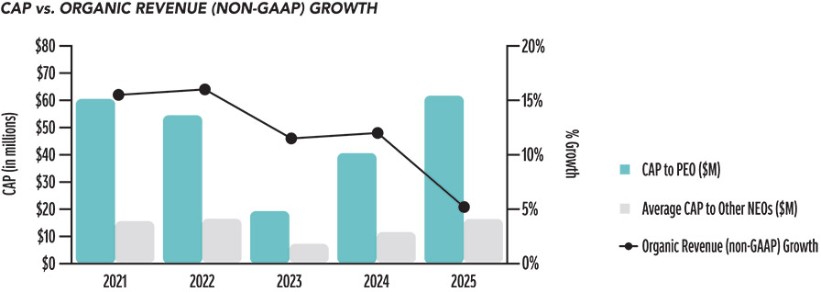
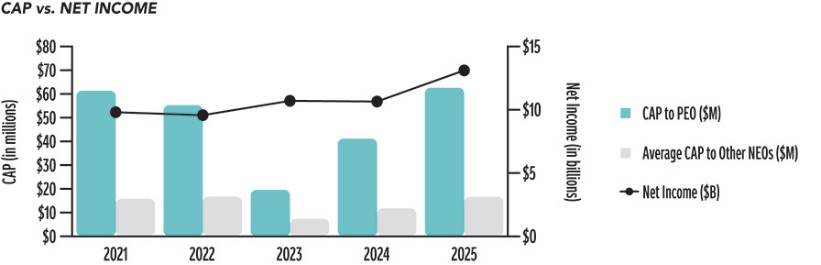
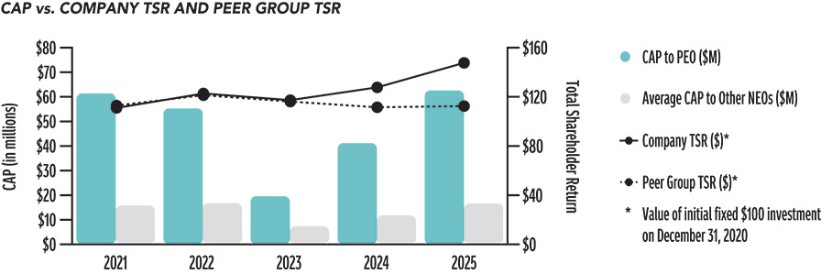
REPORT OF THE AUDIT COMMITTEE
The Audit Committee operates under a written charter, adopted by the Board, that outlines the Audit Committee’s responsibilities and the practices it follows. You can view the charter on the Company’s website, www.coca-colacompany.com, by clicking on “Investors,” then “Corporate Governance” and then “Documents.” The Audit Committee reviews and assesses the adequacy of its charter at least annually and, when appropriate, recommends to the Board changes to the charter to reflect the evolving role of the Audit Committee.
The Audit Committee is composed entirely of non-employee Directors who meet the independence and financial literacy requirements of the NYSE and additional, heightened independence criteria applicable to members of the Audit Committee under SEC and NYSE rules. For 2025, the Board designated each of Amity Millhiser, Christopher C. Davis and David B. Weinberg as an “Audit Committee financial expert” under the SEC rules.
Primary Responsibilities and 2025 Actions
The Audit Committee represents and assists the Board in fulfilling its oversight responsibility relating to the integrity of the Company’s financial statements and the financial reporting process, the systems of internal accounting and financial controls, the internal audit function and the annual independent audit of the Company’s financial statements. The Audit Committee oversees the Company’s compliance with legal and regulatory requirements; the Independent Auditors’ qualifications and independence; the performance of the Company’s internal audit function and the Independent Auditors; the Company’s ethical compliance programs, including the Company’s Codes of Business Conduct; the Company’s quality and food safety programs; the Company’s workplace and distribution safety programs; and cybersecurity. The Audit Committee also generally oversees the Company’s overall ERM program and has direct oversight over financial reporting and controls. In addition, the Audit Committee has oversight over certain processes related to the Company’s significant external sustainability disclosures.
At the request of the Audit Committee, during some of its meetings, the Audit Committee participates in educational sessions on accounting and financial control matters, cybersecurity and on areas of the Company’s operations, including some of the areas of risk it oversees.
In 2025, the Audit Committee held nine meetings. Meeting agendas are established by the Audit Committee Chair and the Chief of Internal Audit. During 2025, among other things, the Audit Committee did the following:
| ● | met with the senior members of the Company’s financial management team at each regularly scheduled meeting; |
| ● | during its regularly scheduled meetings, held separate, private sessions with each of the Company’s Global General Counsel, the Independent Auditors and the Chief of Internal Audit, at which candid discussions regarding financial management, legal, tax, accounting, auditing and internal control matters took place; |
| ● | continued its long-standing practice of having independent legal counsel regularly attend Audit Committee meetings; |
| ● | met with the Chief Ethics and Compliance Officer to discuss the effectiveness of the Company’s compliance programs and regularly received status reports of compliance issues; |
| ● | received periodic updates on management’s process to assess the adequacy of the Company’s system of internal control over financial reporting, the framework used to make the assessment and management’s conclusions on the effectiveness of the Company’s internal control over financial reporting; |
| ● | discussed with the Independent Auditors the Company’s internal control assessment process, management’s assessment with respect thereto and the Independent Auditors’ evaluation of the Company’s system of internal control over financial reporting; |
| ● | reviewed and discussed with management and the Independent Auditors the Company’s earnings releases and Quarterly and Annual Reports on Form 10-Q and Form 10-K, respectively, prior to filing with the SEC; |
| ● | reviewed the Company’s internal audit plan and the performance of the Company’s internal audit function; |
| ● | reviewed with senior members of the Company’s financial management team, the Independent Auditors and the Chief of Internal Audit the overall audit scope and plans, the results of internal and external audits, evaluations by management and the Independent Auditors of the Company’s internal control over financial reporting and the quality of the Company’s financial reporting; |
| ● | reviewed with management, including the Chief of Internal Audit and the Global General Counsel, and the Independent Auditors, significant risks and exposures identified by management, the overall adequacy and effectiveness of the Company’s legal, regulatory and ethical compliance programs, including the Company’s Codes of Business Conduct, the Company’s quality and food safety programs, workplace and distribution safety programs, significant external sustainability disclosures and cybersecurity; |
| ● | evaluated the performance of the Company’s Independent Auditors; |

| | | | | | | | | | |||||||
| Our |
| Voting |
| Governance |
| Share |
| Compensation |
| Audit Matters |
| Shareowner |
| Annexes |
|
| ● | received regular updates from management and discussed Company initiatives; and |
| ● | participated with representatives of management and the Independent Auditors in educational sessions about topics requested by the Audit Committee. |
Oversight of Independent Auditors
The Audit Committee engaged EY as the Company’s Independent Auditors for the fiscal year ended December 31, 2025. In its meetings with representatives of the Independent Auditors, the Audit Committee asks them to address, and discuss their responses to, several questions that the Audit Committee believes are particularly relevant to its oversight.
These questions include the following:
| ● | Are there any significant accounting judgments or estimates made by management in preparing the financial statements that would have been made differently had the Independent Auditors prepared and been responsible for the financial statements? |
| ● | Based on the Independent Auditors’ experience and their knowledge of the Company, do the Company’s financial statements fairly present to investors, with clarity and completeness, the Company’s financial position and performance for the reporting period in accordance with GAAP and SEC disclosure requirements? |
| ● | Based on the Independent Auditors’ experience and their knowledge of the Company, has the Company implemented internal controls and internal audit procedures that are appropriate for the Company? |
The Audit Committee believes that using these questions to help focus its discussions with the Independent Auditors promotes a more meaningful dialogue that provides a basis for its oversight judgment.
The Audit Committee also discussed with the Independent Auditors those matters required to be discussed by the applicable requirements of the Public Company Accounting Oversight Board (the “PCAOB”) and the SEC. The Audit Committee received the written disclosures and the letter from the Independent Auditors required by applicable requirements of the PCAOB regarding the Independent Auditors’ communication with the Audit Committee concerning independence and has discussed with the Independent Auditors their independence. The Audit Committee and the Independent Auditors considered whether the Independent Auditors’ provision of non-audit services to the Company during 2025 was compatible with the Independent Auditors’ independence.
2025 Audited Financial Statements
In its oversight role, the Audit Committee relies on the work and assurances of the Company’s management, which has the responsibility for establishing and maintaining adequate internal control over financial reporting and for preparing the financial statements and other reports, and of the Independent Auditors, who are engaged to audit and report on the consolidated financial statements of the Company and its subsidiaries and the effectiveness of the Company’s internal control over financial reporting.
The Audit Committee has reviewed and discussed with management and the Independent Auditors the audited financial statements in the Company’s Annual Report on Form 10-K for the fiscal year ended December 31, 2025, including a discussion of the quality, not just the acceptability, of the accounting principles, the reasonableness of significant accounting judgments and estimates, and the clarity of disclosures in the financial statements. In addressing the quality of management’s accounting judgments, members of the Audit Committee asked for management’s representations, reviewed certifications prepared by the Chief Executive Officer and the Chief Financial Officer that the unaudited quarterly and audited consolidated financial statements of the Company fairly present, in all material respects, the financial condition, results of operations and cash flows of the Company, and expressed to both management and the Independent Auditors their general preference for conservative policies when a range of accounting options is available.
In reliance on these reviews and discussions, and the reports of the Independent Auditors, the Audit Committee has recommended to the Board, and the Board has approved, that the audited financial statements be included in the Company’s Annual Report on Form 10-K for the fiscal year ended December 31, 2025 for filing with the SEC.
In reliance on these reviews and discussions, and the reports of the Independent Auditors, the Audit Committee has recommended to the Board, and the Board has approved, that the audited financial statements be included in the Company’s Annual Report on Form 10-K for the fiscal year ended December 31, 2025 for filing with the SEC. | |||
|
|
|
|
AMITY MILLHISER Chair | CHRISTOPHER C. DAVIS | CAROLINE J. TSAY | DAVID B. WEINBERG |
|
|
|
|





| | | | | | | | | | |||||||
| Our |
| Voting |
| Governance |
| Share |
| Compensation |
| Audit Matters |
| Shareowner |
| Annexes |
|
| | | | | | | |
| | | | ITEM 3: RATIFICATION OF THE APPOINTMENT OF ERNST & YOUNG LLP AS INDEPENDENT AUDITORS | | | |
| | | | What am I voting on? | | | |
| | | Shareowners are being asked to ratify the appointment of EY, a registered public accounting firm, to serve as the Company’s Independent Auditors for the fiscal year ending December 31, 2026. Although the Audit Committee has the sole authority to appoint the Independent Auditors, the Board submits its selection of the Independent Auditors to our shareowners for ratification as a matter of good corporate governance. If the shareowners should not ratify the appointment of EY, the Audit Committee will reconsider the appointment. | | |||
| | | | The Board of Directors recommends a vote FOR the ratification of the appointment of Ernst & Young LLP as independent auditors. |
| | |
| | | | | | | |
The Audit Committee has the sole authority and responsibility to hire, evaluate and, when appropriate, replace the Company’s Independent Auditors and, in its capacity as a committee of the Board, is directly responsible for the appointment, compensation and general oversight of the work of the Independent Auditors.
The Audit Committee has appointed EY to serve as Independent Auditors for the fiscal year ending December 31, 2026. EY (including its predecessors) has served as the Company’s Independent Auditors since 1921.
The Coca-Cola Company | 85 | 2026 Proxy Statement |
| | | | | | | | | | |||||||
| Our |
| Voting |
| Governance |
| Share |
| Compensation |
| Audit Matters |
| Shareowner |
| Annexes |
|
Annual Evaluation and Selection of Independent Auditors
The Audit Committee annually evaluates the performance of the Company’s Independent Auditors, including the senior audit engagement team, and determines whether to reengage the current Independent Auditors or consider other audit firms. Factors considered by the Audit Committee in deciding whether to retain EY, the current Independent Auditors, include the following:
| ● | EY’s global capabilities; |
| ● | EY’s technical expertise and knowledge of the Company’s global operations and industry; |
| ● | the quality and candor of EY’s communications with the Audit Committee and Company management; |
| ● | EY’s independence; |
| ● | the quality and efficiency of the services provided by EY, including input from management on EY’s performance and how effectively EY has demonstrated its independent judgment, objectivity and professional skepticism; |
| ● | external data on audit quality and performance, including recent PCAOB reports on EY and its peer firms; and |
| ● | the appropriateness of EY’s fees, EY’s tenure as Independent Auditors, including the benefits of a longer tenure, and the controls and processes in place that help ensure EY’s continued independence. |
BENEFITS OF LONGER TENURE
| ✓ | Enhanced audit quality – EY’s significant institutional knowledge and deep expertise of the Company’s global business, accounting policies and practices, and internal control over financial reporting enhance audit quality. |
| ✓ | Competitive fees – Because of EY’s familiarity with the Company, audit and other fees are competitive with those of EY’s peer companies. |
| ✓ | Avoidance of costs associated with a new auditor – Bringing on new Independent Auditors would be costly and would require a significant time commitment, which could lead to management distractions. |
INDEPENDENCE CONTROLS
| ✓ | Audit Committee oversight – Oversight includes regular private sessions with EY, discussion with EY about the scope of audit and business imperatives, a comprehensive annual evaluation when determining whether to reengage EY and direct involvement by the Audit Committee and its Chair in the selection of the new lead assurance engagement partner and new global coordinating partner in connection with the mandated rotation of these positions. |
| ✓ | Limits on non-audit services – The Audit Committee pre-approves audit and permissible non-audit services provided by EY in accordance with its pre-approval policy. |
| ✓ | EY’s internal independence process – EY conducts periodic internal reviews of its audit and other work, assesses the adequacy of partners and other personnel working on the Company’s account and rotates the lead assurance engagement partner, the global coordinating partner and other partners on the engagement consistent with independence requirements. A new lead assurance engagement partner was appointed in 2022, and a new global coordinating partner was appointed in 2024. |
| ✓ | Strong regulatory framework – EY, as an independent registered public accounting firm, is subject to PCAOB inspections, “Big 4” peer reviews from other premier accounting firms and PCAOB and SEC oversight. |
Based on this evaluation, the Audit Committee and the Board believe that retaining EY to serve as Independent Auditors for the fiscal year ending December 31, 2026 is in the best interests of the Company and its shareowners.
Audit Fees and All Other Fees
The Audit Committee is responsible for approving the audit and permissible non-audit services provided by the Independent Auditors and the associated fees.
The following table shows the fees for audit and other services provided by EY for fiscal years 2025 and 2024.
| | | | | | | | |
| | 2025 Fees | | 2024 Fees | | | ||
| | (In thousands) | | (In thousands) | | Description | ||
Audit Fees | | $ | 30,587 | | $ | 32,104 |
| Includes fees associated with the annual audit and the audit of internal control over financial reporting, comfort letters issued in 2025, the reviews of the Company’s Quarterly Reports on Form 10-Q, and statutory audits required internationally. |
Audit-Related Fees | |
| 4,834 | |
| 5,078 |
| Fees for services that are reasonably related to the performance of the audit or review of financial statements and are not included in “Audit Fees.” These services principally include due diligence in connection with acquisitions, audits of certain employee benefit plans’ financial statements, consultation on accounting and internal control matters, information systems audits and other attest services. |
Tax Fees | |
| 6,760 | |
| 8,224 |
| Fees for tax services, including tax compliance, tax advice and tax planning. |
All Other Fees | |
| 85 | |
| 162 |
| Fees for services that are not included in the above categories and primarily include benchmarking services. |
TOTAL | | $ | 42,266 | | $ | 45,568 |
| |
The Coca-Cola Company | 86 | 2026 Proxy Statement |
| | | | | | | | | | |||||||
| Our |
| Voting |
| Governance |
| Share |
| Compensation |
| Audit Matters |
| Shareowner |
| Annexes |
|
Audit Committee Pre-Approval of Audit and Permissible Non-Audit Services of Independent Auditors
The Audit Committee pre-approves all audit and permissible non-audit services provided by the Independent Auditors. These services may include audit services, audit-related services, tax services and other services. The Audit Committee has adopted a policy for the pre-approval of services provided by the Independent Auditors.
Under the policy, pre-approval is generally provided for work associated with the following:
| ● | registration statements under the Securities Act of 1933, as amended (for example, comfort letters or consents); |
| ● | statutory or other financial audit work for non-U.S. subsidiaries that is not required for the 1934 Act audits; |
| ● | due diligence work for potential acquisitions or dispositions; |
| ● | attest services not required by statute or regulation; |
| ● | adoption of new accounting pronouncements or auditing and disclosure requirements for financial or non-financial data and accounting or regulatory consultations; |
| ● | internal control reviews and assistance with internal control reporting requirements; |
| ● | review of information systems security and controls; |
| ● | tax compliance, tax planning and related tax services, excluding any tax service prohibited by regulatory or other oversight authorities, expatriate and other individual tax services; and |
| ● | assistance and consultation on questions raised by regulatory agencies. |
For each proposed service, the Independent Auditors provide the Audit Committee with a description of the service and sufficient information to confirm the Independent Auditors’ determination that the provision of such service will not impair the Independent Auditors’ independence.
The Audit Committee has approved in advance certain permitted services whose scope is routine across the Company’s operating units, including statutory or other financial audit work for non-U.S. subsidiaries that is not required for the 1934 Act audits.
Other Information
One or more representatives of EY will be present at the 2026 Annual Meeting. The representatives will have an opportunity to make a statement if they desire to do so and will be available to respond to appropriate questions.
Ratification of the appointment of EY as Independent Auditors requires the affirmative vote of a majority of the votes cast by the holders of the shares of Common Stock voting in person or by proxy at the 2026 Annual Meeting.
The Coca-Cola Company | 87 | 2026 Proxy Statement |
| | | | ITEMS 4-8: SHAREOWNER PROPOSALS | | | |
| | | | What am I voting on? | | | |
| | | The following proposals were submitted by shareowners. If the shareowner proponent of each proposal, or a representative who is qualified under state law, is present and submits the proposal for a vote, then the proposal will be voted on at the 2026 Annual Meeting. | | |||
| | | | The Board of Directors recommends a vote AGAINST each of the shareowner proposals. |
| | |
| | | | | | | |

In accordance with federal securities regulations, we included the shareowner proposal plus any supporting statements exactly as submitted by the proponent. The proposals may contain assertions about the Company or other matters that we believe are incorrect, but we have not attempted to refute all of those assertions. To ensure readers can easily distinguish between materials provided by the proponent and materials provided by the Company, we have placed a black box around the materials provided by the proponent and a teal box around materials provided by the Company. Information contained on or accessible through any website links included in the proposals, supporting statements, and the responses from our Board is not incorporated in, and does not constitute a part of, this Proxy Statement. The Board accepts no responsibility for the content of the shareowner proposals.
If proposals are submitted by more than one shareowner, we only list the primary filer’s name, address and stock ownership. We also list the name of any co-filing proponent if specifically requested by such proponent. We will furnish the name, address and stock ownership of all co-filing proponents upon written request to the Corporate Secretary, addressed to the Office of the Secretary as specified in question 28 on page 105.
The Coca-Cola Company | 88 | 2026 Proxy Statement |

| | | | | | | | | | |||||||
| Our |
| Voting |
| Governance |
| Share |
| Compensation |
| Audit Matters |
| Shareowner |
| Annexes |
|
ITEM 4: |
Shareowner Proposal REQUESTING a SUSTAINABILITY COMMITTEE BY-LAW AMENDMENT National Center for Public Policy Research, 2005 Massachusetts Avenue NW, Washington, DC 20036, the beneficial owner for at least three years of Company Common Stock having a market value of at least $2,000, submitted the following proposal: |
Sustainability Oversight Resolved: The shareholders of The Coca-Cola Company hereby amend Article Ill of the Company’s Bylaws to include the following: “Section 4. Corporate Governance and Sustainability Committee. The Company shall have a Corporate Governance and Sustainability Committee. The process by which the Corporate Governance and Sustainability Committee shall exercise its oversight of the Company’s sustainability initiatives shall at a minimum include assessing whether and to what extent those initiatives have been approved and are being maintained on the basis of net present value (NPV) and return on investment (ROI) calculations. The Corporate Governance and Sustainability Committee shall report annually to the shareholders on its findings.” Supporting Statement Coca-Cola’s continued success depends on disciplined capital allocation across all areas of investment, including environmental, social, and governance (ESG) and sustainability initiatives. These programs represent significant and growing portions of corporate spending. Yet, unlike traditional capital investments, sustainability expenditures are apparently not consistently subjected to transparent financial evaluation. The 2024 Coca-Cola Environmental Update reveals multiple red flags on the absence of NPV or ROI analyses for sustainability initiatives.1 First, ambitious goals—returning 100%+ water globally, 35-40% recycled material by 2035, and 1.5°C-aligned emissions cuts—are presented without any cost-benefit estimates, capital allocation details, or projected returns. Second, investments in refillable packaging (14% of volume) and collection systems yielding 65% recovery are touted, yet no financial justification or payback periods appear despite acknowledged infrastructure costs. Third, 28% renewable electricity usage and Scope 3 supplier reductions are highlighted, but the document omits any quantification of incremental expenses versus emissions savings or shareholder value creation. These omissions raise governance concerns over unchecked capital deployment. The Company’s existing Corporate Governance and Sustainability Committee Charter authorizes the Committee to oversee sustainability programs and monitor risks but does not require any formal review of the financial returns or opportunity costs associated with such programs.2 Establishing a clear bylaw requirement for NPV and ROI analysis would align sustainability oversight with the same rigor applied to other investment decisions. Integrating financial assessment into sustainability governance promotes accountability, data-driven decision-making, and alignment between environmental and shareholder value. Moreover, an annual statement confirming that sustainability expenditures are grounded in positive NPV and ROI would increase transparency and investor confidence while discouraging initiatives that lack demonstrable benefit to the Company or its shareholders. Such transparency would also allow shareholders to properly value their shares. Coca-Cola has been a global leader in sustainability reporting. This modest amendment would reinforce that leadership by ensuring that sustainability commitments are also economically sustainable—producing measurable returns and advancing the Company’s fiduciary responsibility. For these reasons, we urge shareholders to vote FOR this proposal. 1 https://www.coca-colacompany.com/content/dam/company/us/en/reports/2024-environmental-update/2024-environmental-update.pdf 2 https://investors.coca-colacompany.com/_assets/_d751f19d2b308b0aaf2006424bb44fad/cocacolacompany/db/870/10107/file/Corporate |
The Coca-Cola Company | 89 | 2026 Proxy Statement |
| | | | | | | | | | |||||||
| Our |
| Voting |
| Governance |
| Share |
| Compensation |
| Audit Matters |
| Shareowner |
| Annexes |
|
The Board’s Statement in Opposition to Item 4 | |
The Board of Directors recommends shareowners vote AGAINST this shareowner proposal. | |
The Board believes that the requested amendment to the Company’s By-laws is not necessary nor in the best interests of the Company or its shareowners. Financial considerations are already embedded in the Company’s oversight of sustainability programs and goals. At The Coca-Cola Company, these initiatives are not discretionary or standalone, but fully integrated into the Company’s all-weather strategy. As such, they are evaluated through normal business planning and capital allocation processes that consider investments, risks, opportunities and long-term value. Because our work in this space is embedded across the business, it seeks to support short-term actions while setting up the business for long-term sustainable growth. We seek to grow our business by staying close to the consumer across all parts of our strategy — including marketing, innovation, revenue growth management and execution. For example, our work on water stewardship in high-risk locations is intended to ensure that we protect the natural resources on which our business depends for continued growth, while driving continuous improvement in the efficiency of our usage. Similarly, our work on packaging sustainability helps reduce costs through lightweighting, driving efficiency, and also gives the Company a voice with government and stakeholders as new regulations are being developed. We believe our sustainability strategy helps create value for shareowners by contributing top-line growth, delivering cost savings, and strengthening resilience as we adapt to changing consumer expectations and regulatory requirements. Investments in areas such as packaging innovation, water stewardship and energy efficiency support consumer demand, supply chain resilience, brand strength and long-term business continuity. The Board believes the Company’s current governance framework already provides effective oversight and that additional prescriptive by-law requirements would add rigidity and administrative burden without improving decision-making or outcomes. | |
| The Board of Directors recommends a vote against the shareowner proposal requesting a sustainability committee by-law amendment. |
The Coca-Cola Company | 90 | 2026 Proxy Statement |
| | | | | | | | | | |||||||
| Our |
| Voting |
| Governance |
| Share |
| Compensation |
| Audit Matters |
| Shareowner |
| Annexes |
|
|
ITEM 5: |
SHAREOWNER PROPOSAL REQUESTING A REPORT EVALUATING THE COMPANY’S PLASTICS PACKAGING POLICIES National Legal and Policy Center, 107 Park Washington Court, Falls Church, VA 22046, the beneficial owner for at least three years of Company Common Stock having a market value of at least $2,000, submitted the following proposal: |
Report on Objective Evaluation of Plastics Packaging Policies Whereas: In 2018 The Coca-Cola Company (“Coca-Cola” or “Company”) pledged under its unrealistic “World Without Waste” campaign that it would reach “100% of packaging recyclable globally by 2025,” to “collect or recycle a bottle or can for each one sold,” and to use “50% recycled content by 2030.”1 With those goals unreachable, in 2024 the Company replaced them with still-unworkable targets to “use 35% to 40% recycled material in primary packaging (plastic, glass and aluminum), including increasing recycled plastic use to 30% to 35% globally” and to “help ensure the collection of 70% to 75% of the equivalent number of bottles and cans introduced into the market annually.”2 Initiatives like Coca-Cola’s are driven by an alleged “plastics pollution crisis.”3 Yet objective evidence shows that plastic packaging in many ways offers net environmental and economic benefits,4 including lighter weight, durability, lower transportation costs, and reduced emissions compared to alternatives.5 Critics argue that to the degree there’s a problem, that it’s not plastic production, but inadequate waste management and disposal systems, particularly in developing economies.6 Global advocacy campaigns for a “circular economy,” which rely on biased reports such as Breaking the Plastic Wave7 and Plastics: The Costs to Society, the Environment, and the Economy,8 emphasize environmental “costs” while mostly ignoring the well-documented benefits of plastics and the trade-offs of substitutes. Materiality: In 2024, 48% of Coca-Cola’s global unit case packaging was plastic bottles.9 The Company dictates packaging policy and design standards, meaning bottlers execute strategy set by Coca-Cola, not independently.10 Packaging is one of the Company’s most visible and material operational issues, shaping brand reputation, investor expectations, and regulatory exposure. With Coca-Cola’s 2023 consolidated net operating revenues at nearly $46 billion,11 even conservative estimates show that packaging costs — and especially plastics — influence a significant share of the Company’s economics. Accordingly, shareholders have a right to request assurance that these policies are based on factual data and outcomes, not activist rhetoric (like “zero waste”) and “circular economy” fantasies. Supporting Statement: Coca-Cola’s packaging strategy should be grounded in verifiable, scientific, and economic cost-benefit analysis. An objective evaluation would: 1. Comprehensively analyze the environmental impact of plastics versus alternatives, including lifecycle emissions, energy usage, and recyclability. 2. Assess the economic costs of replacing single-use plastics with higher-cost or heavier materials with recycled content inputs, and the implications for Coca-Cola’s supply chain and shareholders. 3. Examine whether corporate policy targets the true pollution culprit — poor waste management — rather than demonizing plastics as a material. Resolved: Shareholders request the Board of Directors to commission and publish, by March 31, 2027, at reasonable cost and omitting proprietary information, a report evaluating Coca-Cola’s plastics packaging policies. The report should assess these policies in light of non-biased, scientifically accurate, and economically rigorous research, and include a quantifiable analysis of potential policy changes versus current practices as they affect the Company’s financial position. 1 https://www.packagingdive.com/news/coca-cola-new-packaging-sustainability-goals-2035/734379/ 2 https://www.coca-colacompany.com/media-center/the-coca-cola-company-evolves-voluntary-environmental-goals 3 https://www.unep.org/interactives/beat-plastic-pollution/ 4 https://www.bizpacreview.com/2021/11/15/hold-for-michele-the-great-pacific-garbage-patch-twice-the-size-of-texas-is-fake-1162875/ 5 https://plastics.americanchemistry.com/life-cycle-impacts-of-plastic-packaging-compared-to-alternatives 6 https://www.science.org/doi/10.1126/science.1260352 7 https://www.pewtrusts.org/en/research-and-analysis/reports/2020/07/breaking-the-plastic-wave 8 https://wwfint.awsassets.panda.org/downloads/plastics_the_costs_to_society_the_environment_and_the_economy.pdf 9 https://www.fooddive.com/news/coca-cola-environmental-recycled-packaging/760942/ 10 https://www.sec.gov/Archives/edgar/data/1491675/000119312510223971/dex102.htm 11 https://www.sec.gov/Archives/edgar/data/21344/000002134424000004/a2023q4earningsreleaseex-9.htm |
The Coca-Cola Company | 91 | 2026 Proxy Statement |
| | | | | | | | | | |||||||
| Our |
| Voting |
| Governance |
| Share |
| Compensation |
| Audit Matters |
| Shareowner |
| Annexes |
|
The Board’s Statement in Opposition to Item 5 | |
The Board of Directors recommends shareowners vote AGAINST this shareowner proposal. | |
The Board believes the report requested in this proposal is unnecessary because the Company’s packaging strategy is already grounded in scientific research, lifecycle assessment and economic analysis, while also providing consumers with choice in how they consume our beverages. Our strategy also considers affordability, premiumization and demand. These criteria are embedded in the Company’s regular business planning and capital allocation processes. Packaging decisions are evaluated similar to other strategic investments and are designed to advance both our sustainability objectives and long-term business value. The Company offers beverages in a wide range of packaging formats, including glass, aluminum and plastic bottles, aluminum cans and refillable packaging in both plastic and glass. The Company recognizes that each format can play a role in helping provide consumers with choice and reducing packaging waste and emissions, while mitigating costs and supporting revenue growth management. Regardless of the packaging material, increasing package collection helps increase the use of recycled content while supporting waste management and increasing production efficiency. Indeed, PET, the plastic used in the company’s beverage containers, is a type of clear, durable and versatile plastic, which is the most recyclable and recycled plastic in the world.1 Aside from being recycled into new beverage containers, empty beverage bottles are also recycled into fiber, carpets, playground equipment and many other items. Consistent with the proponent’s emphasis on waste management, the Company is focused on increasing recycled content in primary packaging and supporting collection rates, which depend on enabling policies and expanded collection infrastructure. As a consumer-centric company, we also use targeted sustainability marketing to reach consumers to support our collection efforts, recognizing that behavior and interests differ by market. The requested report would largely duplicate existing analyses and could require the Company to produce prescriptive or static assessments in an area that is dynamic and rapidly evolving, while adding cost and administrative burden without clear benefit to shareowners. The Board believes the Company’s current approach to packaging balances environmental responsibility, economic performance and consumer preferences. 1 https://napcor.com/recycling/ | |
| The Board of Directors recommends a vote against the shareowner proposal requesting a report evaluating the Company’s plastics packaging policies. |
The Coca-Cola Company | 92 | 2026 Proxy Statement |
| | | | | | | | | | |||||||
| Our |
| Voting |
| Governance |
| Share |
| Compensation |
| Audit Matters |
| Shareowner |
| Annexes |
|
|
ITEM 6: |
SHAREOWNER PROPOSAL REQUESTING A REPORT ON THE EXTENT OF THE company’S DIVERSITY, EQUITY AND INCLUSION EFFORTS As You Sow, 11461 San Pablo Avenue, Suite 400, El Cerrito, CA 94530, on behalf of Elizabeth Juda, the beneficial owner for at least one year of Company Common Stock having a market value of at least $25,000, submitted the following proposal: |
WHEREAS: Equity-based policies and programs that promote diversity, equity and inclusion (DEI) strengthen workforce effectiveness and corporate performance. Evidence shows that transparent disclosure of diversity policies and quantitative outcomes mitigates material risk to brand value and financial performance: ● Companies with the strongest racial and ethnic diversity are 35% more likely to outperform their industry medians for earnings before interest and tax.1 ● Organizations that lead with inclusion are eight times more likely to have better business outcomes.”2 ● 80% of workers prefer to work for a company that values DEI.3 ● A recent study of EEO-1 forms found a “positive association between diverse representation in management and positive financial performance.”4 Coca-Cola Co. is lagging behind peers on diversity and inclusion disclosure. Coca-Cola earned a 13% score on As You Sow’s Racial Justice Scorecard, compared with PepsiCo’s 21% and Starbucks’s 27%.5 The Company’s low score reflects minimal transparency on workforce data and diversity-related policies and practices. Coca-Cola’s 2024 Annual Report states that “we strive to cultivate diversity in our workforce and believe teammates with different backgrounds, experiences and viewpoints bring value to our organization.6 Despite the company’s public statement about its willingness to cultivate diversity, the company’s weak diversity and inclusion disclosures reduce clarity on whether our company actually attracts and retains diverse talent critical to long-term success. The company can demonstrate ongoing success and performance in this area by increasing transparency around its diversity and inclusion policies and practices. The failure to disclose this information raises material and unacknowledged risk of reduced brand value and financial performance. RESOLVED: Shareholders request that Coca-Cola issue a public report, at reasonable cost and omitting proprietary information, on the extent of the Company’s current diversity, equity, and inclusion efforts. 1 https://www.mckinsey.com/capabilities/people-and-organizational-performance/our-insights/delivering-through-diversity 2 https://www.ceoaction.com/purpose/ 3 https://www.cnbc.com/2021/04/30/diversity-equity-and-inclusion-are-important-to-workers-survey-shows.html 4 https://www.asyousow.org/reports/racial-justice-june2024 5 https://www.asyousow.org/reports/racial-justice-june2024 6 P.22 https://investor.cokeconsolidated.com/static-files/57814901-7685-4e3c-851f-63f56335da7f |
The Coca-Cola Company | 93 | 2026 Proxy Statement |
| | | | | | | | | | |||||||
| Our |
| Voting |
| Governance |
| Share |
| Compensation |
| Audit Matters |
| Shareowner |
| Annexes |
|
The Board’s Statement in Opposition to Item 6 | |
The Board of Directors recommends shareowners vote AGAINST this shareowner proposal. | |
The proposal requests a report based on the claim that our Company lags peers on disclosure related to diversity and inclusion. However, given our current policies and disclosures, we believe there is no basis for this claim, and therefore do not believe additional reporting is necessary. Where required, we report on representation metrics, including the submission of our EEO-1 report to the U.S. Equal Employment Opportunity Commission. We comply with applicable local regulations by reporting on gender pay gaps and human rights matters as required by jurisdiction. Some of these reports are publicly accessible on local market websites. Further, in our 2024 People & Communities Update1, we voluntarily provide workplace representation numbers and include a copy of our EEO-1 report. Previous versions of our EEO-1 report can also be found on the Company’s website. In certain instances, the Company’s website shares examples of our work in supporting our people and local communities. The proponent’s claims about inadequate disclosure are further diluted by the fact that this proposal mistakenly cites and links to information from another company’s annual report, not The Coca-Cola Company. We continue to aspire to develop a global workforce with diverse perspectives, experiences and backgrounds that reflect the broad range of consumers and markets we serve around the world. To help us achieve this, we will continue to foster an inclusive culture where every employee can thrive and has equal access to opportunity. 1 https://www.coca-colacompany.com/content/dam/company/us/en/reports/2024-people-and-communities-update.pdf | |
| The Board of Directors recommends a vote against the shareowner proposal requesting a report on the extent of the Company’s diversity, equity and inclusion efforts. |
The Coca-Cola Company | 94 | 2026 Proxy Statement |
| | | | | | | | | | |||||||
| Our |
| Voting |
| Governance |
| Share |
| Compensation |
| Audit Matters |
| Shareowner |
| Annexes |
|
ITEM 7: |
SHAREOWNER PROPOSAL REQUESTING A REPORT ON RISKS RELATED TO INGREDIENTS CommonSpirit Health, 444 West Lake Street, Suite 2500, Chicago, IL 60606, the beneficial owner for at least three years of Company Common Stock having a market value of at least $2,000, as lead filer, and other co-filers, including the Benedictine Sisters of Mount St. Scholastica, the Benedictine Sisters of Boerne, Texas, and the Dominican Sisters of Springfield, Illinois, submitted the following proposal: |
RESOLVED: Shareholders request that The Coca-Cola Company (“Coca-Cola”), at reasonable cost and omitting proprietary information, report to shareholders on the processes and policies, above and beyond legal compliance, to assess and manage risks and/or hazards to human health, the company’s reputation and its financial position associated with chemicals and additives in its food and beverage products. SUPPORTING STATEMENT: Weak federal regulations concerning Generally Recognized as Safe (GRAS) substances enable the food industry to self-regulate and determine whether an ingredient is GRAS without notifying the Food and Drug Administration (FDA) of the company’s determination or the research underlying its determination that the substance is safe.1 According to a 2022 analysis, nearly 99 percent of all food chemicals introduced since 2000 were approved by the food and chemical industry, not the FDA.2 The Coca-Cola Company publicly states, “We use additives in some of our drinks, including Coca-Cola Classic, to give them flavour and colour and increase their appeal. Only additives that are known and proven to be safe make it into our drinks…Additives are not necessarily artificial. Additives including citric acid, ascorbic acid and cochineal are all found in nature.”3 Coca-Cola’s Quality & Food Safety Policy states that they, “Identify, evaluate and proactively address quality and food safety risks and emerging trends.”4 However, there is no further disclosure regarding this process and Coca-Cola does not disclose the underlying safety and hazard assessment data for their ingredients. Additionally, there have been several instances where Coca-Cola has reactively responded to ingredient safety concerns, raising questions for investors about the Company’s ability to effectively and proactively manage these risks. For example, Coca-Cola committed to remove brominated vegetable oil in 2014, despite the chemical’s ban in several European countries since the 1970s due to its health harms.5 Furthermore, an external assessment has identified synthetic dyes in 22 percent of Coca-Cola’s products, and the Company has no commitment to phase these out.6 These dyes have been associated with neurobehavioral issues in children, including hyperactivity7 and adverse behavioral outcomes.8 Consumers are increasingly concerned about the ingredients in the products they purchase, as demonstrated by litigation claiming that the flavoring in some of Coca-Cola’s beverage products are made from synthetic substances, rather than natural ingredients.9 In response to litigation, Coca-Cola reformulated some of their products in 2007 to remove benzene, a known carcinogen.10 States are seeking to address the GRAS regulatory loophole by banning food chemicals that pose potential harm to human health. As of 2025, 20 states have introduced and/or passed legislation targeting food chemicals.11 The federal government is also advocating for the food industry to reduce health-harming substances in their products.12 The lack of transparency regarding Coca-Cola’s risk assessment and management approach, combined with growing regulatory pressures, litigation, and consumer demand for ingredient information, creates risks for shareholders and our Company. 1 https://ajph.aphapublications.org/doi/full/10.2105/AJPH.2024.307755?role=tab 2 https://www.ewg.org/news-insights/news/2022/04/ewg-analysis-almost-all-new-food-chemicals-greenlighted-industry-not-fda 3 https://www.coca-cola.com/hk/en/about-us/faq/are-there-any-additives-in-cocacola 4 https://www.coca-colacompany.com/policies-and-practices/quality-and-food-safety-policy 5 https://www.chemistryworld.com/news/fda-bans-use-of-brominated-vegetable-oil-in-food-and-drink/4019765.article 6 https://infogram.com/synthetic-dyes-corporate-commitment-tracker-1h0n25owglewl4p 7 https://www.sciencedirect.com/science/article/pii/S2772529424001255 8 https://oehha.ca.gov/risk-assessment/press-release/report-links-synthetic-food-dyes-hyperactivity-and-other-neurobehavioral-effects-children 9 https://www.kazlg.com/nationwide-class-action-against-coca-cola/ 10 https://www.beveragedaily.com/Article/2007/05/15/coca-cola-settles-in-benzene-lawsuit/?utm_source=copyright&utm_medium=OnSite&utm 11 https://www.ewg.org/news-insights/news/2025/10/interactive-map-tracking-state-food-chemical-regulation-us 12 https://www.whitehouse.gov/wp-content/uploads/2025/05/MAHA-Report-The-White-House.pdf |
The Coca-Cola Company | 95 | 2026 Proxy Statement |
| | | | | | | | | | |||||||
| Our |
| Voting |
| Governance |
| Share |
| Compensation |
| Audit Matters |
| Shareowner |
| Annexes |
|
The Board’s Statement in Opposition to Item 7 | |
The Board of Directors recommends shareowners vote AGAINST this shareowner proposal. | |
Our Company produces beverages enjoyed around the world, with brands reaching billions of consumers, supported by a long history of using ingredients that meet rigorous quality and safety standards. We are aware that some consumers have concerns regarding certain ingredients used in our products. Accordingly, we strive to ensure that information about our ingredients is easily accessible on our packaging and digital platforms, allowing consumers to make informed decisions. We maintain policies and governance processes designed to identify, assess, and manage potential risks related to product safety and quality. We continually assess ingredient safety through scientific evaluation, regulatory horizon scanning, engagement with independent experts and regulatory authorities, and investment in robust studies and clinical research. We also continuously monitor emerging science and regulatory developments worldwide to inform decision-making and guide proactive risk management. The Company’s products are sold globally and are subject to oversight by various regulatory authorities. The ingredients used in the Company’s products are authorized for use by leading food safety authorities in the markets where they are sold. We recognize that science evolves and that there may be differing interpretations of scientific data. We base our decisions on thorough, peer-reviewed scientific research as well as evaluations by global health and food safety bodies. Ingredient stewardship is integrated into our enterprise risk management systems. For these reasons, the Board believes the proposal is unnecessary and duplicative of our existing processes and recommends that shareowners vote against it. | |
| The Board of Directors recommends a vote against the shareowner proposal requesting a report on risks related to ingredients. |
The Coca-Cola Company | 96 | 2026 Proxy Statement |
| | | | | | | | | | |||||||
| Our |
| Voting |
| Governance |
| Share |
| Compensation |
| Audit Matters |
| Shareowner |
| Annexes |
|
ITEM 8: |
SHAREOWNER PROPOSAL requesting a report on the company’S plans to increase sustainability disclosure Green Century Equity Fund, 114 State Street, Suite 200, Boston, MA 02109, the beneficial owner for at least one year of Company Common Stock having a market value of at least $25,000, submitted the following proposal: |
Whereas: Public sustainability reporting enables investors to make better informed decisions through a deeper understanding of enterprise risks and how companies manage them to deliver stable, long-term financial returns. Reporting is most useful when it aligns with recognized disclosure frameworks, thereby enhancing consistency, comparability, and relevance. As the largest beverage company in the world, Coca-Cola’s operations both significantly impact and rely on the environment and ecosystem services. The company released sustainability reports in accordance with the GRI standards from 2019-2023. Its 2022 sustainability report identified Packaging and Circularity, Water Stewardship, and Climate Change as priority topics based on importance to stakeholders and impact on the company.1 Subsequent to 2023, the company has released Environmental Updates but not full sustainability reports.2 These updates lack decision-useful information on initiatives and outcomes related to those priority environmental topics. The sustainability section of Coca-Cola’s website does not include this missing information, and the reporting is not prepared in accordance with recognized reporting frameworks. • Packaging: Reusable packaging is considered by experts to be one of the most effective way to reduce plastic pollution and an important sales strategy.3 Coca-Cola’s previous reporting included information on how the company was investing in refillable packaging.4 Its recent reporting omits these disclosures. • Water stewardship: The Company’s recent reports also fail to disclose information about water use from its 200 high-risk locations or report progress towards its water management goal for these locations. • Climate change: Coca-Cola previously disclosed a short-term, SBTi-verified GHG emissions reduction goal, its plans to reduce its emissions and progress against the old goal. Its current reporting does not provide this disclosure for its new goal to reduce emissions in line with a 1.5-degree trajectory by 2035. By comparison, Coca-Cola’s peers disclose sustainability reports according to external standards.5,6,7,8 In their sustainability reporting, PepsiCo and Nestlé disclose details on how they will achieve their GHG reduction goals and progress against these goals. PepsiCo, Nestlé and KDP all provide quantitative disclosure on water use in high water-risk areas. Resolved: Shareholders request that Coca-Cola issue a report, at reasonable cost and omitting proprietary information, describing whether, and how, it will increase the inclusion of updated information in its sustainability disclosures that better demonstrate the effectiveness of company strategies in mitigating priority sustainability risks for the company, including mitigating risks to the business and improving environmental outcomes of its efforts. Supporting Statement: Proponents suggest, at management’s discretion, that the report: •Be prepared in accordance with a recognized framework •Include a materiality assessment to ensure that reporting covers issues that are material to its business. 1 https://www.coca-colacompany.com/content/dam/company/us/en/reports/coca-cola-business-sustainability-report-2022.pdf 2 https://www.coca-colacompany.com/content/dam/company/us/en/reports/2024-environmental-update/2024-environmental-update.pdf 3 https://www.weforum.org/stories/2025/01/tipping-point-year-for-reusable-packaging-systems/#:~:text=According%20to%20the%20United 4 https://www.coca-colacompany.com/content/dam/company/us/en/reports/coca-cola-business-sustainability-report-2022.pdf 5 https://keurigdrpepper.com/wp-content/uploads/2025/06/2024-impact-report.pdf 6 https://www.nestle.com/sites/default/files/2025-02/non-financial-statement-2024.pdf#page=154 7 https://www.nestle.com/sites/default/files/2025-02/creating-shared-value-nestle-2024.pdf 8 https://edge.sitecorecloud.io/pepsico-5v9wci20/media/Files/esg-topics/2024-esg-summary-esg-performance-metrics.pdf |
The Coca-Cola Company | 97 | 2026 Proxy Statement |
| | | | | | | | | | |||||||
| Our |
| Voting |
| Governance |
| Share |
| Compensation |
| Audit Matters |
| Shareowner |
| Annexes |
|
The Board’s Statement in Opposition to Item 8 | |
The Board of Directors recommends shareowners vote AGAINST this shareowner proposal. | |
This proposal requests that the Company issue a report “describing whether, and how, it will increase the inclusion of updated information in its sustainability disclosures.” However, as outlined below, the Company already takes a deliberate and evolving approach to sustainability reporting, adapting its disclosures to support business strategy, stakeholder expectations and compliance within an increasingly complex environment. Since announcing updated goals in December 2024, the Company has refined the data included in its voluntary sustainability disclosures to focus on performance indicators that relate to these goals, which the Company believes are important for resilience of our business and the communities in which we operate. This data is published in the Company’s 2024 Environmental Update (the “Environmental Update”), 2024 Portfolio Update and 2024 People & Communities Update. The Company seeks to provide disclosures that are accurate, credible, and comparable and therefore engages its external auditor to perform limited assurance on select environmental metrics prior to publication. In fact, additional data points were included in the scope of external assurance for the 2024 Environmental Update. While the Environmental Update focuses primarily on certain key data related to water, packaging and emissions, sustainability-related information is also embedded within the Coca-Cola system’s broader reporting framework, including public reports issued by our bottling partners. We and the broader Coca-Cola system also share our progress via communications channels such as company websites, press releases, social media and communications led by partners. For example, over the course of 2025, we’ve continued to communicate about projects that support our water security strategy on our corporate website and social media channels.1 Similarly, our bottling partners communicate about sustainability in their annual reports and corporate channels, including investment in packaging collection, expansion of refillable packaging production lines and innovative climate solutions in Europe2,3, Latin America4 and Africa5. The Company and its partners have also communicated about reusable packaging pilots in the U.S., Canada and Scotland.6 The Company remains committed to sustainable practices, and expects its related disclosures will continue to evolve alongside its business strategy and the rapidly changing landscape. We comply with all applicable laws and regulations and anticipate reporting under the EU Corporate Sustainability Reporting Directive. Because of the points outlined above, the Board believes that preparing a separate, dedicated report in response to this proposal would be duplicative and an imprudent use of resources. 1 https://www.coca-colacompany.com/media-center/four-ways-the-coca-cola-foundation-and-partners-are-helping-protect-water.html; https://www.coca-colacompany.com/media-center/tackling-global-water-loss-with-smart-technology-and-partnerships.html 2 https://www.cocacolaep.com/assets/Global/Investors/2024-Annual-Report/2024-CCEP-Annual-Report_2025.03.20_Interactive.pdf 3 https://www.cocacolaep.com/news-and-stories/ccep-unveils-150-million-innovation-investment-in-grigny-france/ 4 https://koandina-prod-files-bucket.s3.amazonaws.com/wp-content/uploads/2025/04/11164130/Memoria-Integrada-2024-ESP.pdf 5 https://www.ccbagroup.com/coca-cola-beverages-south-africa-expands-rollout-of-2l-returnable-bottles-in-kwazulu-natal-and-soweto/ 6 https://www.closedlooppartners.com/results-from-petaluma-reuse-project/ and https://www.tourchampionship.com/news/2025/04/22/driving-the-green-tour-championship-celebrates-sustainability-streak-earth-day in the U.S.; https://www.torontozoo.com/mediaroom/press2025/20250715 in Canada; and https://packagingscotland.com/2025/01/major-brands-collaborate-on-landmark-scottish-returnable-cup-trial/ in Scotland | |
| The Board of Directors recommends a vote against the shareowner proposal requesting a report on the Company’s plans to increase sustainability disclosure. |
The Coca-Cola Company | 98 | 2026 Proxy Statement |
ANNEX A — QUESTIONS AND ANSWERS
Information About the Virtual Annual Meeting
1. How Will the 2026 Annual Meeting be Conducted?
The 2026 Annual Meeting will be held exclusively online via live webcast. While you will not be able to attend the meeting at a physical location, we are committed to ensuring that shareowners will be afforded the same rights and opportunities to participate as they would at an in-person meeting, including voting shares electronically and submitting questions during the virtual meeting. As in previous years, shareowners will also be able to vote and submit questions prior to the virtual meeting. We are excited to continue employing the latest technology to provide expanded access to shareowners, allowing them to participate from any location around the world, at no cost to them.
2. How Do I Attend and Participate in the 2026 Annual Meeting?
There will be no physical location for the 2026 Annual Meeting, which will be held exclusively online. To attend the virtual meeting, please visit meetnow.global/KO2026. Online access for the meeting will begin at 8:00 a.m. Eastern Time on April 29, 2026. The meeting will begin promptly at 8:30 a.m. Eastern Time on April 29, 2026.
Only shareowners of record of our Common Stock as of the close of business on March 2, 2026 are entitled to vote and submit questions during the meeting. If your shares are held in a bank or brokerage account, you are considered the “beneficial owner” of those shares. As outlined below, the procedures required to participate in the 2026 Annual Meeting vary depending on whether you are a shareowner of record or a beneficial owner.
For information on how to submit questions and vote in advance of the 2026 Annual Meeting, please see question 3 and question 12 below.
Shareowners of Record: Visit meetnow.global/KO2026 on the day of the meeting and log in by entering your 15-digit control number that appears on your Notice Regarding the Availability of Proxy Materials (the “Notice”) or proxy card. Options for voting and submitting questions will be available after logging in with your control number. No advance registration is necessary.
Beneficial Owners: To attend the meeting or vote or submit questions during the meeting, beneficial owners must register for the meeting using one of two options:
Advance Registration (recommended): To register in advance, you must obtain a legal proxy from the bank, broker or other nominee that holds your shares, giving you the right to vote the shares. A copy of your legal proxy reflecting your Company holdings must be delivered, along with your name and email address, to our transfer agent, Computershare Trust Company, N.A. (“Computershare”), by email or mail at the addresses below:
| By email: Forward the email from your broker granting you a legal proxy, or attach an image of your legal proxy in an email, to legalproxy@computershare.com | |
| By mail: Computershare Trust Company The Coca-Cola Company Legal Proxy P.O. Box 43001 Providence, RI 02940-3001 |


Requests for registration above must be labeled as “Legal Proxy” and be received no later than 5:00 p.m. Eastern Time on April 24, 2026. You will receive a confirmation of your registration by email after Computershare receives your registration.
Online Registration at the 2026 Annual Meeting: We have arranged for an online registration solution that most beneficial owners can use to attend and participate in the meeting. If you choose to use this option, visit meetnow.global/KO2026 on the day of the meeting and log in by entering the control number that appears on your Notice or voting instruction form. Options for voting and submitting questions will be available after logging in with your control number.
We expect that most beneficial owners will be able to fully participate in the meeting using the online registration solution; however, there is no guarantee that online registration will be available for every type of beneficial owner control number. Accordingly, if you are a beneficial owner and plan to submit a question or vote during the meeting, we recommend advance registration.
The Coca-Cola Company | 99 | 2026 Proxy Statement |

| | | | | | | | | | |||||||
| Our |
| Voting |
| Governance |
| Share |
| Compensation |
| Audit Matters |
| Shareowner |
| Annexes |
|
Guest Attendance: Rather than registering in advance, you may also attend the meeting as a guest using the website address above, but you will not have the option to vote electronically at, or submit questions during, the meeting.
An archived copy of the meeting will be available on the 2026 Annual Meeting page of the Company’s website, available at www.coca-colacompany.com/annual-meeting-of-shareowners, through June 2026.
3. How Do I Submit Questions for the Meeting?
We value shareowner engagement and encourage questions. Our shareowners will have two ways to submit questions for the meeting:
In Advance of the 2026 Annual Meeting: Shareowners may submit questions in advance of the meeting by visiting the 2026 Annual Meeting page on the Company’s website at www.coca-colacompany.com/annual-meeting-of-shareowners, or by emailing their questions, along with proof of Company share ownership, to shareownerservices@coca-cola.com. The deadline to submit questions is 5:00 p.m. Eastern Time on April 24, 2026. To show proof of ownership, shareowners should include a copy of one of the following: (i) your proxy card or voting instruction form; (ii) the Notice received by postal mail or email; or (iii) an account statement or a brokerage statement reflecting your ownership of Common Stock as of March 2, 2026.
During the 2026 Annual Meeting: After accessing the 2026 Annual Meeting as a shareowner of record or beneficial owner as described in question 2 above, click on the “Q&A” icon at the top of the screen to type in your question, then click the arrow to submit. Those who attend the 2026 Annual Meeting as a guest will not have the option to submit questions during the meeting.
As time permits and in accordance with our meeting procedures, we intend to answer all questions submitted that are pertinent to the Company and to the items on which shareowners will vote during the 2026 Annual Meeting. Questions regarding personal matters, including those related to employment, product or service issues, or suggestions for product innovations, are not pertinent to meeting matters and therefore will not be answered. Due to time constraints, questions that are substantially similar to one another will be answered only once.
4. What If I Experience Technical Difficulties?
The virtual meeting platform is fully supported across most internet browsers (Microsoft Edge, Firefox, Chrome and Safari) and devices (desktops, laptops, tablets and cell phones) running the most up-to-date version of applicable software and plug-ins. Participants should ensure that they have a sufficient internet connection wherever they intend to participate in the meeting.
Online access will open at 8:00 a.m. Eastern Time, 30 minutes prior to the start of the meeting, to allow time for you to log in and test your system and internet connectivity. We encourage you to access the meeting during this window prior to the meeting’s start time. For further assistance, you may call 1-888-724-2416 (toll free) or 1-781-575-2748 (international toll).
Proxy Materials and Voting Information
5. Who May Vote at the 2026 Annual Meeting?
Only shareowners of record of our Common Stock as of the close of business on March 2, 2026, the record date, are entitled to notice of, and to vote at, the meeting or at any adjournments or postponements of the meeting.
Each shareowner of record on the record date is entitled to one vote for each share of Common Stock owned. On March 2, 2026, there were 4,304,152,877 shares of Common Stock issued and outstanding.
6. What Is the Difference Between Owning Shares as a Shareowner of Record and as a Beneficial Owner?
If your shares are registered directly in your name with the Company’s registrar and transfer agent, Computershare, you are considered the “shareowner of record” with respect to those shares. If your shares are held in a bank or brokerage account, you are considered the “beneficial owner” of those shares.
7. What Is Included in the Proxy Materials? What Is a Proxy Statement and What Is a Proxy?
The proxy materials for our 2026 Annual Meeting include the Notice, this Proxy Statement and our Form 10-K. If you received a paper copy of these materials, the proxy materials also include a proxy card or voting instruction form.
A proxy statement is a document that SEC regulations require us to give you when we ask you to sign a proxy designating individuals to vote on your behalf. A proxy is your legal designation of another person to vote the stock you own. That other person is called a “proxy.”
If you designate someone as your proxy in a written document, that document is also called a “proxy” or a “proxy card.” We have designated three of our officers as proxies for the 2026 Annual Meeting: Henrique Braun, John Murphy and Monica Howard Douglas.
The form of proxy and this Proxy Statement have been approved by the Board of Directors and are being provided to shareowners by the Board’s authority.
The Coca-Cola Company | 100 | 2026 Proxy Statement |
| | | | | | | | | | |||||||
| Our |
| Voting |
| Governance |
| Share |
| Compensation |
| Audit Matters |
| Shareowner |
| Annexes |
|
8. Why Did I Receive a Notice Regarding the Availability of Proxy Materials Instead of a Full Set of Proxy Materials?
We are furnishing proxy materials to our shareowners primarily via “Notice and Access” delivery pursuant to SEC rules. On or about March 16, 2026, we mailed to our shareowners (other than those who previously requested a printed set) a Notice Regarding the Availability of Proxy Materials containing instructions on how to access the proxy materials via the internet. Utilizing this method of proxy delivery expedites receipt of proxy materials by our shareowners, reduces the cost of producing and mailing the full set of proxy materials, and helps us contribute to sustainable environmental practices.
If you receive a Notice by mail, you will not receive a printed copy of the proxy materials in the mail. Instead, the Notice instructs you on how to access the proxy materials and vote over the internet. If you received a Notice by mail and would like to receive paper copies of our proxy materials in the mail, you may follow the instructions in the Notice for making this request. The Notice also contains instructions on how you may request receipt of an electronic copy of our proxy materials by email.
9. Why Did I Receive More Than One Notice, Proxy Card or Voting Instruction Form?
If you received more than one Notice, proxy card or voting instruction form, you own shares registered in different names or own shares held in more than one account. To ensure that all shares are voted, please vote each account over the internet or by telephone, or sign and return by mail all proxy cards and voting instruction forms. If you are a shareowner of record and would like to consolidate your accounts, please contact Computershare at (888) 265-3747 for assistance. If you hold your shares through a bank, broker or other nominee, you should contact them directly and request consolidation.
10. What Shares Are Included on the Proxy Card?
If you are a shareowner of record, you will receive only one Notice or proxy card for all of the shares of Common Stock you hold in certificate form, in book-entry form and in any Company benefit plan.
If you are a Company employee and own shares of Common Stock in the 401(k) Plan, the Caribbean Refrescos, Inc. Thrift Plan, or any of our other U.S. 401(k) plans (collectively, the “Plans”), it is important that you direct the trustee(s) of the Plans how to vote your shares held in such Plans. If you do not vote your shares or specify your voting instructions on your proxy card, the trustee of the applicable Plan will vote your shares in the same proportion as the shares for which they have received voting instructions in accordance with the trustees’ duties. To allow sufficient time for voting by the trustee(s), your voting instructions must be received by April 24, 2026.
If you are a beneficial owner (other than as a participant in a Plan set forth above), you will receive voting instruction information from the bank, broker or other nominee through which you own your shares of Common Stock.
11. What Are My Voting Choices for Each of the Proposals to Be Voted on at the 2026 Annual Meeting and What Are the Voting Standards?
| | |
|---|---|---|
Proposal | Voting Choices and Board Recommendation | Voting |
Item 1: Election of Directors | ● Vote in favor of each nominee; ● vote in favor of specific nominees; ● vote against each nominee; ● vote against specific nominees; ● abstain from voting with respect to each nominee; or ● abstain from voting with respect to specific nominees. The Board recommends a vote FOR each of the Director nominees. | Majority of votes cast |
Item 2: Advisory Vote to | ● Vote in favor of the advisory proposal; ● vote against the advisory proposal; or ● abstain from voting on the advisory proposal. The Board recommends a vote FOR the advisory vote to approve executive compensation. | Majority of votes cast |
Item 3: Ratification of the | ● Vote in favor of the ratification; ● vote against the ratification; or ● abstain from voting on the ratification. The Board recommends a vote FOR the ratification. | Majority of votes cast |
The Coca-Cola Company | 101 | 2026 Proxy Statement |
| | | | | | | | | | |||||||
| Our |
| Voting |
| Governance |
| Share |
| Compensation |
| Audit Matters |
| Shareowner |
| Annexes |
|
| | |
|---|---|---|
Proposal | Voting Choices and Board Recommendation | Voting |
Items 4–8: Shareowner | A separate vote will be held on each of the five shareowner proposals, if properly presented at the meeting. With respect to each proposal, shareowners may do the following: ● vote in favor of the shareowner proposal; ● vote against the shareowner proposal; or ● abstain from voting on the shareowner proposal. The Board recommends a vote AGAINST each of the shareowner proposals. | Majority of votes cast |
As an advisory vote, the proposal to approve executive compensation is not binding on the Company. The Talent and Compensation Committee will consider the outcome of the advisory vote to approve executive compensation when making future compensation decisions. Although the Audit Committee has the sole authority to appoint the Independent Auditors, the Board submits its selection of the Independent Auditors to our shareowners for ratification as a matter of good corporate governance. If the shareowners do not ratify the appointment of EY, the Audit Committee will reconsider the appointment.
12. What Different Methods Can I Use to Vote?
In addition to the below details, see page 5 for additional information about how to vote.
By Telephone or Internet Prior to the 2026 Annual Meeting. All shareowners of record can vote through the internet in advance using the procedures and instructions described on the Notice or proxy card, or by touchtone telephone within the United States, United States territories and Canada using the toll-free telephone number on the Notice or proxy card. Beneficial owners may vote in advance through the internet or by telephone if their bank, broker or other nominee makes those methods available, in which case the bank, broker or other nominee will include the instructions with the proxy materials. The internet and telephone voting procedures are designed to authenticate shareowners’ identities, to allow shareowners to vote their shares and to confirm that their instructions have been recorded properly.
By Written Proxy. All shareowners of record can vote by written proxy card. If you are a shareowner of record and receive the Notice, you may request a written proxy card by following the instructions included in the Notice. If you are a beneficial owner, you may request a written proxy card or a voting instruction form from your bank, broker or other nominee.
Electronically During the 2026 Annual Meeting. After accessing the 2026 Annual Meeting as a shareowner of record or beneficial owner as described in question 2 above, shareowners of record and beneficial owners may vote electronically during the meeting.
13. What If I Am a Shareowner of Record and Do Not Specify a Choice for a Matter When Returning a Proxy?
Shareowners should specify their choice for each matter on the proxy card. If no specific instructions are given for a particular matter, proxies which are signed and returned will be voted as follows for each such matter:
| ● | FOR the election of all Director nominees as set forth in this Proxy Statement |
| ● | FOR the advisory vote to approve executive compensation |
| ● | FOR the ratification of the appointment of Ernst & Young LLP as Independent Auditors |
| ● | AGAINST each of the shareowner proposals |
14. What If I Am a Beneficial Owner and Do Not Give Voting Instructions to My Broker?
As a beneficial owner, in order to ensure your shares are voted in the way you would like, you must provide voting instructions to your bank, broker or other nominee by the deadline provided in the materials you receive from your bank, broker or other nominee. If you do not provide voting instructions to your bank, broker or other nominee, whether your shares can be voted by such person depends on the type of item being considered for a vote, as noted below.
Non-Discretionary Items. The election of Directors, the advisory vote to approve executive compensation and the shareowner proposals are non-discretionary items and may not be voted on by banks, brokers or other nominees who have not received specific voting instructions from beneficial owners.
Discretionary Items. The ratification of the appointment of EY as Independent Auditors is a discretionary item. Generally, banks, brokers and other nominees that do not receive voting instructions from beneficial owners may vote on this proposal in their discretion.
When a bank, broker or other holder of record is unable to vote shares due to a beneficial owner not providing voting instructions on non-discretionary items, it is called a “broker non-vote.”
The Coca-Cola Company | 102 | 2026 Proxy Statement |
| | | | | | | | | | |||||||
| Our |
| Voting |
| Governance |
| Share |
| Compensation |
| Audit Matters |
| Shareowner |
| Annexes |
|
15. How Are Abstentions and Broker Non-Votes Counted?
Abstentions and broker non-votes are included in determining whether a quorum is present but will not be included in vote totals and will not affect the outcome of the vote.
16. What Can I Do If I Change My Mind After I Vote My Shares?
As shareowners, you can revoke a previously delivered proxy prior to the completion of voting at the meeting by doing the following:
| ● | giving written notice to the Office of the Secretary of the Company; |
| ● | delivering a later-dated proxy; or |
| ● | attending the meeting and voting your shares electronically through the online meeting platform (if you are a beneficial owner, you must follow the instructions outlined in question 2). |
17. Can I Access the Proxy Materials on the Internet? How Can I Sign Up for the Electronic Proxy Delivery Service?
The Notice, Proxy Statement and Form 10-K are available at www.edocumentview.com/coca-cola. In addition, shareowners are able to access these documents on the 2026 Annual Meeting page of the Company’s website at http://www.coca-colacompany.com/annual-meeting-of-shareowners. Instead of receiving future copies of the Notice or proxy materials by mail, shareowners of record and most beneficial owners can elect to receive an email that will provide electronic links to these documents. Opting to receive your Notice or proxy materials online will save us the cost of producing and mailing documents, help us contribute to sustainable practices, and give you an electronic link to the proxy voting site.
Electronic Document Delivery ● Electronic delivery has been offered since 2005. ● The Company has a tree planted on behalf of each shareowner that signs up for electronic delivery. ● Over 403,000 trees have been planted on behalf of Company shareowners. |
Shareowners of Record. If you vote in advance on the internet, simply follow the prompts for enrolling in the electronic document delivery service. You also may enroll in this service at any time in the future by going directly to
www.computershare.com/coca-cola and following the instructions.
Beneficial Owners. If you hold your shares in a bank or brokerage account, you also may have the opportunity to receive copies of these documents electronically. Please check the information in the proxy materials provided to you by your bank, broker or other nominee regarding the availability of this service.
18. Are Votes Confidential? Who Counts the Votes?
We will continue our long-standing practice of holding the votes of all shareowners in confidence from Directors, officers and employees except as follows:
| ● | as necessary to meet applicable legal requirements and to assert or defend claims for or against the Company; |
| ● | in the case of a contested proxy solicitation; |
| ● | if a shareowner makes a written comment on the proxy card or otherwise communicates his or her vote to management; or |
| ● | to allow the independent inspectors of election to certify the results of the vote. |
We also will continue, as we have for many years, to retain an independent tabulator to receive and tabulate the proxies and independent inspectors of election to certify the results.
19. When Will the Company Announce the Voting Results?
We will announce the preliminary voting results at the 2026 Annual Meeting. The Company will report the final results on our website and in a Current Report on Form 8-K filed with the SEC within four business days after the 2026 Annual Meeting.
20. Does the Company Have a Policy About Directors’ Attendance at the Annual Meeting of Shareowners?
The Company does not have a policy about Directors’ attendance at the Annual Meeting of Shareowners, but Directors are encouraged to attend. All Directors and Director nominees at the time attended the 2025 Annual Meeting of Shareowners.
21. How Are Proxies Solicited and What Is the Cost?
We bear all expenses incurred in connection with the solicitation of proxies. We have engaged Innisfree M&A Incorporated to assist with the solicitation of proxies for an estimated fee of $33,000 plus expenses. We will reimburse brokers, fiduciaries and custodians for their costs in forwarding proxy materials to beneficial owners of Common Stock.
Our Directors, officers and employees may also solicit proxies by mail, telephone and personal contact. They will not receive any additional compensation for these activities.
The Coca-Cola Company | 103 | 2026 Proxy Statement |
| | | | | | | | | | |||||||
| Our |
| Voting |
| Governance |
| Share |
| Compensation |
| Audit Matters |
| Shareowner |
| Annexes |
|
22. What Is Householding?
As permitted by the 1934 Act, only one copy of the Notice or proxy materials is being delivered to shareowners residing at the same address unless the shareowners have notified the Company of their desire to receive multiple copies of the Notice or proxy materials. This is known as “householding.”
The Company will promptly deliver, upon oral or written request, a separate copy of the Notice or proxy materials to any shareowner residing at an address to which only one copy was mailed. Requests for additional copies should be directed to the Office of the Secretary as described in the response to question 28. Shareowners of record residing at the same address and currently receiving multiple copies of the Notice or proxy materials may contact our registrar and transfer agent, Computershare, to request that only a single copy of the Notice or proxy materials be mailed in the future.
Contact Computershare by phone at (888) 265-3747 or by mail at P.O. Box 43078, Providence, RI 02940-3078.
Beneficial owners should contact their bank, broker or other nominee.
23. Will You Make Available a List of Shareowners Entitled to Vote at the 2026 Annual Meeting?
We will make available an electronic list of shareowners of record as of the record date for inspection by shareowners for any purpose germane to the meeting from April 17 through April 28, 2026. To access the electronic list during this time, please send your request, along with proof of your Company share ownership, by email to shareownerservices@coca-cola.com. Proof of ownership includes a copy of one of the following: (i) your proxy card or voting instruction form; (ii) the Notice received by postal mail or email; or (iii) an account statement or a brokerage statement reflecting your ownership of Common Stock as of March 2, 2026. You will receive confirmation of your request and instructions on how to view the electronic list.
24. What Information Is Included on the 2026 Annual Meeting Page of the Company’s Website?
The 2026 Annual Meeting page of our website allows our shareowners to (i) easily access the Company’s proxy materials; (ii) vote in advance of the meeting via the internet; (iii) submit questions in advance of the meeting; and (iv) learn more about our Company. Shareowners may access the 2026 Annual Meeting page of our website at www.coca-colacompany.com/annual-meeting-of-shareowners.
25. Could Any Additional Proposals Be Raised at the 2026 Annual Meeting?
Management does not know of any items, other than those referenced in the accompanying Notice, which may properly come before the meeting or other matters incident to the conduct of the meeting. As to any other item or proposal that may properly come before the meeting, including voting on a proposal omitted from this Proxy Statement pursuant to the rules of the SEC, it is intended that proxies will be voted in the discretion of the proxy holders. See the response to question 29 for how to submit a proposal for action at the 2027 Annual Meeting of Shareowners.
Company Documents, Communications, Shareowner Proposals and Director Nominees
26. How Can I View or Request Copies of the Company’s Corporate Documents and SEC Filings, Including the Form 10-K?
The Company’s website contains the Company’s Certificate of Incorporation, Corporate By-Laws, Corporate Governance Guidelines and committee charters. To view these documents, go to www.coca-colacompany.com, click “Investors,” then “Corporate Governance” and then “Documents.” To view the Company’s Codes of Business Conduct, go to www.coca-colacompany.com, click “Investors,” then “Corporate Governance” and then “Code of Business Conduct.” To view the Company’s SEC filings, including Forms 3, 4 and 5 filed by the Company’s Directors and executive officers, go to www.coca-colacompany.com, click on “Investors,” then “Filings & Reports” and then “All SEC Filings.”
We will deliver free of charge, upon request, a copy of the Corporate Governance Guidelines, committee charters or Codes of Business Conduct to any shareowner requesting a copy. Requests should be directed to the Office of the Secretary as described in the response to question 28.
The Form 10-K includes our consolidated financial statements for the year ended December 31, 2025. We have furnished the Form 10-K to all shareowners. The Form 10-K does not form any part of the material for the solicitation of proxies. We will promptly deliver free of charge, upon request, a copy of the Form 10-K to any shareowner requesting a copy. Requests should be directed to the Office of the Secretary as described in the response to question 28.
The Coca-Cola Company | 104 | 2026 Proxy Statement |
| | | | | | | | | | |||||||
| Our |
| Voting |
| Governance |
| Share |
| Compensation |
| Audit Matters |
| Shareowner |
| Annexes |
|
27. How Can I Communicate with the Company’s Directors?
The Board has established a process to facilitate communication by shareowners and other interested parties with Directors. Communications can be addressed via mail to Directors in care of the Office of the Secretary, The Coca-Cola Company, P.O. Box 92487, Atlanta, Georgia 30314 or by email to asktheboard@coca-cola.com.
Communications may be distributed to all Directors, or to any individual Director, as appropriate. At the direction of the Board, all mail received may be opened and screened for security purposes. In addition, items that are unrelated to the duties and responsibilities of the Board shall not be distributed. Such items include, but are not limited to, spam, junk mail and mass mailings, product complaints or inquiries, new product suggestions, résumés and other forms of job inquiries, surveys and business solicitations or advertisements. In addition, material that is trivial, obscene, unduly hostile, threatening or illegal, or similarly unsuitable items, shall not be distributed. Any communication that is not distributed will be made available to any independent, non-employee Director upon any such Director’s request.
To answer the many questions we receive about our Company and our products, we offer detailed information about common areas of interest on the “FAQs” page of our website, available at www.coca-colacompany.com/faqs.
28. What Is the Contact Information for the Office of the Secretary?
Materials may be sent to the Office of the Secretary (i) by mail to the Office of the Secretary, The Coca-Cola Company, P.O. Box 92487, Atlanta, Georgia 30314, or (ii) by email to shareownerservices@coca-cola.com.
29. What Is the Deadline to Propose Actions for Consideration at the 2027 Annual Meeting of Shareowners?
Shareowners may present proper proposals for inclusion in our 2027 Proxy Statement and for consideration at the 2027 Annual Meeting of Shareowners by submitting their proposals in writing to the Company in a timely manner. Proposals should be addressed to the Office of the Secretary as specified in question 28. For a shareowner proposal other than a director nomination to be considered for inclusion in our 2027 Proxy Statement for our 2027 Annual Meeting of Shareowners, we must receive the written proposal on or before November 16, 2026. In addition, shareowner proposals must otherwise comply with the requirements of Rule 14a-8 promulgated under the 1934 Act.
Under certain circumstances, shareowners may also submit nominations for directors for inclusion in our proxy materials by complying with the requirements in our By-Laws. For more information regarding proxy access, please see question 30.
Our By-Laws also establish an advance notice procedure for shareowners who wish to present a proposal, including the nomination of Directors, before an annual meeting of shareowners, but do not intend for the proposal to be included in our proxy materials. Pursuant to our By-Laws, in order for business to be properly presented before an annual meeting by a shareowner, the shareowner must have complied with the notice procedures specified in our By-Laws and such business must be a proper matter for shareowner action under the Delaware General Corporation Law. To be timely for our 2027 Annual Meeting of Shareowners, we must receive the written notice between November 30, 2026 and December 30, 2026. In addition to satisfying the requirements under our By-Laws, to comply with the universal proxy rules under the 1934 Act, shareowners who intend to solicit proxies in support of director nominees other than the Company’s nominees must provide notice that sets forth the information required by Rule 14a-19(b) under the 1934 Act no later than February 28, 2027. Notice should be addressed to the Office of the Secretary as specified in question 28.
In addition, the shareowner proponent, or a representative who is qualified under state law, must attend the 2027 Annual Meeting of Shareowners to present such proposal or nomination.
30. How Do I Nominate a Director Using the Proxy Access Provisions of the Company’s By-Laws?
Our Board has adopted a “Proxy Access for Director Nominations” by-law. The proxy access by-law permits a shareowner, or a group of up to 20 shareowners, owning 3% or more of the Company’s outstanding Common Stock continuously for at least three years to nominate and include in the Company’s proxy materials director nominees constituting up to two individuals or 20% of the Board (whichever is greater), provided that the shareowner(s) and the nominee(s) satisfy the requirements specified in Article I, Section 12 of our By-Laws.
Pursuant to our By-Laws, to be timely for inclusion in the proxy materials for our 2027 Annual Meeting of Shareowners, we must receive a shareowner’s notice to nominate a Director using the Company’s proxy materials between October 17, 2026 and November 16, 2026. Such notice should be addressed to the Office of the Secretary as specified in question 28. The notice must contain the information required by our By-Laws, and the shareowner(s) and nominee(s) must comply with the information and other requirements in our By-Laws relating to the inclusion of shareowner nominees in our proxy materials.
The Coca-Cola Company | 105 | 2026 Proxy Statement |
| | | | | | | | | | |||||||
| Our |
| Voting |
| Governance |
| Share |
| Compensation |
| Audit Matters |
| Shareowner |
| Annexes |
|
ANNEX B — SUMMARY OF PLANS
The following section provides information on Company-sponsored plans in which the Named Executive Officers participated in 2025.
Retirement Plans – Pension
TCCC Pension Plan. The TCCC Pension Plan is a broad-based tax-qualified defined benefit plan for substantially all U.S. employees of the Company and its participating subsidiaries. A participant’s benefit formula in the TCCC Pension Plan is dependent on the participant’s date of hire and age. The information below summarizes the provisions applicable to employees, including the participating Named Executive Officers. Upon a change in control under the TCCC Pension Plan, the earliest retirement age is reduced, resulting in an enhanced benefit for participants who have not reached the earliest retirement age. Ms. Mann would receive the enhanced benefit based on the reduced retirement age, but no other Named Executive Officer would receive such an enhanced benefit.
Vesting. Pension benefits vest after completing one year of service.
Benefit Formula. Prior to 2010, all pension benefits were based on a percentage of the employee’s final average compensation (the five highest consecutive years out of the last 11) up to the limit for each year as set by the Tax Code, multiplied by the employee’s years of credited service. Effective January 1, 2010, participants began accruing a pension benefit under a new cash balance formula (known as the “Part B benefit”). Participants employed as of December 31, 2009 retained the pension benefit they accrued under the prior benefit calculation formula through December 31, 2009 (known as the “Part A benefit”) and were eligible for one or more special transition benefits. As a result, beginning in 2010 and through June 30, 2022, a participant’s benefit was potentially based on two formulas: Part A (prior benefit calculation formula) plus Part B (new cash balance formula). Under the cash balance formula, the Company makes an annual pay credit allocation to each active participant’s account on December 31, ranging from 3% to 8% of compensation, based on the participant’s date of hire and age. Beginning July 1, 2022, the annual pay credit was set at 5.5%, credited monthly, with a transition period through June 30, 2027 for participants whose annual pay credit was above 5.5% as of June 30, 2022. In addition, effective July 1, 2022, the Company makes a monthly interest credit allocation based on the value of the participant’s account as of the first day of such month. Prior to July 1, 2022, the interest credit was made annually.
The term “compensation” that is used to determine the pension benefit generally includes base salary, overtime, commissions and cash incentive awards but excludes any amounts related to stock options, performance-based cash awards, PSUs, restricted stock or RSUs. It also excludes deferred compensation and any extraordinary payments related to hiring or termination of employment.
Payment of Benefits. When benefits become payable upon separation from service, participants may choose between an annuity or a lump sum option. The TCCC Pension Plan provides for payment of a reduced benefit prior to normal retirement age and/or the current cash balance amount, as applicable.
Limitations on Benefits. In 2025, a participant could receive no more than $280,000 annually from the TCCC Pension Plan and no compensation in excess of $350,000 for the year could be taken into account for calculating benefits under the TCCC Pension Plan.
TCCC Supplemental Pension Plan. The TCCC Supplemental Pension Plan makes employees whole when the Tax Code limits the benefit that would otherwise accrue under the TCCC Pension Plan. The TCCC Supplemental Pension Plan also operates to keep employees whole when they defer part of their base salary or annual incentive under the Deferred Compensation Plan. Otherwise, electing to defer would reduce an employee’s pension benefits. Upon a change in control under the TCCC Supplemental Pension Plan, the earliest retirement age is reduced, resulting in an enhanced benefit for participants who have not reached the earliest retirement age. Ms. Mann would receive the enhanced benefit based on the reduced retirement age, but no other Named Executive Officer would receive such an enhanced benefit.
Vesting. Vesting and benefits under the TCCC Supplemental Pension Plan are calculated generally in the same manner as if the participant’s otherwise eligible compensation or full annual benefit were able to be paid from the TCCC Pension Plan.
Payment of Benefits. Benefits become payable upon separation from service. The form of payment is dictated by the terms of the plan and the participant’s age and years of service at the time of separation. The cash balance portion of the TCCC Supplemental Pension Plan is paid as a lump sum. The traditional pension benefit portion is paid as an annuity if the participant separates on or after the earliest retirement date (generally, age 55 with 10 years of service). Otherwise, the traditional pension benefit portion is paid as a lump sum.
The Coca-Cola Company | 106 | 2026 Proxy Statement |
| | | | | | | | | | |||||||
| Our |
| Voting |
| Governance |
| Share |
| Compensation |
| Audit Matters |
| Shareowner |
| Annexes |
|
Mobile Plan. The Mobile Plan provides a retirement benefit to globally mobile employees. The Mobile Plan applies the same terms to international service employees worldwide. Under the Mobile Plan, a globally mobile employee’s account is credited with a monthly percentage of pay (“pay credit”) and a defined rate of return (“interest credit”). The pay credit is generally 10% of pay, less any benefits provided by local retirement plans. Both pay credits and interest credits are immediately vested. A participant will continue to receive monthly interest credits for as long as participation in the Mobile Plan continues, even if the employee is no longer on a global assignment. Globally mobile employees who participated in certain other plans were transitioned to the Mobile Plan as of December 31, 2011 and were eligible for a monthly “transition credit” of up to 18% of pay based on the participant’s date of hire, age and service. Benefits accrued under such other plans were converted to an opening balance in the Mobile Plan as part of the transition.
Retirement Plans – 401(k) and Savings Plans
401(k) Plan. The 401(k) Plan is a broad-based tax-qualified defined contribution plan for most U.S. employees of the Company and its participating subsidiaries. The Company matches participant contributions up to a maximum of 3.5% of the participant’s compensation or the amount allowable under the limits imposed under the Tax Code, whichever is lower. The Company’s matching contribution is initially invested in Common Stock, but participants may move the contribution to any other available investment option. Employees are immediately 100% vested in Company matching contributions. For 2025, compensation over $350,000 could not be taken into account under the 401(k) Plan.
Supplemental 401(k) Plan. The Supplemental 401(k) Plan makes employees whole when the Tax Code limits the Company matching contributions that otherwise would be credited to them under the 401(k) Plan. The Supplemental 401(k) Plan also operates to keep employees whole when they defer part of their base salary or annual incentive under the Deferred Compensation Plan. The Company credits the employee with the Company matching contributions in hypothetical share units of Common Stock. The value of the accumulated share units, including dividend equivalents, is paid in cash after separation from service. Participants are immediately vested in their contributions. Employees are not permitted to make contributions to the Supplemental 401(k) Plan.
Spanish Savings Plan. The Spanish Savings Plan consists of a general plan and supplementary plans, which are broad-based defined contribution plans that complement social security coverage provided in Spain for eligible employees. In the general plan, employees contribute based on their pensionable salary, in fixed percentages according to applicable legislation. The Company triples the employee’s contribution to the general plan. Participation in the supplementary plans is optional, and being active in the general plan is a requirement to contribute. Employees can choose to contribute to the supplementary plans from 1% up to 5% of their pensionable salary. The Company matches contributions to supplementary plans into an early retirement insurance policy. Vesting of these contributions occurs upon fulfillment of applicable social security early retirement rules, but only while the relevant employee is still employed with the Company. Generally, under the Spanish Savings Plan, normal retirement age is 65 and benefits may not be drawn before age 60.
UK Savings Plan. The UK Savings Plan is a broad-based registered defined contribution plan in which the majority of employees in the UK participate. Effective April 2019, participants must contribute 4% of pensionable salary and the Company contributes 10% of pensionable salary. There are no limits to the amount of contributions that employees can make to their pension account; however, tax effectiveness of contributions is limited by both an annual allowance and a lifetime allowance. These amounts have changed frequently over recent years and continue to be subject to change. For the 2025/2026 tax year, the annual allowance was £60,000. Generally, under the plan, normal retirement age is 65 and benefits may not be drawn before age 55.
Incentive Plans
Annual Incentive Plan. The Company maintains the Annual Incentive Plan for eligible employees. The Annual Incentive Plan provides an annual cash payment based on predefined performance measures. The Talent and Compensation Committee may designate one or more performance measures from the list contained in the plan. Annual incentive ranges are established for each participant. Payments are generally made in March of the year following the applicable performance year. No participant may receive an annual payment greater than $10,000,000. See page 53 for additional information about the Annual Incentive Plan.
Long-Term Incentive Plans. The Company maintains long-term incentive plans for employees above a specified job level. The following types of awards may be granted under the plans, as designated by the Talent and Compensation Committee: (i) stock options; (ii) PSUs; (iii) restricted stock and RSUs; (iv) other performance-based awards, payable in cash or Common Stock; (v) stock appreciation rights (“SARs”); and (vi) other stock-based awards. The Company currently has outstanding awards of stock options, PSUs, restricted stock, RSUs and performance-based cash awards, which are described below. See page 55 for additional information about long-term incentive compensation.
Stock Options. Stock options give the holder the right to purchase shares of Common Stock at a specified price during specified time periods. The exercise price of an option may not be less than the fair market value of Common Stock on the grant date. The fair market value is the average of the high and low prices of a share of Common Stock on the grant date.
The Coca-Cola Company | 107 | 2026 Proxy Statement |
| | | | | | | | | | |||||||
| Our |
| Voting |
| Governance |
| Share |
| Compensation |
| Audit Matters |
| Shareowner |
| Annexes |
|
In certain foreign jurisdictions, the law requires additional restrictions on the calculation of the option price. The grants provide that stock options generally may not be exercised during the first 12 months after the grant date. Generally, options vest 25% annually and have a term of ten years. The Company’s current compensation programs include stock options as part of the annual long-term compensation awards made to eligible employees.
PSUs. PSUs provide an opportunity for employees to receive Common Stock if predefined performance measures are met for a predefined performance period. The Company’s current compensation programs include PSUs as part of the annual long-term compensation awards made to eligible employees.
Restricted Stock and RSUs. Restricted stock awards may be performance-based or time-based. Shares of stock are granted and transferred into the employee’s name. Shares remain subject to forfeiture until the shares are released under the terms of the awards. RSU awards may be performance-based or time-based and are settled in stock when all required criteria are met. Employees do not receive any dividend equivalents on RSUs during the term. The Company’s current compensation programs include RSUs as part of the annual long-term compensation awards made to eligible employees. No Named Executive Officer received RSUs in 2025.
Performance Cash Awards. Performance cash awards are used in countries where it is difficult to grant equity. Employees who receive performance cash awards do not receive equity awards as part of the long-term incentive program. No Named Executive Officer received a performance cash award in 2025.
Other Awards. While the 2024 Equity Plan provides the Talent and Compensation Committee discretion to grant different types of equity awards, including SARs and other stock-based awards such as unrestricted shares, no such awards have been or are expected to be granted to Named Executive Officers.
Other Plans
Deferred Compensation Plan. The Deferred Compensation Plan is a nonqualified and unfunded deferred compensation program offered to approximately 300 U.S.-based Company employees in 2025. International service employees do not participate in the Deferred Compensation Plan. Eligible participants may defer up to 80% of their base salary and up to 95% of their annual incentive. The Company has the benefit of full unrestricted use of all amounts deferred under the Deferred Compensation Plan until such amounts are required to be distributed to the plan participants. Gains and losses are credited based on the participant’s election of a variety of deemed investment choices. The Company does not match any employee deferral or guarantee a return. Participants’ accounts may or may not appreciate and may depreciate depending on the performance of their deemed investment choices. None of the deemed investment choices provide returns at above-market or preferential rates. All deferrals are paid out in cash upon distribution. Participants may schedule a distribution during employment or may opt to receive their balance after separation from service. Participants who are considered “specified employees” under Tax Code Section 409A (generally, the top 50 highest paid executives) may not receive a post-termination distribution for at least six months following separation. On occasion, the Company may provide a one-time credit to the Deferred Compensation Plan to make up for benefits lost under various circumstances, such as benefits lost at a prior employer. The Company has not provided any such credits for any of the Named Executive Officers.
International Service Programs. International service program benefits generally include relocation expenses, a housing allowance (including certain housing expenses), a cost-of-living adjustment (a cash adjustment designed to provide equivalent purchasing power), certain cash allowances recognizing differences in living conditions in the host location, a home leave allowance and currency protection. The programs also provide tax preparation services and tax equalization, where applicable. There were approximately 320 participants in these programs in 2025.
TCCC Severance Plan. The TCCC Severance Plan provides cash severance benefits to eligible employees who are involuntarily terminated. Eligible employees include regular, non-union U.S. employees and certain global mobility employees. Generally, benefits are payable when an employee is terminated involuntarily due to certain circumstances such as an internal reorganization or position elimination. Benefits are not payable if the employee is offered a comparable position with the Company or one of its affiliates, is terminated for cause or has entered into a separate agreement. The benefit payable is determined based on job level, salary and/or length of service. The minimum benefit is eight weeks of base pay, and the maximum benefit is two years of base pay.
The Coca-Cola Company | 108 | 2026 Proxy Statement |
| | | | | | | | | | |||||||
| Our |
| Voting |
| Governance |
| Share |
| Compensation |
| Audit Matters |
| Shareowner |
| Annexes |
|
ANNEX C — RECONCILIATIONS OF GAAP AND NON-GAAP FINANCIAL MEASURES
The Company reports its financial results in accordance with GAAP (or referred to in this Annex C as “reported”). However, management believes that certain non-GAAP financial measures provide investors with additional meaningful financial information that should be considered when assessing our underlying business performance and trends. Management also uses these non-GAAP financial measures in making financial, operating, compensation and planning decisions and in evaluating the Company’s performance. Non-GAAP financial measures should be viewed in addition to, and not as an alternative for, the Company’s results prepared in accordance with GAAP. Our non-GAAP financial measures do not represent a comprehensive basis of accounting.
For additional details regarding the reconciliations of GAAP and non-GAAP financial measures below, see the Company’s Current Report on Form 8-K filed with the SEC on February 10, 2026. This information is also available on the Company’s website, www.coca-colacompany.com, by clicking on “Investors,” then “Filings & Reports” and then “All SEC Filings.”
| | | | | | | | |
(UNAUDITED) | | | | Less: Adjustments to Reported Net Operating Revenues | | | ||
| | Reported Net | | | | | ||
| | Operating Revenues | | | | Impact of Acquisitions | | Organic Revenues |
Percent Change | | (GAAP) | | Currency Impact | | & Divestitures | | (Non-GAAP) |
2021 | | 17 |
| 1 |
| 0 |
| 16 |
2022 |
| 11 |
| (7) |
| 2 |
| 16 |
2023 |
| 6 |
| (4) |
| (1) |
| 12 |
2024 |
| 3 |
| (5) |
| (4) |
| 12 |
2025 |
| 2 |
| (2) |
| (1) |
| 5 |
| | | | | | | | | | | | |
(UNAUDITED) | | | | | | | | | | | | |
| | | | | | | | | | | | Comparable Currency |
| | | | | | | | | | | | Neutral Operating |
| | | | Less: Adjustments to Reported Operating Income | | Comparable Currency |
| | | Income Excluding | ||
| | Reported Operating | | Items Impacting | | Comparable | | Neutral Operating |
| Structural | | Structural Changes |
Percent Change | | Income (GAAP) | | Comparability | | Currency Impact | | Income (Non-GAAP) | | Changes Impact | | (Non-GAAP) |
2025 |
| 38 | | 31 |
| (7) |
| 13 | | (1) | | 14 |
| | | | | | |
(UNAUDITED) | | | | Less: Adjustments | | |
| | | | to Reported EPS | | |
| | Reported EPS | | Items Impacting | | Comparable EPS |
Percent Change | | (GAAP) | | Comparability | | (Non-GAAP) |
2025 | | 23 | | 19 | | 4 |
| | | |
(UNAUDITED) | | Year Ended | |
(In millions) | | December 31, 2025 | |
Net Cash Provided by Operating Activities (GAAP) | | $ | 7,408 |
Purchases of Property, Plant and Equipment (GAAP) | |
| (2,112) |
Free Cash Flow (Non-GAAP) | | | 5,296 |
Plus: fairlife Contingent Consideration Payment | | | 6,069 |
Free Cash Flow Excluding the fairlife Contingent Consideration Payment (Non-GAAP) | | $ | 11,365 |
Note: Certain rows may not add due to rounding.
The Coca-Cola Company | 109 | 2026 Proxy Statement |

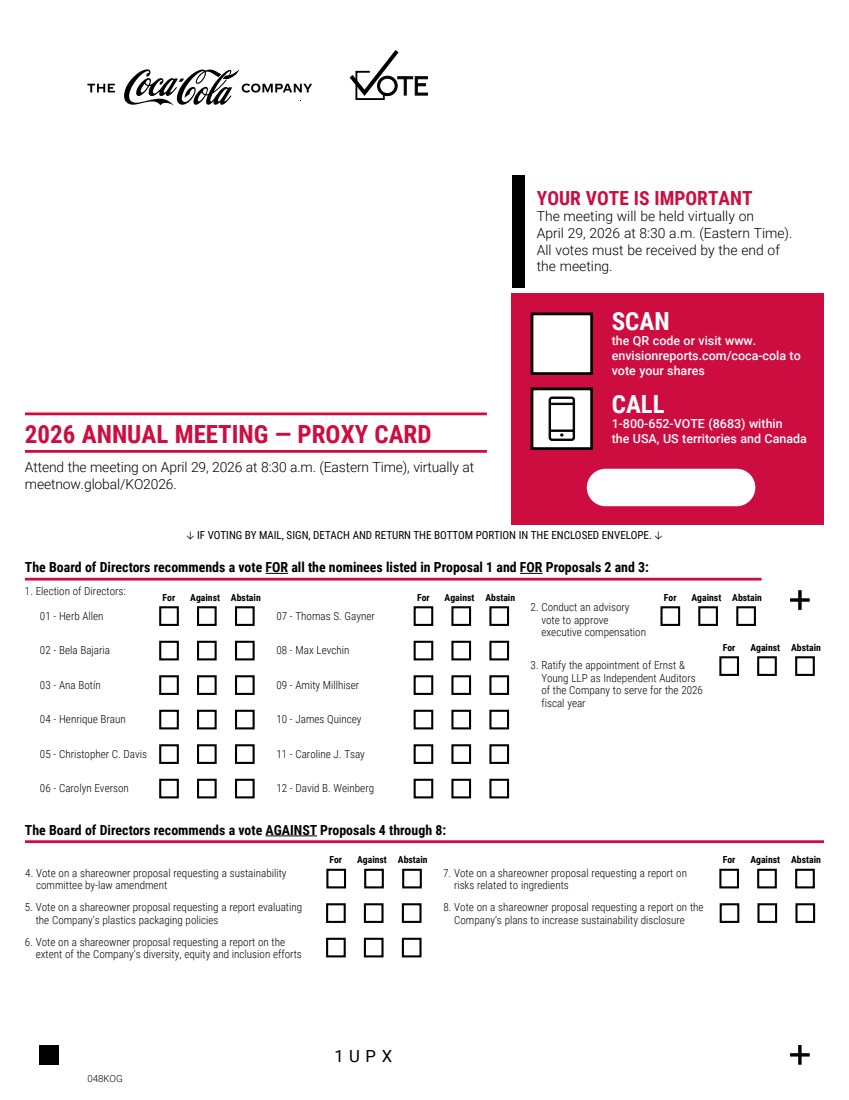
🡣 IF VOTING BY MAIL, SIGN, DETACH AND RETURN THE BOTTOM PORTION IN THE ENCLOSED ENVELOPE. 🡣 1UPX CALL 1-800-652-VOTE (8683) within the USA, US territories and Canada YOUR VOTE IS IMPORTANT The meeting will be held virtually on April 29, 2026 at 8:30 a.m. (Eastern Time). All votes must be received by the end of the meeting. SCAN the QR code or visit www. envisionreports.com/coca-cola to vote your shares 2026 ANNUAL MEETING — PROXY CARD Attend the meeting on April 29, 2026 at 8:30 a.m. (Eastern Time), virtually at meetnow.global/KO2026. 048KOG 2. Conduct an advisory vote to approve executive compensation For Against Abstain The Board of Directors recommends a vote FOR all the nominees listed in Proposal 1 and FOR Proposals 2 and 3: 3. Ratify the appointment of Ernst & Young LLP as Independent Auditors of the Company to serve for the 2026 fiscal year For Against Abstain 01 - Herb Allen 07 - Thomas S. Gayner 1. Election of Directors: For Against Abstain For Against Abstain 02 - Bela Bajaria 08 - Max Levchin 03 - Ana Botín 09 - Amity Millhiser 04 - Henrique Braun 10 - James Quincey 05 - Christopher C. Davis 11 - Caroline J. Tsay 7. Vote on a shareowner proposal requesting a report on risks related to ingredients 6. Vote on a shareowner proposal requesting a report on the extent of the Company’s diversity, equity and inclusion efforts 5. Vote on a shareowner proposal requesting a report evaluating the Company’s plastics packaging policies For Against Abstain For Against Abstain The Board of Directors recommends a vote AGAINST Proposals 4 through 8: 4. Vote on a shareowner proposal requesting a sustainability committee by-law amendment 8. Vote on a shareowner proposal requesting a report on the Company’s plans to increase sustainability disclosure 06 - Carolyn Everson 12 - David B. Weinberg
🡣 IF VOTING BY MAIL, SIGN, DETACH AND RETURN THE BOTTOM PORTION IN THE ENCLOSED ENVELOPE. 🡣 2026 ANNUAL MEETING — PROXY CARD This Proxy is solicited on behalf of the Board of Directors of The Coca-Cola Company The undersigned, having received the Notice of 2026 Annual Meeting of Shareowners and Proxy Statement, hereby (i) appoints Henrique Braun, John Murphy and Monica Howard Douglas, and each of them, proxies with full power of substitution, for and in the name of the undersigned, to vote all shares of Common Stock of The Coca-Cola Company owned of record by the undersigned, and (ii) directs the Northern Trust Company, Banco Popular de Puerto Rico and Coca-Cola Southwest Beverages LLC, the trustees (the “Trustees”) under The Coca-Cola Company and its subsidiaries’ 401(k) and savings plans (the “Plans”), to vote in person or by proxy all shares of Common Stock of The Coca-Cola Company allocated to any accounts of the undersigned under such Plans, and which the undersigned is entitled to vote, in each case, on all matters which may come before the 2026 Annual Meeting of Shareowners to be held on April 29, 2026, at 8:30 a.m. Eastern Time, and any adjournments or postponements thereof, unless otherwise specified herein or unless to do so would be inconsistent with the Trustees’ duties. The proxies, in their discretion, are further authorized to vote (x) for the election of a person to the Board of Directors if any nominee named herein becomes unable to serve or for good cause will not serve, (y) on any matter which the Board of Directors did not know would be presented at the 2026 Annual Meeting of Shareowners by a reasonable time before the proxy solicitation was made, and (z) on other matters which may properly come before the 2026 Annual Meeting of Shareowners and any adjournments or postponements thereof. You are encouraged to specify your choices by marking the appropriate boxes (SEE REVERSE SIDE), but you need not mark any boxes if you wish to vote in accordance with the Board of Directors’ recommendations. If no direction is given, your shares will be voted FOR all nominees listed in Proposal 1, FOR Proposals 2 and 3 and AGAINST Proposals 4 through 8. The proxies cannot vote your shares unless you sign and return this card. ATTEND The 2026 Annual Meeting of Shareowners of The Coca-Cola Company will be held on April 29, 2026 at 8:30 a.m. (Eastern Time) exclusively online at meetnow.global/KO2026. If you plan to attend the 2026 Annual Meeting of Shareowners see question 2 of the accompanying Proxy Statement for details. To access the virtual meeting, you must have the login details in the white circle located on the reverse side. YOUR VOTE MATTERS • Have a voice • Keep your account active • Stay informed SAVE PAPER, TIME AND MONEY! Sign up for electronic delivery at www.envisionreports.com/coca-cola. Holders of record of our Common Stock as of March 2, 2026 are entitled to notice of, and to vote at, the meeting. Important Notice Regarding the Internet Availability of Proxy Materials for the 2026 Annual Meeting of Shareowners The material is available at: www.envisionreports.com/coca-cola. Date (mm/dd/yyyy) — Please print date below. Signature 1 — Please keep signature within the box. Signature 2 — Please keep signature within the box. Please sign exactly as name(s) appears hereon. Joint owners should each sign. When signing as attorney, executor, administrator, corporate officer, trustee, guardian, or custodian, please give full title. AUTHORIZED SIGNATURES — THIS SECTION MUST BE COMPLETED FOR YOUR VOTE TO COUNT; PLEASE DATE AND SIGN BELOW.